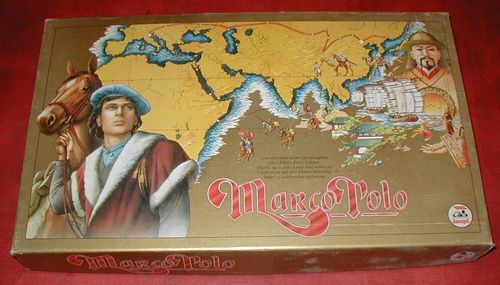
Marco Polo
Marco Polo Rulebook
Table of Contents
Table of Contents
Contains
- 1 game board
- 4 playing pieces
- 2 dice: 1 white, 1 black
- 56 ware cards in four different colors. In each color:
- 3 80 Gulden cards
- 4 50 Gulden cards
- 2 30 Gulden cards
- 5 Joker cards
- 4 "Geheimnisse des Orients" [Secrets of the Orient] cards, each worth 240 Gulden
- 4 "Goldene Tafel des Kubilai Khans" [Golden Plaque of Kubilai Khan] cards, each worth 240 Gulden
- 1980 Gulden, divided into cards of values of 10, 20, 30 and 50 Gulden
- 1 spinner
The Game
The merchants leave Venice for Khanbalik – capital of Kubilai Khan's empire – with a starting capital of 240 Gulden.
Upon arrival at Khanbalik the travelers present the Khan with expensive gifts: three ware cards each worth 80 Gulden. Kubilai Khan shows his thanks by extending to them his Golden Plaque of Kubilai Khan and entrusts them with their mission: they are to travel to a particular city in the empire.
If they succeed in this task, they acquire the Secrets of the Orient and can return to Venice.
During their journeys the merchants frequently encounter pirates and bandits. Along the way they try to enlarge their fortunes by trading with other merchants.
The winner is the first to return to Venice as a "made man", laden with wares, money, the Secrets of the Orient and the Golden Plaque of Kubilai Khan. The winner may call himself "Messer Millioni".
Game Preparation
The cards are sorted by color and laid out in stacks.
Each player receives a playing piece and places it on the Venice exit space. In addition he has 240 Gulden at his disposal.
One player is appointed the banker.
Play proceeds in clockwise order. The youngest player begins.
How to Play
The pieces must travel along the designated route. Stopping points are the large and small circles as well as the triangles.
- The large, colored circles represent trading cities.
- The triangles indicate ports.
- A trading city (large circle) is also a port.
On their trip players can use either the land route or the sea route. However, they must decide before the game begins which route they will use. Then the player spins the spinner. A player who chooses the sea route consults the outer, blue ring; for land routes, the red ring is used. A player can change his route type at any port and then continue his journey along the other type of route (land or sea).
The playing pieces move the number of spaces indicated by the spinner. Only in trading cities (large, colored circles) may more than one figure stop. Thus, a player who would arrive on an occupied space loses a turn instead.
Example
- The player would like to switch from the sea route to the land route. He must stop in the next port (even if he was entitled to move additional spaces). He may first move again on his next turn.
- If the player prefers to keep to his current route, he moves his piece according to the spinner. If he is unable to stop on a space since it is already occupied, he must sit out the turn.
Fighting Pirates and Bandits
If the spinner indicates "Piraten" [pirates] or "Banditen" [bandits], the player must fight. He rolls both dice. If the pips on the black die are higher, the pirates or bandits have won. The player must give up one of his ware cards, or, if he prefers, pay a bribe of 50 Gulden. The corresponding offering or the card is left in the pirates/bandits space.
If, however, the white die is same as or higher than the black die, the player has won. He may then take the bandits' booty. (If the space is empty, he receives nothing.)
How to Trade
Trading is only possible in a trading city.
a) Selling
One can only sell to the bank. If a player's piece has reached a trading city, he may sell one or more cards of the same color. He reveals the cards and receives the corresponding worth in Gulden. The cards are shuffled under the deck of the same color.
b) Buying
The player has two choices: either he buys cards from the bank or he trades with other merchants. He may not do both.
Trading with the Bank
The color of each trading city shows the color of the cards (wares) which he may buy there. He pays 20 Gulden to the bank and draws a card from the corresponding deck. In each trading city the player may purchase one, two or at most three ware cards, but is not required to buy any.
Joker Cards
If a player draws a joker card, he reveals it and does as instructed on the card.
Example: "You are under the protection of the prince and may draw two extra cards".
After this the joker card is immediately placed under the corresponding deck.
Trading with Another Player
When a player arrives in a trading city already containing the playing pieces of one or more other players, the newly-arrived player can trade with another player of his choice. He gives the player 30 Gulden and draws one of his cards. The cards are placed face down on the table. Only ware cards may be drawn. The Secrets of the Orient and the Golden Plaque of Kubilai Khan cards may not be traded.
A player may only trade with one other player and only purchase one card.
Arriving at Khanbalik
A player may only enter Khanbalik if he possesses at least three ware cards worth at least 80 Gulden each. These wares are gifts for the Khan. As soon as a player arrives in Khanbalik, he reveals these three cards and returns them to the corresponding decks. Kubilai Khan thanks him and in return presents him with a "Goldene Tafel des Kubilai Khans" [Golden Plaque of Kubilai Khan] card worth 240 Gulden. The Golden Plaque of Kubilai Khan card is an imperial credential that protects the player from pirates and bandits.
However, it is only effective as long as the player is on the way to the city whose name is given on the card. He is traveling on a secret mission and may only reveal the card to the other players when he arrives at his destination. When there, he receives a "Geheimnisse des Orients" [Secrets of the Orient] card worth 240 Gulden. He may also keep the Golden Plaque of Kubilai Khan card. It doesn't protect him anymore. His mission is over and he may return to Venice.
Return to Venice
The player can return to Venice when he has accumulated the following amount of capital:
- 2 player game: 1200 Gulden
- 3 player game: 1000 Gulden
- 4 player game: 800 Gulden
This capital is comprised of the value of cards as well as money. The player may have as many yellow jewels and valuable stone cards as desired. However, they must have at least one card of each color, i.e. green, red, blue and brown, but also not more than 2 cards of each color.
The first player having the correct amount (1200, 1000 or 800 Gulden) in the form of wares, money, the Secrets of the Orient card and the Golden Plaque of Kubilai Khan card to return to Venice wins.
Paying Debts
If in the course of the game the player cannot pay a required amount, he must sell one or more of his cards (wares, Secrets of the Orient card, Golden Plaque of Kubilai Khan) to the bank in order pay off his debt. If he has neither money nor cards to sell, he must return to Venice to get more money. He can start the game again with 240 Gulden there.
Tactics
Trade can occur throughout the game, even while performing the great Khan's mission. One should trade as often as possible to become rich quickly. However, it's advisable to hold on to low worth cards (30 Gulden) for use as bribes for pirates and bandits as well as for trade with other players.
Joker Card Translations
The source lists the joker cards as German (in alphabetical order) paired with their English translation.
| German | English |
|---|---|
| Befragen Sie einen Astrologen bevor Sie Ihre Reise fortsetzen: Sie müssen 20 Gulden bezahlen. | Consult an astrologer before you set out on your journey: you must pay 20 Gulden. |
| Chinesisches Neujahr: alle Kaufleute schenken Ihnen 30 Gulden. | Chinese New Year: all merchants gift you with 30 Gulden. |
| Der Papst langweilt sich: shicken Sie einen Kaufmann Ihrer Wahl nach St. Jean d'Arce, wenn Sie möchten. | The Pope is bored. Send the merchant of your choice to St. Jean d'Arce if you like. |
| Ein starker Wind treibt Sie voran: Sie dürfen noch zwei zusätzliche Runden weiterspielen. | A strong wind drives you on: you may take two extra turns. |
| Koubilai Khan beschützt Sie: nehmen Sie eine weitere Karte vom gleichen Stapel. | Koubilai Khan protects you: take an extra card from the same deck. |
| Koubilai Khan bittet Sie, einen Kaufmann nach Karakorum zu schicken (Sie selbst dürfen jedoch nicht reisen). | Koubilai Khan asks you to send a merchant to Karakorum. (You yourself don't have to go there.) |
| Koubilai Khan shickt Sie direkt nach Sansibar. | Kubilai Khan sends you direction to Sansibar. |
| Sie bauen Kriegsmaschinen und Koubilai Khan belohnt Sie dafür: nehmen Sie eine neue Karte vom gleichen Stapel. |