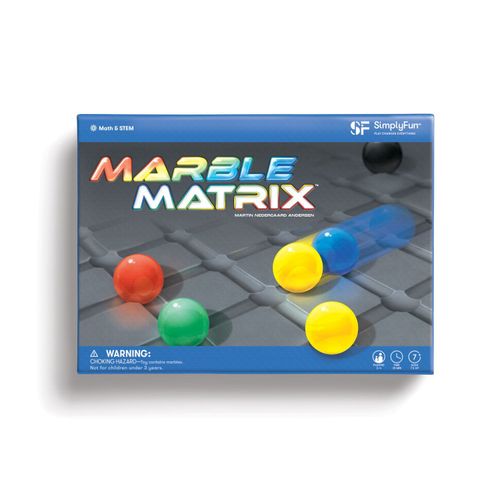
Marble Matrix
Marble Matrix Rulebook
Table of Contents
Table of Contents
Object of the Game
Study the matrix grid, and then make your move. Slide a group of marbles across the grid so that two or more matching marbles line up, and then collect the matching set(s). At the end of the game, players score one point for each set of three matching marbles in their storage tray. The player with the most points wins!
What's in the Box
- 48 Marbles (8 of each color)
- 1 Marble Matrix Gameboard
- 4 Marble Storage Trays
- 1 Storage Bag
For a video tutorial on how to play, visit www.simplyfun.com/howtoplay. For additional game play questions, contact [email protected].
Setup
- Place the Marble Matrix Gameboard in the center of the play area.
- Randomly place all the marbles on the gameboard so that no two marbles of the same color are next to one another, either horizontally or vertically. Leave the center space empty.
- Each player receives a Marble Storage Tray. This is where players store the marbles they collect.
- The player who is reading the rules goes first.
The rulebook's four-player setup diagram shows one example of a correct arrangement.
NOTE: The image shown is just one example of a correct marble setup. There are many ways to arrange the marbles around the center space so that it's different each time you play.
How to Play
On your turn, take up to two slides, collecting any sets of matching marbles they create.
1. First Slide
On your turn slide one row of marbles, either vertically or horizontally, across the matrix grid to create one or more sets of matching marbles. To slide a row, move the rear marble so that it pushes the marbles in front of it as far as they can go on that line of the grid. Your slide stops when the row reaches the next marble after an open space or the edge of the grid, whichever happens first.
- A "row" is defined as a group of consecutive marbles on the same line of the matrix without any gaps between them. It is possible to have a "row" that contains only one marble, if that marble has an open space on either side of it, but that usually occurs later in the game.
- A "set" is defined as two or more marbles on the gameboard that are the same color and are next to one another either vertically and/or horizontally, not diagonally. It is possible to create a set of three marbles, or even multiple sets of marbles during one turn.
Example of slides that would create a set of matching marbles: sliding the row with the red marble to the edge of the grid creates a set of yellow marbles; sliding the blue marble to fill in the empty space creates a set of three blue marbles.
2. Second Slide
If you cannot create a set of matching marbles on your first slide, you are allowed a second slide during your turn to help make a match.
- You must make a set in one slide when possible. You cannot avoid a valid set on your first attempt just to get a second slide in one turn.
- Before going forward with a turn that requires two slides, check with the other players. If they see a set that can be created in one slide, then you must take their suggestion.
- Both your first and second slides must follow the guidelines listed in step 1 for sliding a row.
First Slide: If you cannot create a matching set in one slide, then you may use your first slide to set up a second slide.
Second Slide: On your second slide you can either slide the same row again or choose a different row to complete the match.
Match: sliding the row with the red and green marbles to the right creates a matching set of green marbles.
3. Slides That Are Not Allowed
There are several slides that are not allowed during your turn, as detailed in the examples below.
- The highlighted row can be slid until the blue marbles are next to each other, but no further. Once a space between two marbles is filled, the slide is over.
- You may not stop your slide if there are still empty spaces, even if doing so would create a match. In this example, the rows need to slide until they reach the blue marble in that line of the grid.
4. Collecting Sets
Collect all sets of matching marbles created by your slide that are next to one another on the grid. Place the set(s) in your storage tray. Now it is the next player's turn.
End of the Game
The game continues until a player is unable to collect any marbles after two slides on their turn. Players count their marbles and score one point for each set of three matching-color marbles they've collected.
Players do not earn points for leftover pairs or single marbles.
The player with the most points wins! If there's a tie, the player with the most leftover matching pairs wins.
Example of a player's collected marble sets and final score: 1 point, 2 points, 0 points, 0 points.
Try This!
Players can receive two additional points for collecting ALL the marbles of one color. If a player ends up with all eight marbles of one color, they receive four points (one for the first three, one for the second three, and two more points for getting the last two remaining marbles).
Example of a final score after collecting ALL the marbles of one color: 4 points, 0 points, 0 points, 0 points.