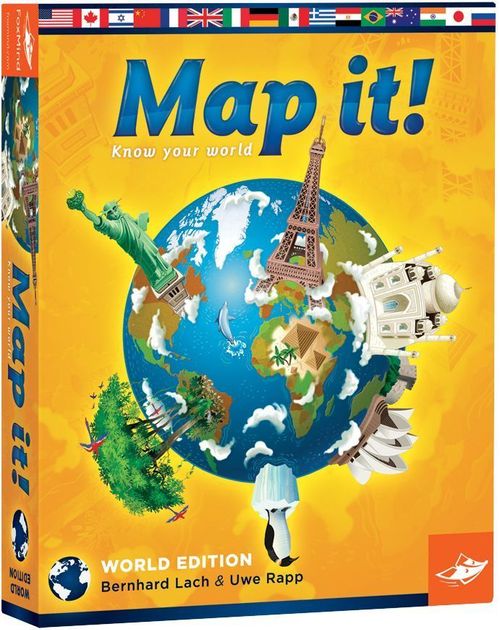
Map It! World Edition
Map It! World Edition Rulebook
Table of Contents
Table of Contents
Contents
- 208 Place cards (183 places and 25 sights)
- 2 Intermezzo cards
- 1 Direction card
- 35 wooden chips
Paper and pencil are also needed.
Object of the Game
The places must be arranged on the table according to their geographical location in north-south or west-east direction. Whoever makes as few mistakes as possible and catches as many fellow players as possible making mistakes is rewarded with chips and wins.
Setup
The Place cards are shuffled well and sorted so that the place names are on top, and the coordinates and other information are hidden on the back of the card. Then three stacks of 15 cards each are formed. The remaining cards are first set aside. An Intermezzo card is placed on the first stack; on top of it go the second stack, the second Intermezzo card and finally the third stack of Place cards. The stack formed in this way lies on the table within easy reach of everyone.
The Direction card is placed in the middle of the table. Of the Place cards set aside, the top card is placed on the Direction card. It is the start card. Each player receives 4 chips. The remaining chips are needed later.
The Game
The youngest player begins. Play proceeds clockwise. The player whose turn it is takes the top card from the stack and reads out the place name. Attention: no player may see the coordinates on the back of the card! Then he decides whether he wants to place this card in west-east or north-south direction. Since at the start of the game only the start card is out, the starting player has four possibilities for placing his card: above the start card (north), below the start card (south), to the left of the start card (west) or to the right of the start card (east).
The next player takes the top card of the stack and decides whether to place his card above, below, left or right, or whether to place it between two cards that are already out, and so on.
Attention: a Place card may only ever be placed in west-east or north-south direction relative to the start card. In the course of the game the cards thus form a cross. Other placement options are not allowed.
Whoever has decided on a place puts his card there. It now lies either in west-east or north-south direction relative to the start card. Only in this one direction does the card have to be placed correctly.
(Example: Vancouver is to be placed; five of the ten placement possibilities are marked with check marks on a cross with the cards Brussels, Novosibirsk, Casa Milà, Archive, Panama, Calcutta, Nuuk and Nairobi.)
Now All the Other Players Are Asked
The player to the left of the one who placed the card is asked first whether he doubts the card just placed. If he does not doubt the card, the question is passed on to the next player in the direction of play, and so on. If everyone is of the opinion that the card just placed lies correctly, the next player is to place a card. But if a player believes the card lies wrongly (too far west or too far east if it lies in the west-east direction, or too far north or too far south if it lies in the north-south direction), he now turns over the card just placed as well as one neighbouring card.
Right or Wrong?
The card just placed is checked only with regard to the turned-over neighbouring card. All other cards are irrelevant. On the back of the cards the coordinates (geographic longitude and latitude) of the respective places can be seen. If a card in the west-east direction was doubted, only the two coordinates to the east or to the west are decisive. If a card in the north-south direction was doubted, only the two coordinates to the north or to the south are decisive. The card just played lies correctly if the numbers become larger in the direction of the arrow.
Attention: at the equator, which runs through parts of South America, Africa and Asia, the direction of the arrow reverses. From here the numbers become larger both to the north and to the south. A place with a north coordinate always lies further north than a place with a south coordinate, and vice versa. At the prime meridian, which runs through parts of Europe and Africa, the direction of the arrow also reverses. From the prime meridian the numbers become larger both to the east and to the west. A place with a west coordinate therefore always lies further west than a place with an east coordinate, and vice versa.
Occasionally two cards with exactly the same longitude or latitude may be turned over. In that case both cards are correct.
(Illustrated example: Libreville, Gabon, 0° 23' North, 9° 27' East, and Quito, Ecuador, 0° 13' South, 78° 31' West – shown as pairs of cards that are placed correctly and incorrectly.)
If a card was doubted rightly, i.e. the card lies wrongly, the challenger receives a chip from the player who placed this card. The card is removed from the game.
If a card was doubted wrongly, i.e. the card lies correctly, the player who placed this card receives a chip from the challenger. Both cards remain and are turned back over so that again only the place names can be seen.
Whoever has no chip left does not have to hand one over. In that case the winner of the duel may take a chip from the supply. If there are not enough chips left, 5 chips are exchanged for a Place card that has already been removed from the game. This Place card is thus worth 5 chips in the final scoring.
Interim Scoring
Play continues around the table until the first Intermezzo card appears. Now an interim scoring takes place, in which all players estimate how many cards in the currently displayed card cross are wrongly placed. Each player secretly notes down his number. All cards on display are turned over and checked.
Important: the check always starts from the start card and refers only to the immediately neighbouring card. In all four compass directions it is thus checked card by card whether it lies geographically at the correct place (see above). If a card lies wrongly, it is immediately set aside. At the end the cards set aside are counted. Each player who estimated correctly receives two chips from the supply. If no player estimated the correct number, all players who come closest to the correct result receive one chip.
And On It Goes
All Place cards on display, including the start card, are removed from the game. From the cards set aside at the start of the game a new start card is drawn and the game is continued around the table as described above.
End of the Game
When all (3 x 15) cards of the stack are used up, one last interim scoring is carried out. After that the game is over. The player with the most chips is the winner.
Tip: whoever wants to get to know the game first, or whoever plays with children who do not yet know their way around the world well, can sort out some of the "difficult" Place cards before the game.
Variant: Population
The cards also contain information on the populations of the places. These details can be played with as well! You can arrange the places not by their geographical location in north-south or west-east direction but by their population. For this, do not lay out a cross but a straight line, on which you place the places from bottom to top so that the smaller places are at the bottom and the larger at the top. The Direction card is not needed for this variant. The possibility of doubting and the awarding of points correspond to the rules of Ausgerechnet Honolulu.
Note: current population figures were used for the game. Since these numbers change continually, slight deviations may occur compared with individual sources.