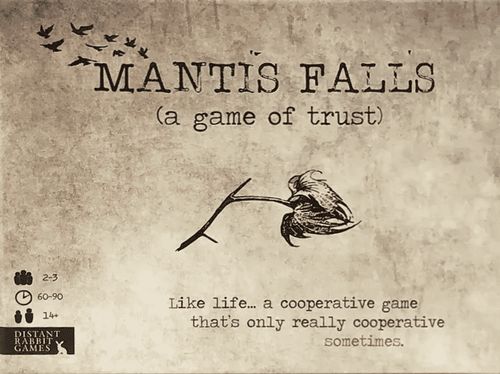
Mantis Falls
Mantis Falls Rulebook
Table of Contents
Table of Contents
- 1. Components
- 2. Objectives
- 3. Learning Curve
- 4. Modules
- 5. Setup
- 6. Getting Started
- 7. Active Players & Bystander (3P Only)
- 8. Turn Sequence
- 9. Bystander Capabilities (3P Only)
- 10. Roads
- 11. Events
- 12. Actions
- 13. Conditions and Afflictions
- 14. Allies
- 15. Conserved Energy
- 16. Wounds & Life Tracker
- 17. Last Gasps
- 18. Death
- 19. Other Rules & Notes
- 20. Game End & Victory
- 21. Full Circle Module (2P or 3P Games)
- 22. Triad Module (3P Games Only)
- 23. Under the Rose Module (2P or 3P Games)
- 24. Strategy Tips for New Players
- Quick Reference
1. Components
Base Game
- 60 Action cards
- 50 Event cards
- 12 Ally cards
- 1 Playmat
- Blank cards provided for replacements and creativity.
- 3 Characters
- 3 Roles
- 6 References
- 3 Life Trackers
- 3 Playing Pieces
- 6 Buttons
Included Add-On Modules
- 5 "Sunset" Roads, 5 "Night" Roads, 5 "Dark" Roads
- Full Circle (30 cards) — For more in-depth gameplay (2P or 3P)
- Triad (12 cards) — REQUIRED for 3 player games
- Under the Rose (7 cards & 3 wooden roses) — Variant for advanced players (2P or 3P)
Recommended Albums for Theme Music
- "Mantis Falls Original Soundtrack" by Distant Rabbit (free at www.MantisFalls.com/soundtrack)
- "Dolores" & "Piano Nights" by Bohren & Der Club Of Gore
- "Soundtrack from Twin Peaks" by Angelo Badalamenti
- "Turning Point" by Benny Golson
More music suggestions at www.MantisFalls.com/music
2. Objectives
Objectives depend on the assignment of roles at the start of the game (witness or assassin). Each player receives one role card at game setup but does not show it to others until the game is over. Games may consist of only witnesses, or there could be one assassin:
-
If there are only witnesses, then this is a cooperative game that the players win or lose together.
-
If there is an assassin, then this is a competitive game.
-
If you are a witness, your goal is for all witnesses (including you) to survive. Your game can end successfully if all players make it to the end alive OR with the death of an assassin.
-
If you are an assassin, your goal is for a witness to die and for you to stay alive. Your game can end successfully only with the death of a witness.
Games in which an assassin and a witness both die are tie games for all players.
Note: 3 player games shuffle in a third witness card; there is always a chance for a game with only witnesses.
3. Learning Curve
Mantis Falls is a game of countermeasures and anticipatory tactics that becomes increasingly rewarding with experience and skill. It usually takes multiple plays to start understanding the strategic possibilities. We suggest reading the strategy guide at the end of this manual (Topic 24) and thinking of the first few games as "practice" as you get the hang of it. Once you get the basics, quickly consider including the "Full Circle" module, as this adds considerable depth to the game!
4. Modules
Your box includes the base game of Mantis Falls and three add-on modules. Include combinations to customize your game. Instructions for how to integrate these are in sections 21-23 in the manual.
Note: All of the included modules are compatible with one another and may be used in any combination.
For 2 or 3 Player Games
- Full Circle: Adds complexity for a more involved game experience. Include this as soon as you feel you've gotten the hang of the base game (perhaps after a play or two).
- Under the Rose: A variant for advanced players; adds resource management and deck manipulation.
For 3 Player Games Only
- Triad: Required for 3 player games. Use it in all 3 player games and exclude it from all 2 player games.
Don't wait long before adding Full Circle – it adds a lot to the game!
5. Setup
Playmat: Place the playmat at the center of the playing area; many of the cards and decks will be placed on top of this.
Roads: On the playmat, the road cards make a 3x4 grid that the players will travel in a serpentine pattern. Place as follows:
- Place the "start" and "end" of the road cards at the start and the end as shown.
- Shuffle the remaining road cards, and remove one road card of each type (sunset, night and dark) from the game (don't look).
- Place the rest of the roads face down as shown (sunset in the bottom row, night in the middle row and dark in the top row).
Actions: Separate the "Midnight" action cards (seven in the base game; visually distinct and marked with the module identifier). Distribute as follows:
- 2P games: Give each player one of the two "Call in a Hit" cards to include face down in their hand of action cards. (There are two Midnight cards called "Actions by the Dark" set aside for later.)
- 3P games: The Triad Module includes an additional Midnight card ("The Pact"). Shuffle this with the two "Call in a Hit" cards, and then deal one of these cards face down to each of the three players. (There are three Midnight cards called "Actions by the Night" set aside for later.)
- Shuffle the remaining five Midnight cards, place three face down by the middle of the road ("Actions by the Night") and place the final two face down by the "End" road card ("Actions by the Dark").
After distributing the Midnight cards, shuffle the remaining action cards, and deal six face down to each player (including their Midnight card, each player should begin with seven action cards). Place the rest of the deck face down near the playing area as indicated on the playmat.
Allies & Events: Shuffle each of these decks and place them face down where indicated on the playmat.
Roles: Shuffle the role cards (two witnesses/one assassin for 2P games; three witnesses/one assassin for 3P games). Deal one face down to each player and remove one from the game (don't look!).
Characters: Give an "Urbanite" face up to each player.
Playing Pieces: Place each player's chosen piece on the "start".
Life Trackers: Each player gets a life tracker (face up) matching their chosen playing piece. A red button is placed on "0" wounds and a black button on "0" Last Gasps.
6. Getting Started
- Players look at their role cards and keep them face down.
- Flip face up the first sunset road ahead of the players' pieces.
- Randomly determine the first player.
- The player to go last draws one random ally card from the deck.
7. Active Players & Bystander (3P Only)
In 3P games, turns rotate clockwise. Players play as rotating pairs ("active players"), making one player each turn a "bystander":
Active Players: On your turn, you and the player to your right are the two "active players". The active players face the turn together, with all references in the game to "the other player" (or "both players", "either player", "the players", etc.) referring ONLY to active players (NEVER the bystander).
Bystander: The player not among the two "active players" is, for that turn, the "bystander". The bystander has specific capabilities (Topic 9) and may still talk with the other players, but they can do nothing else. This means they cannot interact with the event, play cards, be the target of an attack, use/receive/lose conditions or allies, receive wounds, etc.
8. Turn Sequence
Players alternate turns. Your turns have the following sequence:
I. Initial Movement: You may move your piece one road forward or stay in the same place. Flip a road card face up to maintain visibility if necessary (always one road ahead of the furthest player; Topic 10). You can also expend Conserved Energy during this phase (Topic 15).
II. Event Draw: You draw an event card and look at it. The event can be "seen" or "unseen", which can dictate if you show this card to other players (Topic 11).
III. Main Play: Both you and the other player make a play with your action cards, each choosing one of four options (you make this play prior to the other player):
- Create an Action Play: Place face down (in front of oneself) any number of action cards of the same suit (Amber, Granite, Hunter, Lilac, Royal or Midnight) in a selected order (these cards make up a player's "action play" sequence).
- Conserve Energy: Place one of your action cards face up in Conserved Energy (Topic 15).
- Discard: Discard (face down) up to two action cards.
- Do Nothing
IV. Action Reveal/Processing: "Reveal" means to flip face up the cards of action plays, and "processing" means doing what the cards say. Actions in action plays are revealed and processed in alternating order (Topic 12), then discarded face down.
V. Event Processing: The event is processed by you (Topic 11).
VI. Draw: Both players (you first) restore hands to seven action cards, drawing from the draw pile, Conserved Energy or both.
Note: Actions and Events are put in discard piles face down.
9. Bystander Capabilities (3P Only)
- Discard/Conserve Energy: After the two active players have made their main plays, the bystander may either discard up to two cards or place one card face up in Conserved Energy.
- Draw: After the two active players have had their draw from the draw phase, the bystander also draws their hand to full.
- Bystander Abilities: Cards in the Triad Module may refer to the bystander by name. These cards are NOT played by the bystander directly, but when an active player processes such a card, it gives the bystander specific abilities or choices.
10. Roads
Overview: Each road card represents "one road": the smallest unit of movement in the game (it doesn't matter where your piece is on a road). The different regions (sunset, night, dark) are referenced by other cards and have different location details (number of ambushes, etc.) but do not otherwise impart specific rules.
Movement & Visibility: Movement through the road follows a serpentine pattern (see diagram in Topic 5). Road cards are flipped face up when they are directly in front of any player's piece (players can always see at least one road ahead of the furthest player). Once flipped face up, road cards do not ever turn back to face down.
Stoplight Numbers: All roads have three "stoplight numbers" (green, yellow and red) in the upper left. These numbers are commonly referenced on event cards; in such a case, it is always referring to the stoplight numbers of the player processing the event (i.e. the player whose turn it is).
Phones & Bus Stops: Some of the road cards contain phone or bus stop symbols in the lower right. Cards may reference these locations, but there are otherwise no special rules associated with these locations.
Ambushes (circled numbers): If you land on a road with a circled number in the lower right, you must randomly discard that number of action cards AND receive that number of wounds (in that order). As always with actions, the cards are discarded face down. Passing through an ambush (not stopping on it) incurs no penalty.
The "Broken Road": One of the night roads is a "Broken Road". You cannot stop on this road. If your movement lands you here, you move to the road before it. You can, however, pass through this road as normal if you have enough movement to do so (e.g. from an action card providing movement).
Any time a player advances across the Broken Road, they look at the "Actions by the Night" and add one of their choice to their hand and return the rest face down. (Some games will have no Broken Road because its card was removed randomly at setup. In this case, no players gain access to the "Actions by the Night".)
Start and End of the Road: The first road is the "Start of the Road" and the final road is the "End of the Road". The game does not end when a player reaches the end of the road (Topic 20). Any time a player lands here, they take one card of their choice from the "Actions by the Dark" and return the rest face down. A player at the end of the road then continues to take their turns as normal, just without moving forward.
Reminder: When a player makes it to the end of the road, that does not end the game!
Impeded Moving: Some effects let players choose between moving and other options. If your movement is impeded (by the end of the road, a card preventing movement, etc.), you may still choose movement but can move only as far as allowed.
11. Events
Events are processed by the player whose turn it is and only AFTER all action processing (NEVER immediately upon drawing it). Process according to the variables at that time (e.g. if a stoplight number changes due to movement during action processing, that can change the event). Events may be "incidents" or "oppositions", and also either "seen" or "unseen". These terms are explained here.
Incidents & Oppositions
Incidents:
- An "incident" event is a harmful occurrence (e.g. an earthquake or stepping on broken glass).
- Incidents may be "prevented" by certain cards, but cards that deal wounds to event oppositions are of no use against an incident.
- If an incident is not prevented, then both the "effect" and the "bonus" happen during event processing. (If the event effects are prevented, then neither happen.)
Reminder: Even though incidents cannot be defeated, they can still be prevented.
Oppositions:
- An "opposition" event is a foe you are facing.
- Like incidents, the effects of oppositions can be entirely prevented by cards that prevent events.
- Oppositions are "defeated" if the actions processed that turn by the players collectively dealt wounds to the opposition at least equal to the opposition's "health" value.
- Depending on whether or not the opposition was defeated, process the appropriate outcome during event processing.
Reminder: No matter what type of event was drawn, the event is always processed only after all action processing.
Seen & Unseen
Seen:
- A "seen" event is visible to all. When drawn, they are turned face up for all to see.
- At event processing on your turn, you process the effects of the event and then put it face down in the discard pile.
Unseen:
- An "unseen" event is visible only to the player that drew it (the player whose turn it is).
- When you draw an unseen event, you cannot show it to anyone, even if you want to. But you can choose to describe the card in any way you want (say nothing, be truthful, bluff its contents, etc.).
- At event processing on your turn, you process the effects of the event and then put it face down in the discard pile. Although nobody else will see this card, you MUST process this card accurately (to do otherwise is simply cheating).
New players can skip the "unseen" rules! Unseen events add to the game but can also add some confusion for new players. When learning Mantis Falls, it's fine to treat all events as seen!
Unseen Events: What You Can and Cannot Bluff
Although you may bluff about unseen events before the event is processed, you cannot alter the actual effects of the event when processing it (that would just be cheating). You can, however, not be fully honest about the way the effects come to be. Here are two examples:
- An event may state to receive wounds "divided among the players as you choose". In this case, you could choose for the other player to receive all of the wounds and not reveal there had been any choice.
- If an event's effects were prevented that turn, it is not necessary to explain at event processing any details about what the event would have done if not prevented.
12. Actions
Suits: Action cards have six "suits" (amber, granite, hunter, lilac, royal and midnight) signified by text and a symbol in the upper left corner; see image. Action plays may include any number of action cards of the same suit.
Each action card is laid out with a suit symbol and module identifier in the upper corner, the card name, a first effect summary heading with effect details below it, and (where applicable) a second effect summary heading with its own effect details below it. (Because a "sometimes" effect is a "sometimes" effect, the effect occurs only if the criteria are met.)
Effects: Effects are always processed by the player that played the card. The bold text is a (usually inexact) summary heading of an effect; when necessary, text below the heading describes the effect in proper detail. When an action card has more than one effect listed (e.g. "1", "2", and "sometimes"), then all effects are processed (no picking and choosing!) in the order listed.
"Sometimes" Effects: Cards with "sometimes" effects (see image) can be played any time an action card is played, but "sometimes" effects only happen if the criteria are met.
Note: You can play an action even if some/all of its effects will do nothing.
Order of Reveal/Processing
- Play Order: Players creating action plays should place the cards face down in front of themselves (from left to right) in the order in which they want them revealed and processed.
- Reveal/Processing Order: When only one player creates an action play, that player reveals and processes the cards in the order in which they were placed. When two players create action plays on the same turn, the actions are revealed and processed in alternating order, beginning with the player whose turn it is.
Example of Action Reveal/Processing Order:
In this scenario, it is Jack's turn. For his main play, Jack created an action play of two cards, and he has placed them face down in front of himself from left to right. Jill then created an action play of three cards, which she placed face down in front of herself from left to right.
For action reveal/processing, Jack would reveal (flip face up) his first card ("1st" in diagram), and process it in its entirety. Jill would then reveal her first card ("2nd" in diagram) and process it in its entirety. Jack would then reveal and process his second card ("3rd"), and then Jill would reveal and process her second card ("4th"). Since Jack has no more cards to process, Jill would proceed to reveal and process her third card ("5th"). After the final card is processed, the five action cards are placed face down in the discard pile and play proceeds to event processing.
Summary of Actions:
- Action plays may be any number of cards of a single suit.
- Action plays are always created face down and are not revealed until after all players have completed their main play.
- Action plays are revealed and processed one card at a time and in alternating order.
13. Conditions and Afflictions
Conditions: Some action cards have effects stating to keep the card as a "condition". When such an effect is processed, the card is placed face up in front of the player (under their "control"), and the condition effect remains active until something (e.g. an action or event card) removes the card. (When condition effects refer to "you", that refers to the player controlling the condition.)
Afflictions: Afflictions (found in modules but not the base set) play exactly like conditions except nothing can remove them.
Reminder: Unlike conditions, NOTHING removes afflictions. So be very careful about playing these!
"Any Time" Effects: Some conditions and allies have effects players can use "any time" (see Gun above). The only moments you cannot enact such an effect are:
- When another card is currently being processed or has just been revealed in an action play (see "Timing" in Topic 19).
- When you are the bystander (3P games only; see Topic 7).
14. Allies
Allies are helpful cards attained from some actions and events.
Getting Them: When a player is told to "take" an ally card, they look through the ally deck face up and take any card they like.
Reminder: Unless stated otherwise, taking ally cards means looking through the ally deck and taking ally cards of your choice.
"Incomplete" Allies: Ally cards state a completion requirement in the upper left. If a player has fewer than this number of that specific ally, then the cards are kept face down with the player. The ally is "incomplete" and provides no effect.
"Complete" Allies: If a player has as many matching ally cards as is required by the ally (noted in the upper left), the ally becomes "complete". This means it is turned face up in front of the player and its effect is active.
For example: If you had two Ms. Cardello cards, she would be "incomplete"; the cards would remain face down and she would provide no effect. If you then got a third Ms. Cardello card, she would become "complete"; the cards would be turned face up and she would provide her written effect continuously.
Discarding Allies: Discarded allies are always returned to the ally deck (there is no ally discard pile). If an effect requires returning an ally to the deck, this refers to the entire complete ally (not just one card).
Summary of Allies:
- Until their completion requirement is met, ally cards stay face down with you and are considered "incomplete allies".
- Once their completion requirement is met, they turn to face up in front of you and have a lasting effect.
15. Conserved Energy
"Conserving Energy": As a main play, players may "Conserve Energy" by placing one of their action cards face up in one of the four spaces in the Conserved Energy area (at the top of the playmat). Cards placed in Conserved Energy do not impart any effects that turn, but may provide value to the players at a future time (described below).
Using Conserved Energy:
- Drawing: Whenever a player draws an action card, they may choose to draw from Conserved Energy instead of the draw pile.
- Expending: At the start of initial movement phase on your turns, if Conserved Energy is full, you may "expend" Conserved Energy by moving all four conserved cards to the action discard pile. Doing so provides you your choice of these two benefits:
-
Increase initial movement one road (move two roads instead of one)
OR
-
Heal one of your wounds
-
Other Notes:
- Expending Conserved Energy to increase initial movement results in moving two roads at once (not moving forward one road and then choosing to move again). This movement can be used to pass over the Broken Road and ambushes.
- If it's "full" (already has four cards in it), discard cards that would otherwise go to Conserved Energy.
Conserved Energy is summarized on the quick reference cards!
16. Wounds & Life Tracker
Wound Accumulation: Players receive wounds cumulatively from a variety of sources. Start at zero and keep track with a red button ("wound marker") on your Life Tracker.
Maximum Wounds: Each player will have a character card stating their maximum number of wounds (the base set includes only the "Urbanite" character with a maximum wound value of eight, but the Full Circle module adds characters with maximum wounds of seven and nine). No player can ever have wounds greater than their maximum. (For example, if you are one wound short of your maximum and receive three wounds, you receive just one wound to put you at your maximum and ignore the other two wounds.) If a player reaches their maximum wounds, they do not die (yet)! They instead make a "Last Gasp" play (Topic 17).
Gasp Tracker: The Life Tracker also has a space to keep track of how many Last Gasps a player has taken (Topic 17). The black button ("gasp marker") begins at zero and moves one to the right at the conclusion of a player's Last Gasp play.
Important Reminders:
- Your wounds can never go above your maximum.
- Reaching maximum wounds does not mean you are dead! You first make a Last Gasp play (Topic 17).
17. Last Gasps
If you reach your maximum wounds, you are not dead! First, you make a "Last Gasp" play. If something causes you to reach maximum wounds, this is what you do:
-
Finish Processing Current Card: If there is still more to process on the card that caused you to reach your maximum wounds, finish processing it in its entirety.
Note: If the card triggering your Last Gasp was part of another player's Last Gasp, then they finish their entire Last Gasp before you proceed with yours.
-
Make a Last Gasp Play: Suspend everything and create an action play (i.e. put face down in front of you any number of action cards of a single suit) as a sidebar to all else. Then reveal and process all of these cards in sequence. After the cards of your Last Gasp have been processed, slide your gasp marker one space right.
Note: If you have action cards that are face down in a suspended action play, you can return your choice of these to your hand for use in your Last Gasp.
-
Evaluate Survival/Death:
- Survival: If your wounds are below your maximum (e.g. because you played a card that healed you) AND your gasp marker is below "3", then you survived the Last Gasp. In this case, the game continues; resume play right from where it had been suspended.
- Death: If, alternatively, your wounds are at your maximum OR your gasp marker is at "3", then you are dead (Topic 18) and the game will soon be over. If the other player is not at their own maximum wounds, then the game ends right then (Topic 20). However, if the other player is at maximum wounds, then they make a Last Gasp play of their own (which they may fail to survive as well). Following their Last Gasp, the game is over.
Last Gasp Flowchart: Some may find it useful at times to refer to the following logic when resolving Last Gasps:
- Something other than a Last Gasp play has put at least one player at their max. wounds → Finish processing the current card and then suspend action → How many players are at their maximum wounds?
- One: That player makes a Last Gasp. Is that player either still at maximum wounds OR is their gasp marker at "3"?
- Yes: Is the other player at maximum wounds?
- No: Play continues from where it was suspended.
- Yes: That player makes a Last Gasp. Is the other player at maximum wounds?
- No: Play continues from where it was suspended.
- Yes: All players that concluded a Last Gasp at max. wounds OR with their gasp marker at "3" are dead (and the game is over).
- No: Play continues from where it was suspended.
- Yes: Is the other player at maximum wounds?
- Two: Turn player chooses one of the two players to resolve first, then the same evaluation applies to each in turn.
- One: That player makes a Last Gasp. Is that player either still at maximum wounds OR is their gasp marker at "3"?
Last Gasps are important even when you can't heal! Having ways to heal during a Last Gasp can be key to victory, but even if you don't heal during a Last Gasp (and will therefore die), you can still use the Last Gasp to wound the other player and possibly salvage a tie.
18. Death
A player is dead if either:
-
They are at maximum wounds after completing a Last Gasp
OR
-
Their gasp marker reaches 3
The death of a player ends the game (although another player may first need to resolve a Last Gasp if at their maximum wounds; Topic 17). A dead player cannot win, but can possibly tie (Topic 20).
19. Other Rules & Notes
Timing (cards always process completely): When actions are revealed in action plays, except for specific choices/effects triggered by the reveal (e.g. Foresight), the action begins to be processed immediately. For all card types in the game, once a card begins to be processed, NOTHING else can happen until after the entire card has been processed.
No Discard Phase: If you end a turn with more than seven cards, there is no need to discard.
Turn Player Decides Order: If players need to do something simultaneously (e.g. both incur Last Gasps from the same event), the turn player chooses who proceeds first.
Draw Piles and Discard Piles: The action and event discard piles are face down and hidden. If any draw pile is depleted, shuffle its discard pile to create a new draw pile.
Witness Only Effects: Some card effects (a notable example being on "Call in a Hit") are usable "ONLY IF YOU ARE TRULY A WITNESS". The thematic explanation is that witnesses have powerful friends that can help in certain cases. One's role cannot be bluffed in order to use these effects.
Don't Show (or "Prove") Face Down Cards: You can tell other players (either truthfully or not) what cards you have, but face down cards cannot be revealed prematurely. Nor can you try to "prove" you have a card by reading its text aloud verbatim, describing visual details, etc.
Talk About Almost Anything: Other than as described directly above, there are no restrictions on what you can talk about.
In 3P games, players are allowed to communicate privately with one another (by whispering, passing notes, etc.).
Important reminder: YOU CAN TALK FREELY! Other than trying to "prove" cards, you can talk openly about anything (what you have, what you're playing, etc.). You can be honest or lie or choose to say nothing at all! It's up to you!
20. Game End & Victory
The game ends with either of the following:
-
Escape: A new turn begins with all players alive at the end of the road
OR
-
Death: A player is dead (and all necessary Last Gasp plays are complete)
Roles are then revealed and victory is decided:
2P Game Victory Conditions
- If it was only witnesses: Players win/lose together. Both win if the players escaped; otherwise, both lose.
- If there was an assassin: The assassin wins if the witness dies and the assassin lives. The witness wins if the assassin dies and the witness lives OR if the players escaped.
3P Game Victory Conditions
- If it was only witnesses: Players win/lose together. All win if the players escaped; otherwise, all lose.
- If there was an assassin: The assassin wins if at least one witness dies and the assassin lives. The witnesses win if the assassin dies and both witnesses live OR if the players escaped.
Games in which an assassin and a witness both die are tie games for all players.
--- End of Base Game Rules ---
Topics 21-23 explain the rules for the modules. We recommend reviewing the strategy guide (Topic 24) before your first play!
21. Full Circle Module (2P or 3P Games)
Contents: 30 cards
Overview: Full Circle adds greater depth to the game; include it as soon as you're comfortable enough with the game to do so. If you don't mind a slightly steep learning curve, you may even wish to include it in your very first play.
Setup: Add the character cards, action cards and ally cards to their respective decks.
New Rules:
- Character cards are now dealt randomly face down to players at game start. (Return the unused character cards to the box without looking at them.)
- Character cards are maintained as face down until a player reaches their maximum wounds. At that point, their character card is turned face up and revealed for the rest of the game.
22. Triad Module (3P Games Only)
Contents: 12 cards (including two references)
Overview: Triad is required for three player games; include it in three player games and exclude it from two player games.
Setup: (1) Add the role card and action cards to their respective decks; (2) if helpful, place the two reference cards within sight of the players.
New Rules: Rules for three player games are highlighted throughout the manual in black boxes. These can be found in Topics 5, 7, 9, 19 & 20.
23. Under the Rose Module (2P or 3P Games)
Contents: Seven cards (including one reference) and three wooden roses
Overview: Under the Rose is an optional variant for advanced players. It offers new forms of combination-building and resource management, and creates powerful opportunities for deck manipulation. Include it as you like! At game start, each player is paired with a random "Agent Under the Rose" - a mercenary that offers impactful effects in exchange for a price. In the end, these agents will not let players escape Mantis Falls until all debts to them have been paid.
Setup:
- Randomly deal to each player one "Horizon" card and one "Sky" card (return any unused of these to the box). Players align these two cards face up in their playing area to make their "Agent Under the Rose".
- Each player takes a wooden rose and sets it near their agent.
- If helpful, place the reference card within reach.
New Rules:
-
Your Agent: Each agent has a name and nickname. (The example agent used throughout this section is "Kit the Moonlighter".)
-
Your Rose and Buried Cards: With the wooden rose received at setup, players will "bury" action cards (i.e., put in a face down stack under their rose) throughout the game.
Players may always look at their own buried cards, but not another player's.
-
Opening Burial: At game start, each player takes a number of action cards as indicated by their agent's numerical dot marking from the top of the action deck and buries these under their wooden rose. (For example, a player would bury two actions from the top of the deck because their agent, Kit, has two dots.)
-
Your Weakness: Each agent has a negative effect. This stays in effect until your agent is paid off (explained later). (Note: If a weakness states cards have "no effect for you", you can still play them and revealing them in your action play can still trigger effects on other cards.)
-
"Meeting Your Agent": Throughout the game, you are able to "meet your agent" whenever you reveal in your action play cards of suits that match your agent's meeting requirement. (For example, you would meet Kit whenever you reveal in your action play a card that is either the first Amber card in your action play sequence or the third Hunter card in your action play sequence.) At this moment, you wait to process the revealed action card and first either "bury" or "redeem" (your choice).
- Bury: If you choose to "bury", then as described on your card, you take action cards from the action deck and bury them under your wooden rose.
- Redeem: If you instead choose to "redeem", you select a single listed effect and enact it once by paying at least its listed cost. Payment is achieved by moving your choice of any number of your buried cards to the action discard pile, using the following value system:
Players cannot escape until all agents have been "paid off"
In Under the Rose, surviving to the end of the road together is no longer enough to "escape" (the only winning endgame condition in games of only witnesses; see Topic 20). There is now the added requirement that all agents must also be "paid off" (explained next). Even if all players are alive at the end of the road, players continue taking turns either until a player dies (and all necessary Last Gasps are complete; "death") or until a turn begins with all players alive at the end of the road AND all agents paid off ("escape").
- Paying Off: Paying off agents is necessary in order to escape Mantis Falls and may also be an effective way to sabotage other players. It is accomplished as follows:
- Be at the End of the Road with an Agent: Immediately following your initial movement (on your turn), if you are at the end of the road and still have your agent (i.e., it wasn't already paid off by you or another player), you may choose to pay off either your agent or the agent of the other player (not both at once).
- Pay the Price: To pay off your own agent, pay from your buried cards (using the same value system as for redemption) the first pay off price listed (five in the example agent). To pay off the other player's agent, pay the second pay off price on your agent (eight in the example agent).
When a player's agent is paid off, the agent and accompanying wooden rose are removed from the game and not replaced. All of their buried cards are discarded face down. For that player, all weaknesses and abilities of their agent (including the ability to pay off other agents) are no longer in effect.
24. Strategy Tips for New Players
Always Start the Game Claiming to Be a Witness
For an assassin, perhaps your single greatest asset is your knowledge that it is a competitive game. Use this to your advantage as much as possible! Pretend to be an honest teammate, feign fear of the other player and save your first undeniably assassin-type of move only for a critical moment.
Understand the Importance of "Call in a Hit" Cards and of Being Near a Phone
A key strength of witnesses is their ability to use the extremely powerful "Call in a Hit" action card (included in the opening deal) to do a LOT of harm to a player they suspect to be an assassin.
A big part of an assassin's strategy should be in making sure this card is not used against them. For a witness, it is similarly important they protect this card and their ability to use it. Note that this effect only works when played within one road of a phone (in either direction). So moments that players move out of range of a phone can be pivotal, as these can be the best opportunities for an assassin to strike!
Desperate/Dying Witnesses Are Dangerous!
If you're an assassin, keeping a witness's trust may not be enough to prevent them from trying to kill you. Consider that if a witness faces certain death, they may have nothing to lose by trying to take you down with them (whether they are suspicious of you or not).
As an assassin, you should be wary that a witness is likely to resort to this type of attack once they are out of options or hope. Your best play may sometimes be to help a witness considerably (even saving their life) if that postpones their most desperate moments to a time you are better able to withstand a final attack (e.g. when they are not near a phone and/or you are prepared to heal).
Assassins and Witnesses May Both Wish to Lie
Unlike some hidden role games in which only certain roles may have reason to lie, in Mantis Falls, dishonesty can be a useful tactic for any player. Because a witness must always fear for their own safety and can never be certain of the motivations of others, they may be smart to use deception and adversarial moves to tilt the tactical situation towards their own benefit and protection.
Because of this, an assassin caught in a lie is not necessarily exposed as a traitor. Rather, they should try to justify their dishonesty as being the move of a fearful or distrusting witness.
Healing Cards Are Extremely Valuable
Action cards like "Medicine" and "Doctor's Bag" may look humble at first, but anything that can heal you could be the difference between living and dying. These are rare and precious cards, and they should be thought of as among the most powerful in the game. In many cases, you'll want to save them and use them only when you need them most (often in a Last Gasp play; see below).
Use Your Last Gasps Strategically
Because you die if your gasp marker reaches three, players may think they should actively avoid using their Last Gasps. This isn't the case! Last Gasps can be highly valuable, so rather than avoiding using them, instead think of how to carefully use them to maximum benefit. Consider the following:
- Last Gasps provide an entire extra action play. When used effectively, this can be a game-changer.
- No overkill (your wound total can't go above maximum) means Last Gasps are often the best time to heal. For example, if you are one wound away from maximum and something is about to deal you four wounds, healing one wound before your Last Gasp won't save you, but healing during your Last Gasp will.
Be Willing to Discard Powerful Action Cards
There are many powerful action cards in Mantis Falls, but the best plays are often combo-driven or situation-dependent. You might find that there are only a few cards (e.g. healing cards and Midnight cards) worth holding onto in all situations.
Don't let your hand stagnate with "powerful" cards for which you have no specific plan. Be willing to use your main play to discard or conserve those cards and find cards you're better able to use!
Quick Reference
Turn Sequence
I. Initial Movement
- Move up to one road forward.
- You may expend Conserved Energy.
II. Event Draw
Show if "seen"; do not show if "unseen".
III. Main Play (both players choose one)
- Create Action Play: Place any number of action cards of a single suit face down in a selected order.
- Conserve Energy: Place one action card face up in Conserved Energy.
- Discard: Discard up to two action cards.
- Do Nothing
IV. Action Reveal/Processing
In alternating order, reveal and process all cards from action plays.
V. Event Processing
Process the event and discard it (if it's "unseen", continue to not show it).
VI. Draw
Players replenish hands to seven action cards (drawing from the action card deck and/or Conserved Energy).
Last Gasps
When a player reaches their maximum wounds, they are not dead (yet)! They first make a Last Gasp play. This play (any number of action cards of a single suit) is immediately processed as a sidebar to all else. Following this, the player's gasp marker advances one space to the right.
If their wounds are reduced to below max. and their gasp marker is below "3", the player survives and play continues from where it was suspended.
Game End & Victory
Game ends at:
-
Escape: A turn begins with all players at the end of the road
OR
-
Death: A player is dead (and all necessary last gasps are done)
Witnesses win if no witness is dead.
The assassin wins if they are alive and a witness is dead.
©2021 Distant Rabbit Games 125 Avery St., Unit 383 Winterville, GA 30683 www.DistantRabbitGames.com
Thank you to our KS backers
For rules videos, playthroughs, detailed FAQs and an original soundtrack, go to MantisFalls.com