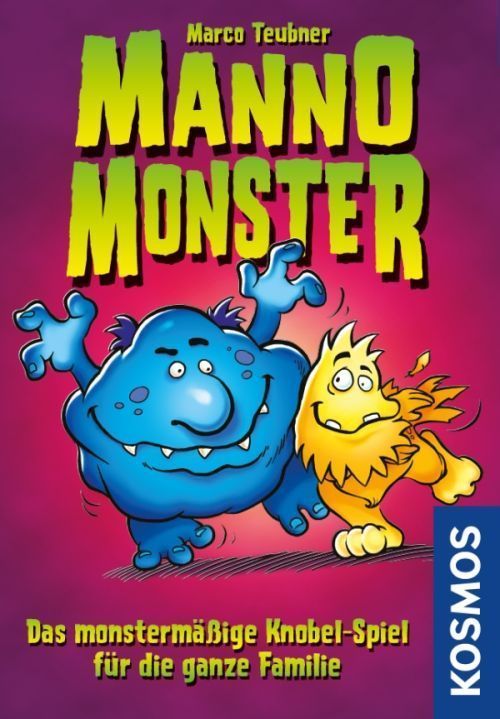
Manno Monster
Manno Monster Rulebook
Table of Contents
Table of Contents
Game Components
- 54 task cards with 108 tasks (18 tasks for each of 6 levels)
- 60 monster tokens (15 for each player)
- 36 gems (9 yellow, 9 red, 9 blue and 9 green)
- 4 treasure chests (1 for each player)
- 1 scoring plate
- 1 sand timer
- 3 monster figures (large, medium and small)
Object of the Game
In each of the nine rounds, the players try to present their solution to the shared task as fast as possible. You must quickly combine different monsters so that their characteristics and numbers satisfy the given task. Whoever succeeds receives a gem of varying value as a reward (the fastest player receives a gem worth more points than the second fastest player, and so on). The player with the most valuable collection of gems at the end of the game wins.
Before playing for the first time, assemble the 4 treasure chests following the three illustrated steps (1, 2, 3).
Game Setup
- Give each player a set of 15 monster tokens (the individual sets are distinguished by the colour of the background) and add the chest of the corresponding colour.
- Together, choose one of the 6 difficulty levels (do you want to play Level 1, Level 2, Level 3, etc.). In the chosen level, randomly pick 9 task cards (out of 18 possible), shuffle them and place them on the table as a draw pile. For your first game we recommend Level 1, the easiest tasks.
Example: On the back of the Level 1 task cards you will find the tasks for Level 4. If you agreed to play Level 1, prepare the draw pile so that the "reverse" side (that is, the one visible in the pile) is the one showing Level 4 (so that in every round you must first turn the card over and only then start playing).
- Place the gems, the scoring plate, the monster figures and the sand timer in the middle of the table.
- For a 2-player game you need only the monster figure with the number "2".
- For a 3-player game prepare only the monster figures with the numbers "2" and "3".
- For a 4-player game you will need all 3 monster figures.
- Return the remaining game material to the box; you will not need it during the game.
Course of the Game
The game is played over 9 rounds. One task is prepared for each round. In each round, all players simultaneously try to satisfy the given task as fast as possible by flipping their set of tokens.
Course of a Round
-
According to the number of players, place 2-4 gems on the scoring plate as follows:
- 2 players: 1 blue and 1 green gem,
- 3 players: 1 red, 1 blue and 1 green gem,
- 4 players: 1 yellow, 1 red, 1 blue and 1 green gem.
These valuable gems are what is played for in each round. The coloured gems have different point values:
- yellow gem: 4
- red gem: 3
- blue gem: 2
- green gem: 1
-
The youngest player starts the game. They turn over the first card and place it on the table so that all players can see it well.
Tip: The task text and the shapes and colours of the monsters on the card are clear and easy to read, but if a player has trouble reading the task because from their seat at the table the text is "upside down", make sure that in the next round the card is turned "upside down" from the point of view of another player, so that you create fair conditions for everyone.
-
Now the players concentrate so that all of them, simultaneously and each as fast as possible, solve the task by flipping their monster tokens.
Important: The sand timer does not come into play yet!
How to Solve a Task
There are 6 types of monsters available: a plump (fat) and a thin version in each of three colours:
- 2 blue monsters (plump and thin)
- 2 red monsters (plump and thin)
- 2 yellow monsters (plump and thin)
The following types of tasks appear on the cards:
Each kind of monster at least x times. To evaluate the task as successfully solved, the set of monsters you present must contain at least as many monsters of the given kind as the task specifies. That means you must count the monsters of the given kind on the task card and then, as fast as possible, flip (combine) your monster tokens so that your set contains the corresponding number.
Example: Task card shows 4 plump blue monsters, 3 plump red monsters, 2 thin yellow monsters and 1 plump yellow monster. One possible solution:
- According to the task, at least 4 plump blue monsters should appear; we have 4.
- According to the task, at least 3 plump red monsters should appear; we have 3.
- According to the task, at least 2 thin yellow monsters should appear; we even have 3.
- According to the task, at least 1 plump yellow monster should appear; we even have 3.
The appearance of the other (remaining) monsters does not matter much to us at the moment. The task is successfully solved.
A monster of the given kind in an exact number ("=3x"). For this type of task you must find on the tokens the exact number of monsters of the given kind, neither more nor fewer.
Example: In the solution, all the monster kinds shown are combined in exactly the number the task requires. The task is successfully solved.
Several kinds of monsters in an equal number. To successfully solve this type of task, you must combine the depicted kinds of monsters so that they occur in the same number.
Example: A plump yellow monster, a plump blue monster and a thin red monster are here represented in the same number (each three times); the appearance and number of the other monsters do not matter at the moment. The task is successfully solved.
One kind of monster should be represented more often than another. In this case you must combine a larger number of the monsters shown on the left with a smaller number of the monsters shown on the right of the sign.
Example: The plump red monster (represented 4 times) outnumbers its thin red colleague (represented only 2 times). The plump blue monster (represented 3 times) in turn outnumbers the plump yellow monster (represented only 2 times). Again, the number and appearance of the other monsters does not matter to us this time. The task is successfully solved.
We also offer tasks that do not specify the kind of monster in the way described so far. Instead of both colour and shape, they give only the form (plump or thin) or only the colour (blue, red or yellow) of the monster.
- Coloured blots indicate that we are now comparing only the quantity of all monsters of that colour; it does not matter to us whether the monster is plump or thin.
- The symbols for a plump or a thin monster mean that the goal is to find the correct number of plump (or thin) monsters; it does not matter whether the monsters are blue, red or yellow.
Example: Here we have the same number of blue and red monsters (each is present 5 times). There is not a single plump yellow monster. And there are more yellow monsters (5 thin yellow monsters) than plump monsters (2 plump blue monsters + 2 plump red monsters = 4). The task is successfully solved.
Important: On some task cards many different conditions are shown. All conditions listed on the card must always be satisfied at the same time!
Important: For the successful solution of a task, all 15 monster tokens must be taken into account. No monster token may ever be set aside, even if you feel that "it really cannot be combined any better". You must keep looking for a solution until all 15 monsters on the tokens satisfy the task!
Finishing the Round and Scoring
- The player who finds a solution first turns over the sand timer; however, they may no longer touch their solution, even if they realize they have made a mistake! From this moment the other players have only limited time to successfully finish solving the task. The second fastest player, after successfully solving the task, grabs the largest wooden monster figure, the third player the medium figure, and the fourth player the smallest wooden monster figure.
- When the sand runs out, it is time for scoring. The players, one after another, defend their solutions of the task before the others; the player who turned over the sand timer begins.
- If the solution satisfied the task, the player receives the most valuable gem from the scoring plate and puts it into their treasure chest.
- The defence continues with the second fastest player, the one who took the largest wooden monster figure from the table after solving the task, and so on.
- If a player did not solve the task correctly, they leave this round empty-handed. A player who was slower than the unsuccessful solver in this round but solved the task correctly moves up the ranking; in that case they receive a more valuable gem.
- It can also happen that no player manages to solve the task successfully; in that case put the task card aside and continue with the next round.
- Return the sand timer and the wooden figures to the middle of the table and replenish the gems on the scoring plate according to the number of players. Turning over the next task card begins a new round of the game.
End of the Game
After the ninth round, when the players have more or less successfully completed all 9 tasks, the game ends. It is time to add up the value of all gems collected in each player's chest. The player with the highest number of victory points wins. In case of a tie, the players share first place.
Variant for Parents Playing with Children
If children and adults play at the same time, the children can complete less demanding tasks (a lower Level, e.g. Level 1, Level 2), while the adults work on more difficult tasks (e.g. Level 5 and Level 6) at the same time. In that case the children have one draw pile of their own and the adults have a second one prepared; at the start of the round both cards are turned over at once and everyone works on their own task: the children solve easier tasks, the adults deal with the more complex task.