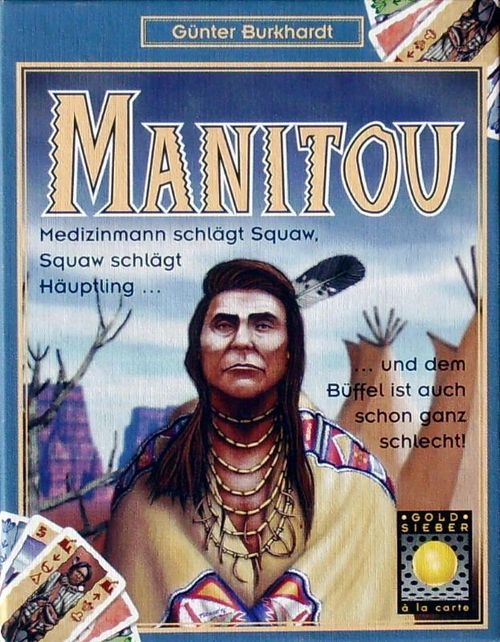
Manitou
Manitou Rulebook
Table of Contents
Table of Contents
Contents
4 sets of cards in four tribal colors (22 cards each) 7 pelt robber cards (marked -10) 15 buffalo cards (with the values 1, 2, 2, 3, 4, 4, 5, 5, 6, 7, 9, 10, 10, 11, 12, 13 )
Game Preparations
Each player chooses one of the four tribal colors and takes a card set consisting of:
- 1 tribe card (which details the ranks and strengths of the great warriors)
- 11 hunters (with strength values of 1, 2, 3, 4, 5, 5, 6, 7, 8, 9, 10)
- 10 great warriors (two each of chief, medicine man, rain maker, scout, and squaw)
With fewer than four players, return the remaining card sets to the box. Place the pelt robber cards in a pile. Sort the buffalo cards into two face-down piles, using the card backs to sort them, then shuffle both piles.
The oldest player deals for the first hunt.
Preparations for the Hunt
Three hunts will be played. To begin each hunt, the dealer lays out buffalo cards face up in the middle of the table to form three hunting grounds. (With two players, the three hunting grounds consist of (1) one large and one small buffalo, (2) one small buffalo, and (3) one small buffalo; with three players, (1) one large and one small buffalo, (2) one large buffalo, and (3) one small buffalo; with four players, (1) one large and one small buffalo, (2) one large and one small buffalo, and (3) one small buffalo.)
Each player then chooses 8 cards from his available hunters and great warriors with which he would like to take part in the hunt. The dealer, however, chooses only 7 cards. The remaining cards are kept in reserve for later hunts and should be placed under the tribe card.
You will discover which combinations of cards are best during the game. For your first hunt, though, we suggest using two hunters with high values, two with low values, and four different great warriors.
Course of the Hunt
Each player shuffles his chosen cards, lays them in a pile face down in front of him, and draws the top three cards to make his hand. The player to the left of the dealer starts, with the other players following in clockwise order.
On a player's turn, he must lay one card in his hand face up next to one of the hunting grounds. (Each player lays his cards on the side of the hunting ground closest to him. See the diagram on page 3 of the German rules.) He then draws one card from his pile to bring his hand back up to three cards. (When no cards are left to draw, he will play out his hand.)
The next player then does the same, laying his card on his side of the hunting grounds, then drawing a replacement card.
If a player plays a card to a hunting ground where he has already played, he should place the card so that all previously played cards are still visible.
If great warriors belonging to different players are played on the same hunting ground, a trial of strength takes place (described below). This will decide which great warrior is the victor and will take prisoners.
You may play one additional great warrior card on top of one of your own already played warrior cards. These two cards can be attacked only via a sacrifice (described below). A player cannot play more than two great warriors on one hunting ground.
Important: Warriors and hunters belonging to a player can be played on a hunting ground in any order. They retain their validity, whether they are on top, in the middle, or underneath other cards on display.
As soon as each player has played seven cards, the hunt ends. Each player (other than the dealer, who has no cards in hand) places his remaining card back in his reserve pile under his tribal card.
Trial of Strength
If a player plays a warrior card on a hunting ground which already has a warrior belonging to another player, then the stronger card beats the weaker. The defeated card is turned face down, while the winning card remains face up.
Each warrior card shows in the left column which cards this warrior can beat, and in the right column which cards will beat this warrior. The tribal card summarizes these rankings. (The Medicine Man (Medizinmann), for example, will be defeated by chiefs and scouts and will himself defeat the rain maker and squaw.)
Important: At each hunting ground, the warriors of only one player may lie face up.
If a player plays the same warrior as another player at the same hunting ground, the cards cancel each other out. Both cards are considered defeated, and both are turned over.
If two warriors belonging to one player lay face up at the same hunting ground, they can be attacked only via sacrifice.
Sacrifice
In order to attack two warriors played by one opponent, a player must first play a warrior which is stronger or as strong as the topmost warrior card — that is, the last one played by the opponent. In this case, both cards (the defeated and the victor) are turned face down.
On a later turn, that player (or another one) can play another warrior to attack the opponent's remaining warrior — if that opponent has not played a second warrior in the meantime.
Example: The rainmaker is protected by a chief. In order to get at the rainmaker, a player must sacrifice a squaw or one of his own chiefs to defeat the chief that's already present. Then the rainmaker can be attacked.
The Reckoning
As soon as each player has played seven cards, determine which tribe has been most successful:
1. Doling out pelt robbers
First, calculate which player has the greatest total strength among all his hunter cards played this hunt. This player takes a pelt robber card (worth -10) and lays it on a face down points pile near his tribal card. In the case of a tie, each player involved takes a pelt robber card.
2. Seizing buffalo
Each hunting ground is now assessed separately. The player who has assembled the hunters with the greatest total of strength points takes the buffalo card. If there are two buffalo cards, he takes the more valuable card and places it in his points pile face down. The other card goes to the player with the second highest total of strength points. If only one player has hunters at a hunting ground, he takes all buffalo cards present. Hunters and warriors remain where they are for the time being.
If two or more players are tied for the most strength points, then no player takes the buffalo card (or cards) and it's returned to the box. If players tie for second most points, only the player with the highest point total takes a buffalo card; the remaining card is placed back in the box. Also, if no hunters have been played at a hunting ground, all buffalo cards belonging to that ground are returned to the box.
3. Taking prisoners
The player who has one or two warriors lying face up at each hunting ground then takes all hunters and face down warriors at this hunting ground. He returns his own cards to his reserve pile, and these cards can be used again later. Each card belonging to an opponent is a prisoner and is worth one point at the end of the game. The player places these cards in his points pile face down. If no warriors lie face up at a hunting ground at the end of a hunt, each player takes back his own cards and returns them to his reserve pile.
Overview
The goal is to have hunters at a hunting ground with the highest total of strength points, while not having the greatest strength total overall as you will collect a pelt robber card. Remember, too, that your warriors can only take prisoners.
Example of a reckoning (page 6 of the German rules):
After the pelt robber card has been given to the player with the most hunting points, each hunting ground is scored. At this hunting ground, yellow has the most points (9+2=11) and takes the buffalo card worth 12.
Green is in second place (10 points and 1 defeated warrior) and takes the buffalo card worth 5. Blue has only 9 points and goes empty-handed. Red has a warrior card (a chief) lying face up and takes all his opponents' cards as well as his own, scoring six points in the process.
New Hunt, New Fortune
After all hunting grounds have been scored, a new hunt begins. The player to the left of the dealer is the new dealer and lays out new buffalo cards as described above. Each player again selects eight cards from his reserve pile, with the dealer taking only seven. The player to the left of the new dealer starts the hunt, and the game proceeds as described above.
End of the Game
As soon as the third hunt ends, each player counts the points in the pile near his tribal card.
- Each buffalo card is worth its face value.
- Each prisoner is worth 1 point.
- Each pelt robber card is worth -10 points.
Whoever has the most points wins.