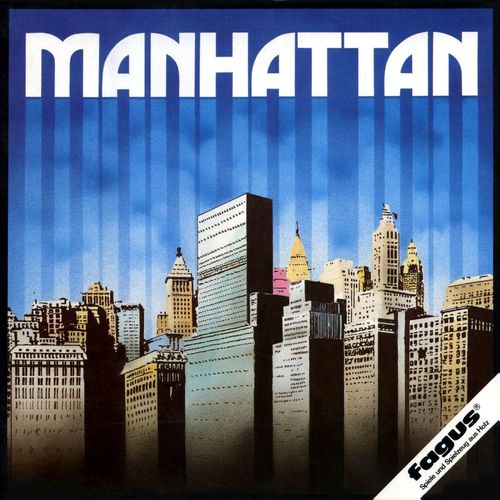
Manhattan (Fagus, 1986)
Manhattan (Fagus, 1986) Rulebook
Table of Contents
Table of Contents
Overview
Manhattan is a building game. Each player competes with the other players to build the highest skyscraper.
Gameboard
The gameboard is a 9x9 grid. The board is separated into a 7x7 grid where the skyscrapers are built, and a ring around this area, where the player's pawns are moved.
Components
- 45 cubes (stories of buildings)
- 20 wedges (roofs)
- 30 flats (roads)
- 14 towers in 6 colors (2 each in green, gray, yellow and purple. 3 each in red and blue.)
- 12 pawns in 6 colors (2 of each color)
- 2 dice
Preparation
Lay the gameboard in the middle of the table. Each player takes a set of colored pieces (2 pawns and two towers). The rest of the stories, roofs and streets form the supply. Whoever has most recently constructed something starts the game. Players take turns deciding which corner to set their pawns upon.
Course of the Game
- Roll the dice
- Move Pawns
- Build or demolish, when possible
- Resolve all doubles, "1"s and "6"s.
Roll the Dice
Always throw both dice. The dice determine where the pawns are set. In addition, certain throws have special effects.
- Doubles: Take a roof from the supply.
- "1"s: Build a roof, if you have one.
- "6"s: Add a story to a building.
Move Pawns
Each player must move his pawns according to the dice. Each space costs one movement point to enter. Advance one pawn the total of the two dice, or advance one pawn using the value of a single die & advance the other pawn using the other die's result.
Pawns only move on the outer ring. Pawns can move in either direction, but they may not double back in the same turn. Even if both dice are used on a single pawn, it may only advance in a single direction. Multiple pawns may occupy the same space.
Build
After moving, check to see if the two pawns are positioned in such a way to create a building opportunity. If the pawns can draw a line out into the city center that intersects, possibilities exist. If the space is empty, it is possible to build. Under certain conditions it may also be possible to demolish an unwanted roof. If the two pawns cannot draw an intersecting line there is no construction opportunity this turn.
Buildings - Buildings can extend over more than one property. Multi-property buildings must have at least one story and touch on at least one edge. The owner marks the building with one of his towers. Since each player has only two towers, he can only have two separate buildings. An individual single story is a building and must be immediately marked with the player's tower. A player may add on to his own building by constructing on a property that has an edge in common with the existing building.
Buildings must be free standing. They cannot share an edge or even a corner with another building. However, an owner can let his two buildings merge together. In this case the owner can remove a tower from the new combined building, and possibly start a new building elsewhere.
Streets - Streets may be built on every free property. They can prove useful to inhibit the building activity of your opponents. If a player's pawns create a building opportunity where the player cannot construct a building story, he must build a street.
Roofs - For each set of doubles rolled, a player will receive a roof. These roofs are very useful, because they interfere with rising competitors. When a "1" is rolled a player may build a roof, if he has one, on any free story of a building.
Under certain conditions a block (building story) previously placed can be built higher. The tower must always be placed immediately on the highest floor of a building. If several stories are of equal height, the tower must be placed immediately on the block that was most recently built. Building stories can only be further built upon if there is not tower or roof present.
If the pawns of the player cross a property which that players owns, and the building story at this intersection is free from a tower or roof, an additional building story may be added.
For each thrown "6" an additional story may be added on any building. It may happen that there is no site to place an additional cube to a particular building. With luck and skill 3 stories can be built in a turn. (Roll double "6"s. the player moves both pawns, where they cross on a free property. He places a building story there. Then for each "6" a floor is added.)
Demolition
Roofs are hindrances. When a player's 2 pawns create a cross on an unwanted roof to one of his buildings, he may remove the roof and return it to the supply. If the throw of the dice included a 6, it would be possible to remove the unwanted roof, and then set an additional story on the building.
Hostile Takeover
With progressive building activity player's options decrease, since the individual buildings may not touch each other. This does not make the other players gentler. A free property between a player's building and a competitor's building may be developed. This is permitted, only if the building of the acting player is taller than the competitor's building. Should this happen the competitor's tower is removed, and his former building becomes part of the acting player's building.
Bankruptcy
Roads and neighboring buildings limit the options for a building. A building is considered developable so long as it can be added onto (by adding additional stories, or tearing off roofs), or by growing into free properties adjacent to the building. (Even if occupying this free property would cause a hostile takeover.)
A player, who has no more developable buildings, must announce bankruptcy, if an opponent demands. His two pawns and tower are taken from the game. His buildings remain, awaiting another player claim them by hostile takeover.
Game End
The game ends when all building stories are constructed. The player with the highest building wins the game. If there is a tie for highest building, the player with the most blocks in his building wins. Alternately a player can win if all other players announce bankruptcy.