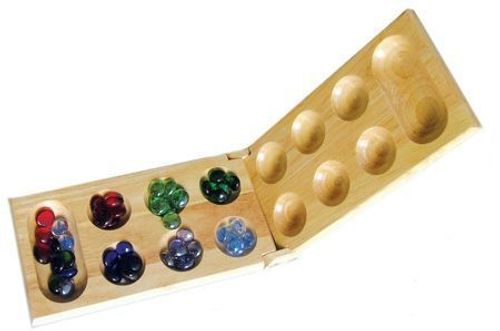
Mangala
Mangala Rulebook: Tournament Regulation
Table of Contents
Table of Contents
Competition Format
The competition is a Mangala game contest.
Basic Rules
The regulation states that Mangala has four basic rules.
Rule 1. The player who wins the right to start takes four stones from any pit on their own side. Holding the stones in one hand, visible to the opponent, they begin placing them into the pits with the other hand. They drop one stone into the pit they took it from, then drop one stone into each following pit moving counter-clockwise, that is, to the right, until the stones in hand run out. If the last stone in hand lands in their treasure, the player has another turn. If the player's pit holds a single stone, then on their turn they may move it into the pit to its right. The turn then passes to the opponent. The last stone left in the player's hand decides the course of the game each time.
Rule 2. When the player who has the move has sown all the stones from their own pits and still has stones in hand, they continue dropping stones into the opponent's pits, again holding the stones in one hand visible to the opponent. If stones are still in hand after the opponent's pits have received stones, the player continues dropping them into their own pits rather than into the opponent's treasure. If the last stone in hand lands in an opponent's pit and makes the number of stones in that pit even (2, 4, 6, 8, and so on), the player takes ownership of all stones in that pit and puts them into their own treasure. The turn then passes to the opponent.
Rule 3. If, while sowing, the last stone in hand lands in an empty pit on the player's own side, and the pit opposite it on the opponent's side contains opponent stones, then the player takes all the stones from the opponent's pit opposite, and also takes the single stone they dropped into their own empty pit, and puts them into their treasure. If the pit opposite the empty pit contains no opponent stones, the player does not take the stone they dropped into their own empty pit. In both cases the turn passes to the opponent.
Rule 4. When the stones on either player's side run out, the game set ends. The player who first empties their own side takes all the stones remaining on the opponent's side. The referee then counts the stones in each player's treasure, and the player who has collected the most stones in their treasure wins the set.
Conduct and Procedure
a) The game has four basic rules, set out above.
b) In groups of stones too numerous to count by eye, the player asks the referee to count the stones after placing the last stone. The referee then counts the stones in the pit.
c) When making a move, all the stones are taken into one hand. The hand is kept open and visible to the opponent, and the stones are placed one at a time into the pits with the other hand.
d) If a player touches any stone, they must play the pit that stone is in.
e) The game is played as a best-of-three sets match. The player who wins two sets wins the round and scores 1 point. The loser scores 0. If the sets end level, the game is declared a draw and each side scores 0.5 points. No extra set is played.
f) Objections about problems in earlier moves are not accepted.
g) If a player does not play a stone they touched, or does not make a move that is allowed under the rules, the opponent reports this to the referee, and the referee gives the player at fault one warning. A player who receives a third warning loses the round.
h) The referee may use a timer. When a timer is used and a player's time runs out, the stones in that player's treasure are counted. If the player's treasure holds 24 or more stones, the game is a draw. If it holds fewer than 24, the player loses.
i) A player may not count the stones in their own pits or in the opponent's pits with any tool or with their fingers.
Evaluation
-
Each school sets up its own jury. The jury chooses the students who act as referees in the games and who place in the rankings.
-
The student who places first in a school tournament may enter the district tournament.