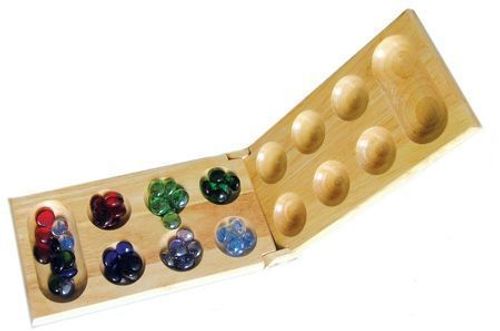
Mangala
Mangala Rulebook
Table of Contents
Table of Contents
Components and Setup
- A board of twelve small pits (kuyu) and two large pits called treasures (hazine).
- Forty-eight stones.
The game is played between two players. Six of the twelve small pits and one of the two treasures belong to one player. The other pits and the other treasure belong to the other player. The source does not describe the board's layout further.
The player who wins the draw (kura) to move first chooses any pit on their own side and takes all four stones from it.
Basic Rules
Sowing
The first player puts one stone back into the pit it was taken from, then drops one stone into each following pit moving counter-clockwise, that is, to the right, until the stones in hand run out.
The last stone in hand may land in several places, and each has its own result:
- Landing in your own treasure: if the last stone in hand lands in your treasure, you have another turn.
- Single stone in your own pit: if your pit holds a single stone, then on your turn you may move this stone into the pit to its right instead of sowing. The turn then passes to the opponent.
The last stone in hand decides the outcome of the move each time.
Sowing into the Opponent's Side
If a player who has the move sows all the stones from their own pit and still has stones in hand, they continue dropping stones into the opponent's pits.
When the last stone in hand lands in an opponent's pit and makes the number of stones in that pit even, the player takes ownership of every stone in that pit and puts them into their own treasure. The turn then passes to the opponent.
Note: the source does not say whether sowing passes over the opponent's treasure. The companion tournament regulation states that stones are not dropped into the opponent's treasure, and that once stones are placed in the opponent's pits, any stones still in hand continue into the player's own pits.
Capture on an Empty Pit
If the last stone in hand, dropped on your own side, lands in an empty pit on your own side, and the pit directly opposite it on the opponent's side contains opponent stones, then:
- you take all the stones from the opponent's pit opposite,
- you also take the single stone you just dropped into your own empty pit,
- you put all of these stones into your treasure.
The turn then passes to the opponent.
If the pit opposite the empty pit has no opponent stones, you do not take the stone you dropped. The turn passes to the opponent in either case.
End of the Game Set
When the stones on either player's side run out, the game set ends. The player who first empties their own side takes all the stones remaining on the opponent's side.
The game therefore stays dynamic until the very end.
Playing Etiquette
The following rules govern conduct and the handling of stones during play.
- A player who places the last stone in hand into their treasure has another turn.
- A player who places the last stone in hand into their own empty pit, with stones in the opposite pit on the opponent's side, takes both the opponent's stones in that opposite pit and their own stone in the empty pit, and moves them into their treasure. The turn then passes to the opponent.
- The player whose own pits empty first takes the stones in the opponent's pits into their treasure.