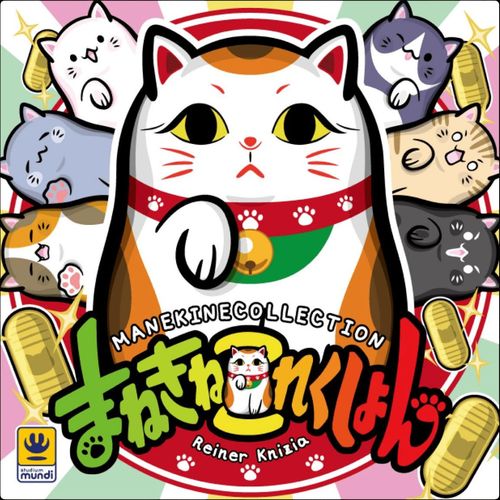
Manekinecollection
Manekinecollection Rulebook
Table of Contents
Table of Contents
Objective of the game
By catching "Zabuton Neko" you earn points, and the player with the highest total score at the end of the game wins. Collect more "Zabuton Neko" than anyone else!
Components
- Cat pieces: 30. All the cat pieces except the black cat have one piece each holding a "gold coin" and a "cat can" (cat food).
- Manekineko: 6
- Kotatsu board: 3
- Tatami board: 6
- Bag: 1
- Bonus tile: 4
- Rulebook: 1
- Cat cards: 72 (6 colors x 12 cards)
- Summary cards: 4 (please have one for each player)
- Zabuton tiles: 30 (6 colors x 5 pieces)
Setup
- Refer to the pictures on the page to prepare the "Kotatsu Board" and "Tiles" etc.
- Draw a "Cat Piece" from the "Bag". Draw the "Zabuton Tile" that corresponds to the piece's color and place them together. This is called a "Zabuton Neko". Place two "Zabuton Neko" on each "Kotatsu Board". (This process is repeated many times during the game.)
- Put one Manekineko in the "bag". Keep the rest together in an easy-to-find place.
- Each player draws three "Cat Cards" from the "Deck" and holds them as their "Hand" so that other players cannot see them.
Additional setup points shown on the setup pictures:
- Zabuton tiles should be shuffled and grouped by color.
- Put all cat pieces in the bag.
- Shuffle cat cards to make a "deck"; the "discard pile" is kept beside it.
- Place the three kotatsu boards side by side in the center of the table. Then set a color-matched tatami board on each. Leave space in front of the tatami board.
- How to assemble the Kotatsu board: assemble it into a box shape.
How to play
Determine the starting player (the player who has most recently touched a cat, or as appropriate). The following moves "A" (1) and "B" (2) are then played in clockwise order.
1. Play the cat card
Choose Cat Cards from your hand and place them face up in front of one of the Kotatsu Boards. The Cat Cards are lined up in front of the Tatami Board of the color that corresponds to the player.
2. Draw the cat cards
Draw Cat Cards from the Deck until you have 3 cards in your hand. If you run out of deck, shuffle the discard pile cards and make a new deck.
Rules for playing cat cards
Up to three cat cards can be placed in one place. The card can be played in one of the following three ways.
- Where there are no cat cards, you can play one or two.
- Two cards must be played where there is one cat card.
- One card must be played where there are two cat cards.
You cannot play two cat cards one at a time on different kotatsu boards.
Examples:
- There is space on all of the Kotatsu Boards, so you can place a Cat Card anywhere.
- There are three cat cards on the right kotatsu board, so they can only be left or center.
- Since there are three cat cards each on the left and in the center, they can only be played on the right.
Get Zabuton Neko
Once everyone has played three cat cards on one kotatsu board, do the following.
1. Showdown
Compare the strength of the "hands" each player has made. (See "How to Form Hands and Judge Strength".)
2. Get Zabuton Neko
- 3-4 players: The player with the strongest hand will check the front sides of the two "Zabuton tiles" without the other players being able to see them, and take the Zabuton Neko of their choice. The player with the second strongest hand will take the remaining Zabuton Neko.
- 2 players: The player with the strongest hand gets both of the Zabuton Neko.
3. New Zabuton Neko sets
All Cat Cards on that Kotatsu Board are discarded. After that, place a new Zabuton Neko in the same way as in step 2 of Setup.
- If you have a Zabuton tile that is out of stock, take one of each color and place them in the bag. If multiple colors run out at the same time, place the same number of colors in the bag. (The number of Manekineko in the bag is increasing rapidly.)
- After drawing a Manekineko from the bag, place the Manekineko between the kotatsu boards and draw again from the bag.
- If Manekineko are drawn in succession, the process is repeated.
- The game ends immediately after the third Manekineko is drawn. (See "End of the game and winner/loss".)
How to Form Hands and Judge Strength
The strength of the hand is determined by the color combination of the two cat pieces on the kotatsu board and the three cat cards played by each player. First, "1" is compared, then "2" if there is a tie, and "3" if there is still a tie, in that order.
1. Strength of combination (Hands)
From strongest to weakest:
| Hand | Composition |
|---|---|
| 5cats | Same color x 5 |
| 4cats | Same color x 4 |
| cathouse | Same color 3 + 2 |
| 3cats | Same color x 3 |
| two pair | Same color x 2 (2 sets) |
| one pair | Same color x 1 (1 set) |
| solocat | There is no same color |
(The five cats counted are the two cat pieces on the kotatsu board plus the player's three played cat cards, as shown in the picture.)
2. Cat Card Ranks
The rank of Cat Cards is determined by the number of [icons printed on the card]. First, compare the ranks of [the cards forming the hand's main set, e.g. the pair/triple color] and [the next color], and if they are the same, compare them [the remaining card]. (See "Example of judging the strength".)
3. Third card first
Be careful not to forget who played the third cat card first. (See "Example of judging the strength".)
Example of judging the strength
- Cathouse: since the strength of the first set is the same, the ranks of the second set cards are compared.
- 3cats: since the first set and the next strongest card are the same, the ranks of the following cards are compared.
- Two pair:
- One player has no pair of the first color, so loses.
- One player has two pairs, but loses in the rank comparison of the later cards.
- Two players have the same rank "Hand", but the one who was first to play the third cat card before the other wins.
End of the game and winner/loss
The game ends immediately when the third Manekineko is drawn from the bag.
Each player calculates the Bonus score and the score of Zabuton tiles they have, and the player with the highest total score wins the game. If the scores are the same, the player with more cat pieces wins. If they are also equal, all of them are winners!
Bonus score
Gold coin: When you have a combination of Zabuton and Cat pieces with "gold coins" on them, the score is based on the number of Cat pieces of the highest color that you have obtained, not on the number written on the Zabuton. If there are multiple sets of gold coins, they all have the same score. If you have the following at the end of the game, each combination of "gold coins" will be worth 3 points. The more Zabuton Neko of the same color you collect, the more points you get.
Cat food: When you have a combination of Zabuton and Cat pieces with "Cat food" on them, at the end of the game, a Zabuton tile with a negative score is chosen to be canceled. If there is more than one "Cat food" combination, the number of combinations can be canceled.
Do not swap the Cat pieces and Zabuton tiles you get to make (or avoid making) combinations of "gold coins" and "Cat food".
Ne-collection (cat collection)
If you get all six types of cats together, you get a bonus tile! (6 points). ("Ne-co (Neko)" means cat in Japanese!)
Score example
- Cancel "A" in "Cat food".
- There are three cats of the gold-coin color, so "Gold coin" is 3 pts.
- Total: 15 points.