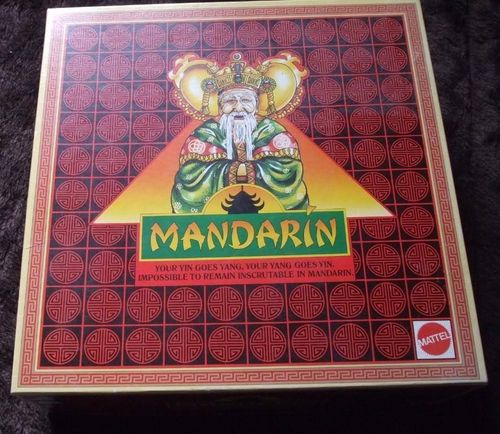
Mandarin
Mandarin Rulebook
Table of Contents
Table of Contents
Game Contents
- 1 game board
- Tile dispenser and lid
- 72 animal tiles
- 1 die
- 5 Mandarin figures
- 5 tile collection cards
- Chinese play money
- Instructions
Description of the Game Board
The game board depicts the Chinese Zodiac, a cycle of 12 years in which each year is characterised by an animal or symbol. The Chinese, in common with many other Oriental people, believe that every person will demonstrate in their lives those qualities of temperament of the special animal which controls the year of their birth.
Players can discover what Animal Year they were born in by looking for their year of birth around each animal picture on the board. The Chinese Year, unlike the Western Year, runs from February to January, so remember this as you discover your animal sign. For example, a person born in January 1956 would be a goat, whereas a person born in February 1956 would be a Monkey.
Operation of the Tile Dispenser
Tiles are drawn one by one from the Dispenser by firmly pushing down on the lever on the side of the Dispenser. Occasionally, and especially when very few tiles are left in the Dispenser, no tile will be dealt on the first push of the lever. Simply push again, until a tile appears.
Game set up
Put all of the tiles in the Dispenser and place the lid on top. Gently shake the Dispenser and place it in the centre of the board. Each player chooses a Mandarin and places it on the board on the centre Chinese Character space of their own animal sign. If two or more players share the same sign, simply place the Mandarins side by side on the same space.
Object of the Game
Players collect tiles and place them in the appropriate places on their Collection Cards. The game ends when one player has collected at least one tile of each animal type, or all 6 tiles of one animal set. The first player to do this is the winner.
Game Play
On a player's turn, he rolls the die and moves his Mandarin in a clockwise direction around the board by the number of spaces shown on the die. If he lands on a Chinese Character space, he collects 100 Yuan from the bank (unless the segment is controlled by another player), and his turn ends.
If the player lands on a coloured space, he operates the Dispenser. If the tile drawn falls picture up or picture down, he may claim the tile and his turn ends there. However, he may choose to leave the tile on the board and risk losing it by drawing another tile. In this case, should the second tile come out picture down, the player may claim both tiles, or he may choose to chance both tiles for a third, and so on. If the second or any subsequent tile should come out picture up, then all the tiles on the game board are offered for sale in a single auction to all of the players. They must NOT be turned over until the auction is over.
Auctions
The player who has caused the auction may bid first, followed by the player to his left, and so on. Each bid must be higher than the last, and if a player drops out of the bidding he may not re-enter the auction. The minimum bid, regardless of the number of tiles, is 100 Yuan. There is no upper limit.
The winner of the auction pays the price to the Bank and places the tiles in the appropriate positions on his Collection Card. If a player is discovered to have bid an amount which he is unable to pay, he forfeits all of his money to the Bank, and the auction is re-run.
Money
Each set of six animal tiles includes an Emperor tile, which is marked with a small symbol of a Pagoda.
Whenever a player owns three or more tiles of the same animal, he may charge other players 200 Yuan whenever they land on any of the three spaces within that animal segment. If one of the tiles is the Emperor Tile, the player may charge other players 400 Yuan when they land on a space within that segment.
In the event of two players each owning three tiles of the same animal, the player with the Emperor Tile controls the segment, and only one player is entitled to receive this money. Once a segment is controlled by a player, the other players may not collect 100 Yuan for landing on the Chinese Character space within that segment.
Cashing in Tiles
At the start of a player's turn, and only then, a player may cash in any number of tiles by returning them to the Dispenser. Ordinary tiles are worth 200 Yuan; Emperor tiles are worth 400 Yuan.
Passing a Mandarin
Whenever one player's Mandarin passes another Mandarin, or Mandarins, on the board, the Dispenser is not used. Instead, the passing player chooses any tile from the board of the other player or players he passed. He then rolls the die again to move clear, and his turn ends.
Going Bankrupt
If, at any time, a player is unable to pay his fines, the player to whom he owes money can choose any tile from the bankrupt player's Collection Card, in addition to taking whatever money that player has. Play then continues in the normal way, with the bankrupt player continuing, hopefully, to collect tiles and money as he moves around the board.
End of Game
The first player to collect at least one of every animal, or six tiles of the same animal, wins the game.
Empty Dispenser
If it is known that the Dispenser is empty, game play continues normally in every respect, except the players do not draw tiles until at least one tile has been cashed in by another player.
Optional Variation
The object of the game is to be the player with the highest amount of money. At the end of the game, the player who is first to complete his collection does not necessarily win the game. Players total their money and the value of their collection, counting ordinary tiles as 200 Yuan each and Emperor tiles as 400 Yuan each. The player with the highest total is the winner.
IN THIS VARIATION THERE IS AN ADDITIONAL AUCTION POSSIBILITY
A player who has at least six tiles on his Collection Card may offer the first tile he draws, whether face up or face down, for Special Auction. In this case, he acts as the Auctioneer and may not take part in the bidding. However, he receives the money for the tile, and not the Bank. If no bid is received for the tile, it is returned to the Dispenser.