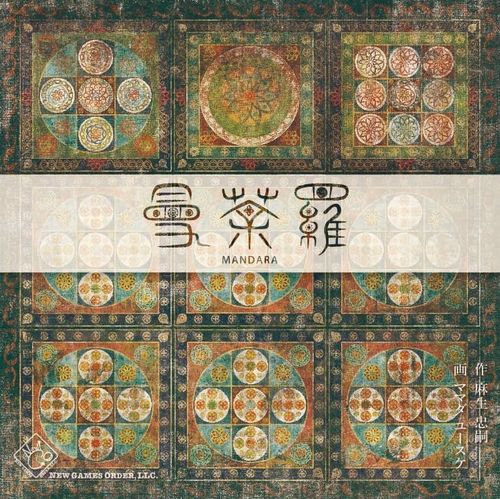
曼荼羅 (Mandara)
曼荼羅 (Mandara) Rulebook
Table of Contents
Table of Contents
Components
- Mandara board (曼荼羅盤) × 1
- Mandara tiles (曼荼羅タイル) × 9
- Six Realms board (六道盤) × 1
- Six Realms cards (六道カード) × 6
- Buddha pieces (仏駒) × 76: 20 each in red, black and grey, and 16 in brown
- Neutral pieces (中立駒) × 8
- Piece placement cards (駒置場カード) × 4, one per colour
- Rulebook × 1
Setup
Place the Mandara board in the centre, with the Six Realms board beside it, both oriented the same way up.
Each player chooses a colour and takes the piece placement card of that colour. With 3 players, use the red, black and grey cards and return the brown card to the box.
Take all six Six Realms cards and place them as follows: the Human Realm (<人間道>) on space 1 of the Six Realms board, the Asura Realm (<修羅道>) on space 2, and the Hungry Ghost Realm (<餓鬼道>) on space 3. In the first round only, no card is placed on space 4. Place the remaining cards face down beside the Six Realms board.
One person takes one Buddha piece of each player's colour and places them on the score track around the outer edge of the Mandara board, starting from space 1, in random order. When doing so, spaces on the track that already contain another piece are ignored (passed over). During the game, whenever points are gained or lost, move the pieces immediately to reflect the change.
Each player takes three Buddha pieces of their own colour; these are the starting hand (開始時の手持ち). Keep your hand pieces on your piece placement card throughout the game so that other players can see them. There is no limit on the number of pieces in hand.
Place each player's remaining Buddha pieces, together with the 8 neutral pieces, in the stock (ストック) at the top of the Six Realms board. Four of each player's pieces in the stock are set aside specifically for the Human Realm, placed in the frame at the top right.
Shuffle the 9 Mandara tiles, place them face down at the lower left of the Six Realms board as a draw pile, and turn over the top tile, placing it in the space above the draw pile. The orientation of the turned tile is decided by the player with the lowest current score.
Figure: 4-player setup, with the following labelled areas: initial placement of score-marker pieces; score track; tile spaces; starting hand; stock; Six Realms card draw pile; Human Realm Buddha piece area; turned Six Realms card row; tile draw pile; turned tile space.
Game Sequence
The game lasts 9 rounds. Each round, one tile turned over on the Six Realms board is placed on the Mandara board, and at the end of the game the mandala is complete. Making a continuous run of your own pieces on the mandala leads to points.
Each round proceeds in the following order:
- Placing pieces (駒の配置)
- Acquiring spaces (マスの獲得)
- Resolving Six Realms cards and placing Mandara tiles (六道カードの解決と曼荼羅タイルの配置)
- Scoring (得点計算)
- Preparing the next round (次のラウンドの準備)
1. Placing Pieces (駒の配置)
Check the score track. Players take turns in order, starting with the player whose current score is lowest. After the player with the highest score has taken a turn, the player with the lowest score takes another turn.
On your turn, place one piece from your hand. A piece may be placed on any space of a tile currently turned over on the Six Realms board, or on any space shown on a row of Six Realms cards. A piece may also be placed on a space that already holds pieces; in that case, stack the new piece on top.
A player with no pieces left in hand is skipped. When every player's hand is empty, proceed to step 2.
2. Acquiring Spaces (マスの獲得)
For each space on each Mandara tile and each Six Realms card, determine which player has finally acquired it. A space is acquired by the player who has placed the most pieces on it. If players are tied, the player who placed their first piece earlier (that is, lower in the stack) acquires it. The acquiring player leaves one of their pieces on the space, and all other pieces are returned to their owners' hands.
Note: the procedure above does not apply to the Human Realm. All pieces placed on Human Realm spaces remain on them.
Placing and acquiring pieces on parallel spaces (並立マスにおける駒の配置と獲得)
Some Mandara tiles have "parallel spaces" (並立マス) that can be acquired by several players. A parallel space contains several spaces but functions as a single space. Parallel spaces also include spaces that are added only in 4-player games (shown in the tile illustration).
When placing a piece on a parallel space, all players stack their pieces on one space within the parallel space. (At this stage, multiple spaces are not used.)
When acquiring spaces, for a parallel space, rank the players up to the number of spaces the parallel space contains (ranked by the number of pieces placed; ties are resolved by earlier placement). Place one piece of each higher-ranked player on each space within the parallel space.
The two examples printed in the rulebook are:
- Two-space parallel space: in a 3-player game, it can be acquired by only one player, like a normal space. In a 4-player game, the top 2 players can acquire it.
- Three-space parallel space: in a 3-player game, the top 2 players can acquire it. In a 4-player game, the top 3 players can acquire it.
3. Resolving Six Realms Cards and Placing Mandara Tiles (六道カードの解決と曼荼羅タイルの配置)
Each card on the Six Realms board is resolved by the player or players who have pieces on it (for the Human Realm, each of those players individually). Cards are resolved in order, starting from space 1. Cards with no pieces on them are skipped.
A card must be resolved, but it is permitted to resolve it so that the result is the same as the original state. Each time a card's effect is resolved, the pieces on that card are returned to hand immediately.
Asura Realm placement and automatic placement
Through the effect of the Asura Realm (<修羅道>), the tile turned over on the Six Realms board is placed on one of the 9 spaces on the Mandara board. In a round in which the Asura Realm did not line up (<修羅道>が並ばなかった), or in which no one placed a piece on the Asura Realm, the Mandara tile is placed on the Mandara board automatically after all Six Realms cards have been resolved. For this automatic placement, and for any placement or movement of tiles by Six Realms cards, the "Tile Placement Rules" below must be followed.
Tile Placement Rules (タイルの配置ルール)
- If Mandara tiles are already on the Mandara board, the new tile must be placed sharing an edge with at least one of them.
- As a result of a tile move, the tiles on the Mandara board must not be split into more than one group.
- For automatic placement, place the tile, without changing its orientation, on the space with the smallest printed number, within the above rules.
4. Scoring (得点計算)
Points are scored here, according to the current state of the Mandara board.
On the Mandara board, choose one path that connects the most spaces holding your pieces and neutral pieces, drawn as a single unbroken stroke (「一筆書きで」). In order from the higher-ranked players, each player scores points equal to the number of spaces in this connected path. Show the other players how you draw the single-stroke path, and move your piece on the score track clockwise by the number of spaces equal to the points scored.
Neutral pieces (中立駒)
Neutral pieces placed on Mandara tiles by the effect of the Heaven Realm card (<天道>) are counted as each player's own piece during scoring. However, a score cannot be made using neutral pieces alone.
Scoring example (得点計算の例)
The example diagram shows a Mandara board state with pieces of each colour and neutral pieces. The printed captions read:
- Red scores 5 points. "A" (the circled group in the diagram) cannot be used twice, and "A" cannot be counted as 2 points from a single use.
- Black scores 8 points, as indicated by the numbers.
- Grey scores 4 points.
- Brown scores 2 points. Brown must not be scored as 3 points using only neutral pieces.
5. Preparing the Next Round (次のラウンドの準備)
Turn over a new Mandara tile from the draw pile and place it beside the board. The player with the lowest current score decides its orientation.
- 4-player game: each player takes one of their own pieces from the upper left of the Six Realms board and adds it to their hand.
- 3-player game: in odd-numbered rounds, each player adds 1 piece to their hand; in even-numbered rounds, each player adds 2 pieces.
Six Realms cards are prepared as follows:
- Rounds 1 to 7: leave the Human Realm (<人間道>) on space 1. Collect the other cards, shuffle them face down together with the remaining cards, then turn cards over one at a time and place them in order on spaces 2 to 4 (3 cards in total).
- At the end of round 8: first take the Human Realm from space 1 and return it to the box. Then shuffle all the remaining cards and place them on spaces 1 to 4 (4 cards in total).
End of Game (ゲームの終了)
When scoring for round 9 is complete, the game ends. Adjust each player's score in the following order. For each item, points are applied starting with the higher-ranked players.
- Player who can draw the longest single-stroke path (一筆書き) on the Mandara board: +3 points (if several players tie for the longest, all of them receive +3 points).
- For each tile, the player who has placed the most pieces on it: +1 point (if several players tie for the most, all of them receive +1 point). Process the tiles in the order of their space numbers on the Mandara board.
- Pieces remaining in hand: −2 points per piece.
The player with the highest final score wins.
Six Realms Card Notes (六道カードの補足)
Human Realm (<人間道>)
Newly acquired pieces are taken from the space to the right of the stock. The maximum number of pieces that can be obtained from the Human Realm over the whole game is 4. Whether or not you acquired pieces from the Human Realm, all pieces placed on the card are returned to hand when the card is resolved.
Asura Realm (<修羅道>)
Place the tile together with the pieces on it onto the Mandara board.
Card face text, as printed on the Asura Realm illustration: "Place this round's Mandara tile in any location on the Mandara board. At this time, the orientation of the tile must not be changed."
Hungry Ghost Realm (<餓鬼道>)
The player who acquired the right chooses the effect they want, and resolves it.
Hell Realm (<地獄道>)
The Tile Placement Rules (p. 3) must still be followed.
Animal Realm (<畜生道>)
The orientation of tiles on the Six Realms board cannot be changed.
Heaven Realm (<天道>)
The piece exchanged for a neutral piece may be either your own piece or another player's piece.