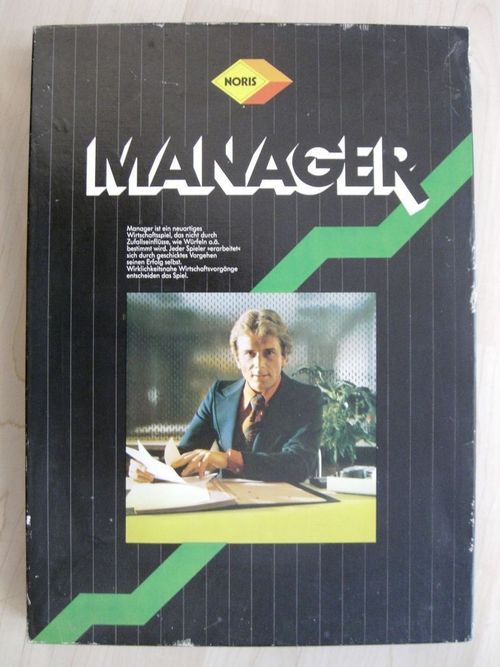
Manager
Manager Rulebook
Table of Contents
Table of Contents
Game Components
- 1 game board "Die Börse" (The Stock Exchange)
- 6 share-price markers ("Kurssteine")
- 6 machine park boards ("Maschinenpark")
- 6 "Cash-O-Meter" price dials
- 60 machines
- 168 shares in 6 types (each type: 22 × "1 share" and 6 × "5 shares")
- 1 stack of play money
- 1 rules booklet
Setup
Each player chooses a colour and receives a matching share-price marker, a Cash-O-Meter, a machine park board and four individual shares. No money is handed out at the start. Place the board "Die Börse" in the middle of the table. Place each player's share-price marker on the specially marked middle value of the exchange, "1.000".
One player is appointed as the banker. The banker manages the machines, the shares and the money.
Game Play
All players act at the same time in an imaginary "market" and try to sell a merely imagined product. Managers set the price themselves using their Cash-O-Meters, but must always consider the wages they have to pay. If the prices lie within the given range, players immediately receive the corresponding sales revenue.
With their capital, players then speculate on the stock exchange or buy new machines to reduce their wage costs. When a manager owns 10 machines, the game ends and the winner is determined. The top manager is the player who can show the greatest capital in the form of shares, machines and cash.
Game Phases
Manager is played over several rounds of four phases each. The phases are:
- Prices
- Sales
- Share prices
- Machines and shares
Phase 1: Prices
Each manager secretly sets on his Cash-O-Meter the price he wishes to achieve for his (fictional) product. Since all companies offer the same product, they are of course in fierce competition with one another. In setting their prices, players must always also take their wage payments into account (see Phase 2). Prices can only be set in steps of 100 marks. The lowest price is 100 marks, the highest 20,000 marks. Once all players have set their prices, the Cash-O-Meters are revealed and laid side by side on the table, beginning with the lowest price.
Phase 2: Sales
In this phase it is determined which managers were able to sell their goods on the market. The manager with the lowest price always sells. The manager with the next-higher amount also sells, provided that he is no more than 1,000 marks above the lowest price. This applies to the other players as well: they may sell if their price is at most 1,000 marks above the next-lower price. If the difference between two players is ever greater than 1,000 marks, then all managers who lie above this gap of 1,000 marks receive no money.
Example:
| Player A | Player B | Player C | Player D | Player E |
|---|---|---|---|---|
| 5,500 | 6,500 | 6,700 | 8,100 | 8,500 |
Player A demands the lowest price and receives his money. Player B is still within the 1,000-mark limit and likewise collects his money. The same applies to Player C. Between Player C and Player D there is a difference of more than 1,000 marks. Therefore Players D and E come away empty-handed!
All players who were able to sell their goods receive their price from the bank. However, the wages due are withheld immediately. The wage costs a player must pay are taken from his "machine park" board. If a player owns no machine, his wage costs are 5,000 marks. Each machine a player owns reduces these costs by 500 marks.
Players who were not able to sell their goods do not have to pay any wages.
In the hard competitive struggle it is quite permitted to demand a price below the wage costs. In this case the player naturally receives no money, but must pay the difference to the bank.
Example:
Player A owns 6 machines, so his wage costs are 2,000 marks. In this round, however, he demands only a price of 1,800 marks, in order possibly to make the shares of his competitors fall. For this he pays 200 marks to the bank.
If a player must pay money to the bank and does not have the necessary cash, he must sell shares to the bank. In this case, however, the player must first wait for the new prices (see Phase 3) and can then sell.
Phase 3: Share Prices
Now the share prices are newly determined. Their changes depend on the sales prices of this round.
- The share price of the player with the lowest price remains unchanged.
- The share price of the player with the next-higher price rises by one step.
- The share price of the next player rises by 2 steps, and the share price of the next player rises by 3 steps.
- A share price can rise by at most 3 steps in one round.
- Share prices of players who were not able to sell their goods in a round fall by one step.
- A share price can fall by at most one step in one round.
Example:
| Player A | Player B | Player C | Player D | Player E |
|---|---|---|---|---|
| 5,500 | 6,500 | 6,700 | 8,100 | 8,500 |
The share price of Player A remains unchanged, since he demanded the lowest price. The share price of Player B lies exactly within the 1,000-mark limit and rises by one step. The share price of Player C rises by two steps, since he achieved the next-higher price. Between Player C and Player D there is a difference of more than 1,000 marks. Therefore the share prices of Players D and E each fall by one step.
If several players achieve the same price for their goods, their prices are treated as one price when calculating the share prices.
Example:
| Player A | Player B | Player C | Player D | Player E |
|---|---|---|---|---|
| 5,500 | 6,500 | 6,500 | 6,700 | 8,500 |
The share prices of Players B and C rise only by one step, since both lie directly above the lowest price. The share price of Player D rises only by two steps, since the prices of Players B and C are identical. The share price of Player E falls by one step.
Phase 4: Machines and Shares
In this phase the managers may buy and sell shares and machines.
The player who demanded the lowest price begins. In case of a tie, the player with the most machines begins. If there is still a tie, the older manager begins. The other players follow in clockwise order until each has had one turn.
A player may buy or sell any number of machines. A machine always has a value of 5,000 marks, regardless of whether it is bought or sold. When a machine is bought, it is always placed on the free space with the highest wage total. Thus the wage costs fall by 500 marks with the purchase of a machine, and rise again by 500 marks when a machine is sold.
If a manager wishes to buy or sell shares, the current price on the "Börse" (stock exchange) applies.
A player may buy or sell shares and machines in any order.
End of the Game and Victory
The game ends as soon as a manager buys his tenth machine. The winner and top manager, however, is the player with the greatest capital. Capital consists of machines, shares and cash. Each machine has a value of 5,000 marks. Shares are valued according to their last price on the stock exchange.
Quick Reference
At the start: each player receives 1 share-price marker, 1 Cash-O-Meter, 1 machine park board and 4 shares (all in the same colour). Set the share-price markers on the middle value, 1,000.
Phases: 1. Prices, 2. Sales, 3. Share prices, 4. Machines and shares.
Phase 1: Simultaneously set a price between 100 marks and 20,000 marks and reveal it.
Phase 2: Collect money for the goods, minus wage costs. The lowest price always sells. All others sell only if there is no gap of more than 1,000 marks between two prices. Whoever does not sell pays no wages.
Phase 3: Change share prices according to the prices of the round. The share price of the lowest price stays unchanged. The next-higher price rises by 1 step, the next by 2, the next by 3. Maximum change upward is 3 steps. Whoever did not sell falls by 1 step.
Phase 4: The player with the lowest price begins the phase, the others follow clockwise. Machines (fixed price 5,000 marks) and shares (prices see share-price marker) may be bought and sold freely.
End: A player with 10 machines ends the game. The top manager is the one with the most capital. This counts cash, machines (fixed price 5,000 marks) and shares (prices see share-price marker).
Translation and Transcription Notes
- The phase heading printed as "Maschinen und Akten" in the scanned sheet is a typo for "Maschinen und Aktien" (machines and shares); it is rendered as "Machines and Shares".
- The printed part count "168 Aktien in 6 Sorten" is reproduced as printed (it matches 6 types of 22 single shares plus 6 five-share pieces each); the scan does not state a different figure.
- The share-price table on the "Börse" board is not reproduced in the text of the scanned sheet. Where the rules refer to share prices, they refer to the values printed on the board and the share-price markers ("Preise siehe Kursstein").
- Currency is Deutsche Mark (DM) in the original; it is printed here as "marks".
- Author and publisher credits on the cover have been omitted.