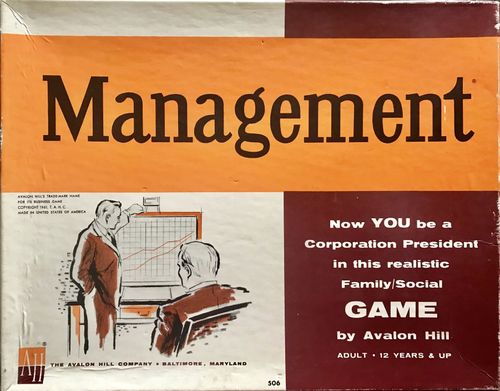
Management
Management Rulebook
Table of Contents
Table of Contents
Instructions — Read First
The rules are patterned after situations common in actual practice. Some players who are inexperienced in business have found themselves playing like veteran business managers before their first game is half over! This is because the game progresses from one step to the next according to a simple plan. Read the rules over carefully, then keep them handy for reference. You will find the playing procedure, plus many reminders, printed on the board in front of you. After you become acquainted with the fundamentals of "Basic MANAGEMENT" you will want to try the post-graduate play entitled "MANAGEMENT Tournament Game" which requires only the materials included in this set.
Basic Game
To Be Successful in MANAGEMENT, you must analyze market conditions, take shrewd advantage of your competitors' circumstances, and prudently operate your own factories and warehouses at peak efficiency. You and your competitors must agree beforehand whether the game is to end after a predetermined number of game years, at some specified time on the clock, or by elimination. In a "time limit" or "clock" game, the player with the greatest net worth, as revealed by the final audit, is the winner. In an "elimination" game, play continues until all players but one (the winner) are eliminated by reason of bankruptcy.
Beginning Play
There are six "phases" to be played each month, as indicated on the Running Record Sheet. All Presidents must complete work on one phase (of the same month) before proceeding to the next. These phases follow the logical sequence of doing business. The corporation must first pay its fixed expenses in cash, then purchase raw materials, convert raw materials into finished inventory, then sell the finished inventory for cash. The cash is used to pay off loans and for capital improvements before building a capital reserve.
Two, Three or Four Players may participate. Each player assumes the role of President of a manufacturing corporation. Each Corporation begins the game with $10,000 in its treasury. The remaining cash is held in the Bank. Any President may double as the Banker throughout the game, without providing his own corporation any undue advantage. For convenience in playing the game, the Bank also serves as the market place, and all spare counters (the square pieces supplied with the game) are kept there. The Banker will find it convenient to keep a scratch pad to record bids of the current month, so that he can determine how the counters are to be distributed.
The Presidents are now ready to begin business. Each has a Running Record Sheet properly filled in, 4 Raw Material Units, 2 Finished Inventory Units, 2 Standard Factories, and $10,000 in cash. Shuffle the situation cards and place them in the center of the board. One of the 24 cards will be turned up for each month of business. At the end of a 12-month series, the deck will be reshuffled to begin the next year.
Each President takes one sheet from the Running Record Sheet pad and fills in the name of his corporation along the side. The current year is then circled (1 for the first year). If the game continues into the second year, a new Running Record Sheet will be required and the year 2 must be circled on that sheet. Running Record Sheets are used to account for all of your own transactions and to make notes of competitors' transactions if you so desire. Information about your competitors might at some future point in the game permit you to make an important decision.
North (East corporation if North is not in business) becomes the Senior President during the month of January and writes his initials above the JAN. column. The Senior President title, which determines the successful bidder in case of a tie, is passed on to the next player on the left at the beginning of the next month of play.
The Running Record Sheet has been designed for use in both the basic game and the tournament game. For the basic game, ignore the vertical dashed lines in the RAW MATERIAL and SALES portions, the STOCK RECORD at the bottom, and the PROFIT AND LOSS STATEMENT on the reverse side. These are used only in the tournament game.
Situation Cards are supplied to state availability of raw material, minimum price for which raw material can be obtained, potential market for finished inventory, and maximum market value of finished inventory. At the start of each round of play, measured as one month in the game, a new situation card is turned face up. Each situation is different, but all Presidents are confronted with the same opportunities at the same time. Disregard the "Special Situation" comments. They are used only in the Tournament Game.
Playing Procedure
1. Turn up the top situation card and pay fixed expenses
Each corporation must pay the Bank $1,000 per month for each Standard Factory ($1,500 for Automated Factories). This represents overhead items such as rent and utilities which must be paid whether the factory produces goods or not. There is a monthly charge of $300 for storing each Raw Material Unit and $500 for each Finished Inventory Unit.
For example, in January, when the Presidents begin with the same number of factories and units, play opens with each President paying fixed expenses as follows:
- $1,000 for 2 Finished Inventory Units
- $1,200 for 4 Raw Material Units
- $2,000 for 2 Standard Factories
- $4,200 TOTAL: pay this amount to the Bank
As the game progresses, either standard factories or automated factories can be acquired as will be explained later. Notice that the large counters supplied with the game are marked STD. on one side and AUTO. on the other. Place two of these counters, with the STD. side up, in the factory site area of each corporation.
Each corporation starts the game with [two] factories ready to produce. Each corporation has four Raw Material Units (RMU) and two Finished Inventory Units (FIU) in stock at beginning of play. Notice that the small counters supplied with the game are marked RMU on one side and FIU on the other. Place four small counters, with the RMU side up, in the raw material site of each corporation. Place two small counters, with the FIU side up, in the finished inventory site of each corporation.
To add color to the game, the Presidents may consider their corporations to be specific competing industries, such as automobile manufacturers. Each Finished Inventory Unit would then represent a fleet of automobiles.
2. Purchase raw materials
The number of Raw Material Units available and the minimum bid price is indicated on the situation card for the month. Each President may make one bid, writing the number of units and the price per unit on his Running Record Sheet. Because the smallest denomination of money supplied is $50, all bids must be in multiples of $50.
Bids are confidential at this point, so cover your Running Record Sheet with your hand or a piece of paper. If a President wishes to withhold bidding, he may do so without revealing his secret to the competition until they have recorded their bids. Remember, the price listed on the situation card is the minimum figure that you can bid and hope to get raw material. Should you inadvertently bid below the minimum, you forfeit your opportunity.
After all bids have been recorded, the Presidents then expose their bids. The highest bidder receives his units first, and the remaining available units go to the next highest bidder, and so forth until all available units are sold. If there are more units for sale than there are offers to buy, the Bank will retain the unsold portion and no action will occur with these units.
As an example, if the first situation card indicates that there are 8 units for sale during the current month for a minimum of $400 each, the Presidents might make these bids:
- NORTH: four @ $600 each
- SOUTH: two @ $550 each
- WEST: five @ $500 each
- EAST: two @ $450 each
North offered the highest bid, $600 per unit. He will pay the Bank $2,400 and receive four Raw Material Units. South will get two of the remaining units for $550 and pay the Bank $1,100. There are two more units available for purchase under the terms of the situation card, and they are purchased by West at a price of $1,000.
Tied bids are resolved in favor of the Senior President for that month. If the Senior President is not involved in a tie-bid, ties are resolved in favor of the tied-bidder seated closest to the Senior President in clockwise rotation.
Should there be a shortage of counters in the Bank, the RMU situation of the Bank over-rules the Situation Card. For instance, if the Situation Card shows 6 RMU's available, but there are only 4 left in the Bank, then only 4 can be bid on.
3. Plan production
After paying fixed expenses and buying new material, the President of a newly formed corporation finds his cash on hand at a low point, and wishes to manufacture and sell as many products as quickly as possible. Decide how many Raw Material Units you wish to convert to Finished Inventory Units and record this figure on the Running Record Sheet, but keep your production planning confidential at this point. Each Standard Factory may produce one Finished Inventory Unit per month at a processing cost of $2,000, while an Automated Factory can produce two units for $3,000 or one for $2,000.
After all Presidents have planned their production for the month, then beginning with the Senior President and progressing clockwise around the board, each President pays the Bank for converting his Raw Material Units into Finished Inventory Units.
Note. It is not mandatory that units be manufactured, or that full production capacity be utilized.
4. Sell finished inventory
The situation card shows the market potential for Finished Inventory Units during the current month, and the highest price that the bank is willing to pay, which is the maximum market value. The price tag that you will have to place on your Finished Inventory Units will be governed by the law of supply and demand, together with other factors that you should consider, such as your need for ready cash and expectations for a better market next month.
If the situation card reveals a market for 12 units, yet the total finished inventory for all corporations is only 9, a "seller's market" situation exists and you can confidently offer your inventory for sale at maximum market value. The maximum market value fluctuates from $4,500 to $6,500. Conversely, if the market potential is limited to 9 Finished Inventory Units and the total inventory for all corporations is 12 units, you will have to underbid competitors to make a sale.
If you do not wish to sell any or all of your Finished Inventory Units during a particular month, keep this fact confidential until your turn to reveal your asking price. The Bank will, of course, buy the units with the lowest price tag first, next lowest second, etc. If two or more Presidents offer their units at the same price, the Senior President sells his inventory first. If the Senior President is not involved in a tie-bid, ties are resolved in favor of the tied-bidder seated closest to the Senior President in clockwise rotation.
Remember, the price listed on the situation card is the maximum market value. If you place a higher price tag on your finished inventory, it cannot be sold.
If the bank runs short of money at any time, it cannot buy Finished Inventory until funds are replenished through the sale of Raw Material.
Continue Business Cycle for Next Month and follow the same six phases of play.
If the game is to be concluded after a certain number of months or after a fixed limit of hours, the Balance Sheet on the reverse side of the Running Record Sheet should be filled out. All necessary instructions for filling out the Balance Sheet are given on the sheet. The President showing the highest net worth is the winner. (Net worth is the total of stock issued plus surplus.) At the end of the game, any surplus inventory which cannot be absorbed by the market is valued at the market figure on the situation card. Raw material in stock at the end of game is valued at the raw material price on the situation card.
Test of Bankruptcy
If a player has insufficient cash on hand to pay his debt in full to the Bank when due, and if he has already borrowed to the full extent of his credit, then that player is bankrupt and out of the game. The bankruptcy occurs immediately upon failure of a player to meet his obligations and not necessarily at the end of the month.
Another President may not buy out a bankrupt President. He may sell if bankruptcy seems evident, so long as it has not actually occurred. For example, if a player has sufficient cash to finish March but will not be able to pay Fixed Expenses in April, then he may arrange a sale to a competitor in March.
The Bank takes over all assets in the event of bankruptcy.
5. Make or repay loans
During this phase, Presidents may borrow money from the Bank, pay interest on loans, or repay loans. A President may borrow up to one half the value of his factory units. All loans are payable 12 months after the loan is made, with interest at the rate of [½%] per month (6% per year). Loans cannot be paid off sooner than 12 months. Interest payments must be rounded off to the nearest $50.
A President cannot refinance a loan if the money is not available to pay off the original obligation; but if he pays off his loan when it becomes due, he may reborrow during the same month. A President may wish to finance a new factory during the same month that it comes into production. For instance, if a factory comes due in March, you may take out a Loan in March during Phase 5 to cover the final payment of that factory.
A President may borrow money during other phases of the game should an emergency need arise, but the interest on these emergency loans is 1% per month (12% per year). No loans between Presidents are allowed.
6. Order capital improvements
Players order new factories or receive factories ordered in previous months during this phase. A lead time of four months must elapse before a Standard Factory is put into production. Lead time is the time required for construction, measured from the month in which the factory is ordered to the month in which the factory is completed. For instance, if a Standard Factory is ordered in January, it is completed in May, and comes into production in June. Six months' lead time is required for Automated Factories, while a conversion from a Standard Factory to an Automated one requires an eight-month lead time.
Standard Factories cost $5,000, Automated Factories $10,000 and a conversion $7,000. One half of the cost must be paid to the Bank when construction is started, and the remainder upon completion. Fixed expenses must be paid from the first month the factory is put into production, which would be the month following completion. Factories under conversion may continue production at Standard Factory capacity.
If at any point in the game you should become desperately short of working capital, you may sell an operating factory to your competitors at mutually agreeable terms. You will note that the number of available factory sites is limited to six. Six Automated Factories, however, are capable of satisfying the entire market for Finished Inventory.
Tournament Game
Introduction
The Tournament Game of MANAGEMENT is simply the Basic Game plus certain additional rules designed to make the play even more realistic. It is absolutely essential that players become proficient at the Basic Game before attempting the Tournament Game. Basic Game rules apply except where otherwise stated herein.
Situation Card Comments
On many Situation Cards there are special comments describing situations which may have effect on any or all presidents. Each such comment explains itself on the card and players must obey the comments if applicable.
Game Ending Details
The Tournament Game may end in the same various ways as outlined for the Basic Game. In the Tournament Game, however, players must complete a PROFIT AND LOSS STATEMENT, pay taxes and complete a BALANCE SHEET at the end of each calendar year. Instructions regarding completion of the P&L STATEMENT are printed on the form, and additional details will be mentioned later in these instructions.
Closing Procedure
At the end of the year, do the following in order:
- Complete your Profit & Loss Statement (Pay taxes to Bank).
- Figure up Balance Sheet.
- If Surplus exists, pay Dividend. Subtract Dividend payment from Surplus and Cash.
- Record Dividend payments and ARREARAGES in Stock Record Section.
- If additional Stock is issued, adjust Cash and Stock Issued sections of Balance Sheet.
If P&L shows a loss, subtract loss from Surplus. If any Surplus remains, you may pay a dividend even though operations in that year were unprofitable.
Depreciation
Factories depreciate in value each year in a "straight line" manner at the rate of 10% per year. Example: If the purchase price of all Factories is $10,000, then Depreciation would be $1,000 each year. Factory value then becomes $9,000. However, the following year's Depreciation is based on the purchase price, not the depreciated value of $9,000.
The depreciation suffered during a year of business is listed on the Profit and Loss Statement when closing the books for the year, and the factories must be listed on the Balance Sheet at their depreciated value. Book VALUE, of course, is based on the depreciated value of a factory.
Taxes
If a net profit exists, 50% of it must be paid to the Bank for corporate income taxes. If a corporation suffers a loss for one or more years and then has a profitable year, previous losses for five years back may be charged against the profit for tax purposes only. Profit and Loss Statement or Balance Sheet figures are unaffected except for the tax entry on the Profit and Loss Statement.
For example, if a corporation lost $5,000 over a three-year period, and the fourth year a net profit before taxes of $8,000 is made, the corporation may deduct the previous loss of $5,000 from the $8,000, thus entering only $3,000 in the Net Profit Before Taxes blank. The tax bill for that year is reduced from $4,000 to $1,500.
Similarly, if operations were profitable for several years and then a loss is sustained, a refund of taxes paid within a five-year period from the time of the loss can be realized.
Dividends and Stock Issuance
A corporation must pay a dividend equal to 10% of the Book VALUE of its stock each year to the Bank. If a Corporation does not wish or plan to issue stock, it is not necessary to pay dividends although an arrearage record must be maintained on the Stock Record form. In the event a Corporation should later decide to issue stock, and has accumulated arrearages, the total arrearage plus 10% penalty must be paid to the Bank. It is permitted to make partial dividend payments and accumulate the difference as an arrearage.
Book VALUE is computed as follows: On your current Balance Sheet, add Stock Liability plus Surplus and divide by the number of shares outstanding to reach the Book VALUE of each share. Dividends are based on 10% of this valuation on each share. A simpler method, of course, is to simply add Stock Liability and Surplus, paying dividends as 10% of the total.
Dividends can be paid only after taxes have been paid and Surplus has been computed on the Balance Sheet. Dividend payments are not tax deductible, and are never computed in any current or future Profit & Loss Statement. Dividends can only be paid from Surplus. This is a matter of law: you cannot pay dividends from Stock Liability. Thus, if at the end of a year no Surplus remains, it is not possible to pay dividends even though an arrearage based on 10% of Book VALUE must be maintained. In this case, of course, the Book Value of a share has dropped below its Par, or original, VALUE. Before it is possible for a Surplus to exist, one must carry stock at full liability, which is to say its full PAR VALUE.
Example (1): At the end of the first year, Stock Issued ($32,000) and Surplus ($8,000) equal Book VALUE ($40,000). Dividends, based on 10% of $40,000, would be paid to the Bank. Deduct $4,000 from Cash and Surplus and re-compute the Balance Sheet. Stock Issued remains the same, but Surplus now reads $4,000 and Cash will be $4,000 lower.
Example (2): If, in Example (1), there is a Surplus of only $2,000, the Book VALUE would be $34,000 instead of $40,000. The dividend requirement would be 10% of $34,000, which comes to $3,400. This is $1,400 more than the Surplus figure. Therefore, the entire Surplus of $2,000 is paid to the Bank. The remaining $1,400 is an ARREARAGE and must be recorded as such on the Stock Record section.
If a Corporation has paid dividends and has no arrearages, per the foregoing, then it may issue stock.
Only one issuance of stock may take place per year per Corporation and the issuance must be done at the year end. In no single year may a Corporation issue more shares than an amount equal to half of the shares currently outstanding. Thus, at the end of the first year of operations, only 16 new shares may be issued.
Valuation of each share sold must be at Book VALUE. Thus if Book VALUE per share is $1200 and 10 new shares are to be issued, the Bank must pay that price per share for a total of $12,000 for the 10 new shares. This is done to avoid "watering down" the equity of older shares. The $12,000 figure would be entered as a new stock liability in full amount.
The Stock may be issued at the end of the first year of operations if circumstances allow. Dividends may not be paid, however, on the new shares issued at that time. All stock transactions must be "public": other players are entitled to full disclosure.
A Corporation may, at the end of any year, "repurchase" its shares from the Bank for the Book Value plus current dividends plus 10% penalty on the total of Book Value and dividends.
Split Bids
Presidents may submit two differently priced bids for raw material, but the total number of units bid on cannot exceed the number of RMU's available. Similarly, finished inventory may be offered for sale at two different prices, but the same unit cannot be offered twice, nor can the total number offered exceed the potential market.
For example, in a market calling for 4 [FIU], North (if he has at least 4 FIU in inventory) may bid 3 at $4,000 and 1 at $3,000. In the case of tie bids, the Senior President is the successful bidder.
Shut Downs
In the event that a strike should occur, operations become unprofitable, or for any other reason, a President may elect to shut down his factories. By so doing, he loses all productive capacity, but cuts his fixed expenses in half. The decision to shut down must be made during the sixth phase (capital improvements) of the month preceding the shut-down period. However, a corporation must decide to reinstate operations one month before such operations may be resumed. The decision to reinstate operations must be made during the sixth phase of the second month preceding the month in which operations are to resume.
For instance, if you decide to Shut Down in March, you pay [one-half] the amount of Fixed Expenses beginning in April. In April, you may decide to re-instate operations. The Factory does not come into production until June. Full amount of Fixed Expenses is paid in June.