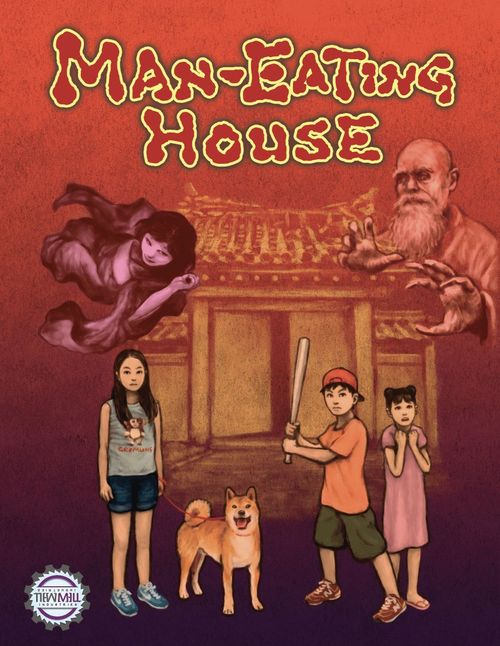
Man-Eating House
Man-Eating House Rulebook
Table of Contents
Table of Contents
Basic Information
- Players: 3-4
- Time: about 15 minutes
- Age: 10 and up
- Contents: 48 cards (44 play cards, 4 summary cards), 1 rulebook
Game Overview
Man-Eating House is a trick-taking game for 3 to 4 players. Following the house's lures, players play cards against one another and collect the scoring cards ("point cards") on which children and ghosts are drawn.
Types of Cards
The play cards used in the game are distinguished by three symbols called "suits": Ivy, Talisman, and Bone. Each suit is divided into four kinds of cards: Children, Weapons, Ghosts, and Places. There are also several special cards.
The play cards are also summarized in the separate "Card List" (printed on the back page). It is a good idea to look it over once before starting.
Child cards (point cards)
- Numbers 1-3 in each suit.
- The number is circled with a single circle (◎).
Weapon cards
- Numbers 5-7 in each suit.
- The background is orange.
Ghost cards (point cards)
- Numbers 12-14 in each suit.
- The number is circled with a double/filled circle (◉).
Place cards
- Numbers 8-11 in each suit.
- The word "Danger" (危) is written in the center of some of them. Danger Zone cards are also included among them.
Special Cards
Dog (point card)
- Ivy 0.
- The number is circled with a single circle (◎).
Little Girl
- Number 4 in each suit.
Old Man (point card)
- Bone 15.
- The number is circled with a double/filled circle (◉).
Danger Zone
- Ivy 11; Talisman 10 and 11; Bone 9, 10 and 11.
- The word "Danger" (危) is written in the center.
Card List
Cards whose number is circled with ◎ or ◉ are point cards. There are 20 point cards in all.
| Suit | Dog | Children | Little Girl | Weapons | Places | Ghosts | Old Man |
|---|---|---|---|---|---|---|---|
| Ivy | 0 | 1, 2, 3 | 4 | 5, 6, 7 | 8, 9, 10, 11 (11 is Danger Zone) | 12, 13, 14 | - |
| Talisman | - | 1, 2, 3 | 4 | 5, 6, 7 | 8, 9, 10, 11 (10 and 11 are Danger Zone) | 12, 13, 14 | - |
| Bone | - | 1, 2, 3 | 4 | 5, 6, 7 | 8, 9, 10, 11 (9, 10 and 11 are Danger Zone) |
Strength of suits: Ivy < Talisman < Bone. If two or more cards with the highest number are played, decide by strength of suit.
Game Setup
The numbers circled in each step correspond to the numbers in the "Card Layout Diagram".
- Shuffle all the play cards face down thoroughly, then deal them face down as hands: 13 cards each when playing with 3 players, 10 cards each when playing with 4 players. You may check the contents of your own hand only. From now on, when the word "card" is used, it means play cards.
- After dealing the hands, the leftover cards (5 cards with 3 players, 4 cards with 4 players) are set face down in a corner of the table. This pile of leftover cards is called the "Unopened Space" (開かずの間).
- Decide a start player by rock-paper-scissors or any suitable method.
- Hand out the summary cards, one each. The start player receives the summary card of a different color (gray) as a marker. The other players receive the yellow summary cards. The summary cards carry explanations of setup and resolution, and can be checked at any time during the game.
Setup is now complete.
Card Layout Diagram
- Hand. 2. Unopened Space. 3. Start player. 4. Summary card (gray for the start player, yellow for the others). 5-6. Play cards played to the field ("the Field"). 7. Point cards you have won (placed in front of you). 8. Discard pile. (Little Girl: see Special Card: Little Girl.)
Basic Rules
The "Basic Rules" of the game are explained in order from here.
- Starting with the start player and going clockwise, each player plays one card to the field. The first player to play a card may play any card they like from their hand. Every later player, however, must play a card of the same suit as the card played first. If you have no card of that suit in your hand, you may play any card you like.
- Example: Player 1 plays Ivy 9. Players 2, 3 and 4 must also play an Ivy card if they have one. If a player has no Ivy card, they play any card.
- When everyone has finished playing a card to the field, compare the cards and apply the effects of the Roles and Special Cards described later. If the winner has not been decided by them, then the player who played the highest number among the cards on the field wins. Even if the suit differs from the first card played, the higher number wins. If the numbers are the same, the player who played the stronger suit wins.
- Strength of suits: Ivy < Talisman < Bone.
- Examples: comparing card numbers, the highest, 10, wins; even if the suits differ, the highest, 12, wins; equal numbers on the field (for example two 8s) are decided by the stronger suit.
- The winning player gets all point cards on the field, if any.
- Point cards: 20 in all; the number is circled with ◎ or ◉. (Dog x 1, Children x 9, Ghosts x 9, Old Man x 1.)
- Point cards you have won are laid face up in front of you. Children go with Children and Ghosts with Ghosts, stacked so that the numbers can be seen.
- Cards remaining on the field other than point cards are discarded and removed from the field. This sequence — everyone plays one card and the strengths are compared to determine a winner — is called a "trick". From the next trick on, the player who won the trick (not the start player) begins the next trick.
Play so as to win as many point cards as possible.
Special Rules
From here on, exceptional handling that occurs depending on the combination of cards played to the field is explained: Roles and Special Cards.
About Roles
When the cards played to the field satisfy certain conditions, a Role is established. Handling that differs from the "Basic Rules" occurs — for example, even a player who played a low number can obtain point cards. There are two kinds of Role: "Escape" and "Fight".
Role: "Escape"
- When two or more Children of the same suit are played to the field, the Children can help each other and escape.
- In this case, each Child is obtained by the player who played that card.
- The Dog is also treated the same as a Child, and when the Dog and an Ivy Child are played at the same time, "Escape" is established.
- Example: A plays Ivy Child 1, B plays Ivy Place 9, C plays Ivy Child 3, D plays Ivy Weapon 7. Two Ivy Children were played, so "Escape" is established. The players who played the Children (A and C) obtain them. (Continues at "Deciding the Trick", note 1.)
Role: "Fight"
- When a Weapon and a Ghost of the same suit are played at the same time, they can drive the Ghost off.
- The player who played the highest-numbered Weapon obtains all of the Ghosts.
- Note that if several Weapons and Ghosts of the same suit were played, all of those Weapons and Ghosts are included in the Role. The Weapons included in the Role all become discarded cards at the same time the Role's handling ends.
- Example: A plays Talisman Weapon 5, B plays Talisman Weapon 7, C plays Talisman Ghost 12, D plays Talisman Place 9. Talisman Weapons and a Ghost were played, so "Fight" is established. The player who played the highest-numbered Weapon obtains all of the Ghosts. At the same time, the Weapons included in the Role are discarded. (Continues at "Deciding the Trick", note 2.)
Deciding the Trick
Whether "Escape" or "Fight" — when either Role has been established, after removing all of the cards included in the Role, compare the cards remaining on the field; the player who played the highest number wins.
- If after excluding the Role exactly one card remains, the player who played the remaining card wins.
- If no card remains, the next trick begins from the start player.
(Note 1: the remaining cards are compared; the player with the 9, the highest number, wins. Note 2: if one card remains, that player wins unconditionally. If no card remains, the next trick starts from the start player.)
When no card remains
The following combinations of cards played in a trick leave no card after the Role is removed. (The original shows these as lists of card types by Child / Weapon / Ghost; the blue-marked cards in the original are the ones forming the Role. Each line is one combination.)
For 3 players:
- Child, Child, Child
- Weapon, Ghost, Ghost
- Weapon, Weapon, Ghost
For 4 players:
- Child, Child, Weapon, Ghost
- Child, Child, Child, Child
- Weapon, Ghost, Ghost, Ghost
- Weapon, Weapon, Ghost, Ghost
- Weapon, Weapon, Weapon, Ghost
- Weapon, Ghost, Weapon, Ghost
[Translator's note: the original diagram's first two 4-player lines are printed as "Child Child Weapon Ghost / Child Child Child Child" with the last two cards of the second line marked in blue; the grouping is transcribed as printed.]
However, when a Special Card explained in the next section satisfies certain conditions, the Role becomes invalid.
About Special Cards
When a Special Card is played, handling different from the "Basic Rules" occurs. The Special Cards are four kinds: Danger Zone, Little Girl, Old Man, and Dog.
Special Card: Danger Zone
- In a trick in which a Danger Zone is on the field, the monsters of the Man-Eating House interfere, and the Role becomes invalid.
- When the Role becomes invalid, as in the "Basic Rules," compare the numbers of all cards played to the field; the player with the highest number wins.
- Note: a Role becomes invalid even when the suit of the Role and the suit of the Danger Zone differ.
- Examples:
- A Danger Zone 11 was played, so "Escape" is invalid. Compare numbers; the highest, 11, wins.
- A Danger Zone 10 was played, so "Fight" is invalid. Compare numbers; the highest, 13, wins.
- A Role and a Danger Zone of different suits are also invalid. When the numbers are the same, it is decided by strength of suit.
Special Card: Little Girl
- When a Little Girl is played as the first card of a trick, a special process [Kagome Kagome] occurs immediately.
Procedure of Kagome Kagome
When a Little Girl is played, the trick is interrupted and Kagome Kagome begins.
- The player who played the Little Girl places the Little Girl face up in a corner of the field. Then they draw one card from the Unopened Space and add it to their hand.
- Each player chooses one card of the same suit as the Little Girl from their hand and places it face down in front of themselves. If you have no card of the same suit, you may choose any card.
- Note: even if a player has no card of the same suit, if the card newly drawn from the Unopened Space turned out to be of the same suit, they must put that card out for [Kagome Kagome].
- Each time the player who played the Little Girl says "Kagome," each player passes the face-down card to the neighboring player. The player who played the Little Girl specifies in which direction (left or right) to pass the cards and up to which player to pass them.
- Note: before the cards have gone all the way around, someone must exchange. In the example, "Ka
go-me, kago-me~" was said twice, so A's card went around as far as C. (For simplicity the diagram omits it; B's, C's and D's cards likewise travel to D, A and B respectively.)
- Note: before the cards have gone all the way around, someone must exchange. In the example, "Ka
- When you have finished passing the cards, each player adds the card that came around to their hand.
- The next trick begins from the player who played the Little Girl. (Playing a Little Girl in consecutive tricks is allowed.)
- If the Little Girl is not the first card of the trick, [Kagome Kagome] does not occur. She is treated as an ordinary "4" card. However, the Little Girl is not discarded; at the end of the trick, she is placed face up in a corner of the field.
- When the third Little Girl is played to the field, at the same time the beguiling movement begins and "Twilight of the Demons" (逢魔時, Ōmagatoki) arrives, and from then on all Roles are invalid in every trick.
- Example: (1) a third Little Girl was played, so "Fight" is invalid; (2) after the trick ends, the Little Girl is placed in a corner of the field.
Special Card: Old Man
- The Old Man is the strongest card, able to win alone even when a Role is established.
- All Roles become invalid, and all point cards can be obtained.
- However, when the Old Man and the Dog are played at the same time, the brave Dog has its dog skin stripped off, and the Dog wins alone.
- Example: when the Old Man is played, the Role is invalid; the Old Man wins the trick and obtains all of the point cards. When the Old Man and the Dog are played at the same time, the Dog wins the trick and obtains all of the point cards.
Special Card: Dog
- The Dog is the weakest card, but it is treated like a Child, and when it is played at the same time as an Ivy Child, "Escape" is established.
- Example: Dog 0, Ivy Child 2, Place 10 and Ghost 14 played together — "Escape" is established. The Dog and an Ivy Child played at the same time also establish "Escape."
- Also, when the Dog and the Old Man are played at the same time, the Dog wins alone. All Roles are invalid, and all point cards are obtained.
- Note: when the Dog, Old Man and Child are played at the same time, the Old Man invalidates "Escape," but the Old Man is beaten by the Dog, so the Dog wins alone.
- Note: even when the Old Man is obtained by the Dog, the Old Man's player is the one who becomes the Old Man player (see the 3-player game), not the side that obtained the Old Man.
3-Player Game
Story
Each player is a child who has sneaked into the Man-Eating House. Some are naughty brats, some are busybody pranksters, some are lonely kids. They came for various reasons, but the most cowardly of them seems to have been possessed by the master of the house, the Old Man. Closing in on them is the hour of the demons. Do your best so that everyone can escape without anyone going missing.
How to Play
The player who has the Old Man in their hand plays against the other players, in two teams. The player with the Old Man must proceed with the game without being noticed that they hold the Old Man.
Victory Conditions
At the time the final trick ends, if the player with the Old Man has either:
- obtained one each of Children "1", "2" and "3" (the suit does not matter), or
- obtained 11 or more point cards,
then the Old Man player wins. If neither condition is achieved, the other players win.
However, during the course of the game the Old Man may be added to someone's hand — for example, the card drawn from the Unopened Space was the Old Man, or the Old Man was received through [Kagome Kagome].
In any case, the player who played the Old Man to the field becomes the Old Man player. Even if the Old Man was obtained by the Dog, it is the side that played the Old Man, not the side that obtained the Old Man, who becomes the Old Man player.
If the player who won the last trick turns over the Unopened Space and draws the Old Man from it, that player becomes the Old Man player at that moment.
Number of Players and Victory Conditions
The "Story," "How to Play" and "Victory Conditions" differ depending on the number of players. The other rules are common to all. When playing for the first time, the 4-player game, whose victory conditions are simpler, is recommended.
4-Player Game
Story
The players are a gang of monsters living in the Man-Eating House. They use the mysterious power of the cards to draw in foolish children and lure them in, take powerful monsters as followers, and bet on the seat of master of the Man-Eating House.
How to Play
Players facing each other form the same team, and the game is played as two teams.
Victory Conditions
After the game ends, total the point cards obtained within each team; the team with more cards wins. If the numbers are equal, the team that obtained the Dog wins.
Q&A
Q: Hey, my hand is short of cards... A: There are two possible causes. Either the number of cards in the Unopened Space was wrong in Game Setup (step 2), or you forgot to draw one card from the Unopened Space in step 1 of the Kagome Kagome procedure. Make up the shortfall from the Unopened Space.
Q: If I form a Role, do I also win the trick? A: Forming a Role and obtaining point cards does not mean you won the trick. Think of "(1) form a Role and obtain point cards" and "(2) win the trick" as separate. If (1) is unclear, check the "About Roles" section. If (2) is unclear, judge according to the victory-determination chart on the summary card.
Q: When the cards run out after processing a Role, who wins? A: When the processing of the Role has finished, if there is not a single card left on the field, it is "no contest" and the next trick begins from the start player.
Q: In [Kagome Kagome], may I pass the card I put down around to myself? A: You must not pass it around to yourself. Before it returns to you, it must be exchanged with another player.
Q: In [Kagome Kagome], who wins? A: [Kagome Kagome] is not a trick, so the next trick begins from the player who played the Little Girl (= the player who won the previous trick).
Q: That player couldn't play a suit before, but now they did — isn't that cheating? A: In [Kagome Kagome], this happens when the card drawn from the Unopened Space, or a card exchanged with another player, was a suit the player did not have in hand.
Techniques
- Void a suit: use up a particular suit so that you can always play the card you want to play.
- Attach point cards: when a teammate looks likely to win the trick, play a point card of no further use to you so that your teammate obtains it.
- Bait the Old Man and the Dog: when leading a trick, play only Bone cards if you want the Old Man out, or only Ivy cards if you want the Dog out, to steer the Old Man or Dog into appearing early.
- Aim for Role spillover: play a point card unrelated to the Role, expecting that you will be able to obtain it when a Role is established.