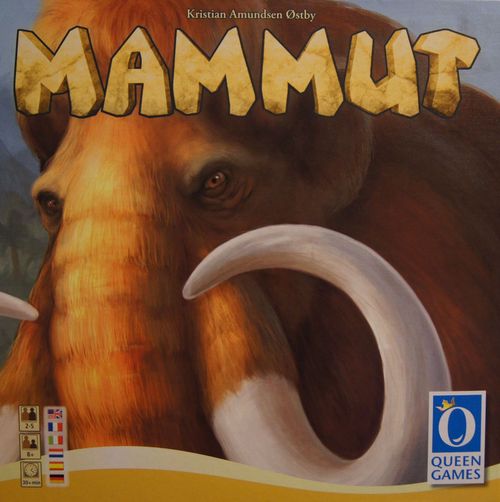
Mammut
Mammut Rulebook
Table of Contents
Table of Contents
Game Components and Setup
Components:
- 2 Game Boards (Scoring track and storage)
- 1 Start player mammoth
- 2 x 5 Thin mammoths in 5 player colors
- 5 Fat mammoths in 5 player colors
- 1 Round marker
- 19 Action cards (8 prey cards & 11 scoring cards)
- 35 Collectible animal tiles, 5 each of 7 kinds
- 31 Prey tiles
- 1 Shaman tile
- 1 Linen bag
- 1 Rules booklet
Place the game boards on one or two sides of the playing area. Then, setup is done in this order:
- Each player selects a player color. They place one of their thin mammoths on the start space of the fur points track, in front of the cave. Each player keeps their other thin mammoth in front of themselves on the table to indicate their player color. All players place their fat mammoth on space 10 of the victory (mammoth) points track.
- Shuffle the action cards and deal two to each player. Put the remaining cards in a pile face down on the storage board, this is the draw pile.
- All numbers of players: Sort all collectible animal tiles and place them in the center of the storage board (supply of collectible animals), each kind on its corresponding icon. 4 - 5 players only: Put one tile of each kind of collectible animals into the bag. Each player draws one tile and places it in front of themselves. Add the remaining tiles from the bag to the supply of collectible animals.
- Give the start player mammoth to the youngest player; they are the start player.
- Place the round marker on the scoring board. 2 - 3 players: Round 1. 4 - 5 players: Round 2. (The game lasts only for four rounds.)
- Put all 31 prey tiles and the shaman tile into the linen bag.
Sequence of Play
The start player lets all prey tiles (thoroughly shuffled and including the shaman tile) drop in the center of the playing area by turning the bag upside down. If necessary, shove the tiles carefully, thus separating them for a better overview, but make sure not to turn them over. First, the players split all prey and then score it; each round consists of these two phases.
Splitting the Prey
Seizing tiles
Beginning with the start player, followed by the other players in clockwise direction, the players take their turns. During their turn, a player must perform one of two possible actions:
- Select any number of tiles from the center and place them in front of themselves.
- Take all tiles of another player, put at least 1 of those back in the center and place the remaining ones in front of themselves.
A player's turn is skipped, if they have a number of prey tiles in front of themselves already.
Note:
- The start player has no choice but to seize tiles from the center.
- A player may take all tiles from the center!
- The shaman tile is among the prey tiles and may be seized by a player like any prey tile.
Hint: A player owning prey tiles may perform a turn later this round, if some other player seizes their tiles from them. They perform their turn in given player order.
Play cards
Before seizing any prey tiles, the player may play as many hand cards as they want.
There are two different kinds of cards:
- Prey cards are played face up. They are effective for the active player immediately.
- Scoring cards are played face down. They are revealed at the beginning of the scoring phase.
Note:
- Scoring cards may affect other players.
- Unplayed cards are useless at the end of the game.
- Please see the section "The Action Cards in Detail" for a detailed explanation of the cards.
End of this phase
If the only player without any prey tiles decides to seize tiles from the center, they must take all those tiles. This ends splitting the prey and that player is the start player of the next round; give them the start player mammoth.
Scoring the Prey
Preparations
I. Reveal all played scoring cards. II. Turn over all tiles with a question mark. The revealed side is taken into account for the subsequent scoring.
Now all players score their share of the prey. They mark their victory points on the victory points track.
Please note: A player may never have less than 0 victory points, even if they lose further victory points. They stay on the "0" space as long as they do not gain any more victory points.
The shaman
In case of a tie, the shaman tile helps to solve it. The player owning the shaman tile wins any tie in which they are involved. Concerning ties, a player's ranking is the better the nearer they are sitting next to the shaman (red arrows: clockwise direction; blue arrows: anti-clockwise direction).
Example: Player 2 has seized the shaman tile. Thus the ranking when solving ties is:
- 1st rank: Player 2
- 2nd rank: Player 3
- 3rd rank: Player 4
- 4th rank: Player 1
Score prey tiles in the following order:
Consider played cards according to their relevance when scoring.
Axe
Players draw one action card for each of their axe tiles from the draw pile (beginning with the shaman player, in clockwise direction).
During the final game round, each axe tile is worth 3 victory points; no cards are drawn.
Fur
I. Players advance their mammoth one space on the fur points track for each of their fur tiles (following the direction of the arrows). II. The player owning the most furs according to the fur points track gains a number of victory points as shown by the game round marker. III. The player owning the least furs according to the fur points track loses a number of victory points as shown by the game round marker.
Example: In round 4, the player owning the most furs gains 4 victory points, the player with the least furs loses 4 victory points.
Tusk
Each player gains 2 victory points for each of their tusk tiles.
Meat
I. The player owning the most meat tiles gains 8 victory points. II. The player owning the second most meat tiles gains 5 victory points. III. The player owning the third most meat tiles gains 2 victory points.
In a 2-player game only the first position (8 points) is scored. In a 3-player game only the first two positions (8 points and 5 points) are scored.
Note: A player not owning any meat tiles at all can never gain points for this sort of tiles.
Fire
The player owning the least fire tiles loses 5 victory points.
Animals
Players receive one collectible animal tile of the same kind as their prey tile(s), if they do not own this tile yet.
No player may have more than one of the same kind of collectible animals.
Note: Owning different kinds of collectible animals will earn victory points at the end of the game.
End of the Game Round
The game round ends after scoring is completely done.
Put all played cards face down on the discard pile.
The start player moves the game round marker one space forward, puts all 31 prey tiles and the shaman tile in the bag and shuffles them thoroughly.
Note: The game ends after scoring in round 5 and a final scoring will take place.
End of the Game and Final Scoring
The game ends after scoring is complete in round 5.
Now, victory points are awarded for the number of collectible animals the players have gathered during the game:
| Number of different collectible animals | 0-2 pieces | 3 pieces | 4 pieces | 5 pieces | 6 pieces | 7 pieces |
|---|---|---|---|---|---|---|
| Victory Points | 0 VP | 4 VP | 9 VP | 15 VP | 22 VP | 30 VP |
The player with the most victory points (mammoth points track) is the winner of the game.
In case of a tie, the tied player owning the most furs (on the fur points track) is the winner. If there is still a tie, all tied players share the victory.
Rules Changes for 2 Players
Use the basic rules and apply the following changes:
Splitting the prey
Both players collect 2 shares of prey tiles, which they place separately in front of themselves. Alternating, the players perform their turns, seizing one share each turn. If a player wants to seize all tiles from their opponent, they may take only one share. Skip a player's turn, if they have 2 separate shares of prey tiles in front of themselves.
Scoring the prey
When scoring the prey, merge both shares of a player.
Fire change: The player owning the least fire tiles loses 5 victory points, the other player gains 1 victory point for each of their fire tiles.
Score all other prey tiles as usual.
The Action Cards in Detail
Prey cards:
When playing these cards, the player must perform the action immediately.
- (3x) Secretly look at the back of 2 question mark tiles of your choice.
- (3x) Turn over 1 or 2 prey tiles of your choice. This includes the shaman tile, but no animal tiles! You may turn over any tiles in the center and in front of any players.
- (2x) Prompt 1 or more players to put all their prey tiles back into the center. 2-player-game: Put one or two shares of prey tiles back into the center. This includes a player's own shares.
Scoring cards:
Play these cards face down. They are effective only when scoring the prey, adding their effects to the basic scoring.
- (2x) This card counts as a fur tile for the player.
- (2x) The player may take a collectible animal tile that they do not own yet for any of their animal prey tiles.
- (1x) All players: Each axe tile is worth 2 additional victory points.
- (1x) The player owning the most fur tiles gains 4 victory points. Do not consider positions on the fur points track!
- (1x) The player owning the most fur tiles takes a collectible animal of their choice.
- (1x) The player owning the most axe tiles counts this card as a fur tile.
- (1x) The player owning the most tusk tiles gains 4 victory points.
- (1x) The player owning the most tusk tiles counts this card as a fire tile.
- (1x) The player owning the most axe tiles counts this card as a fire tile.