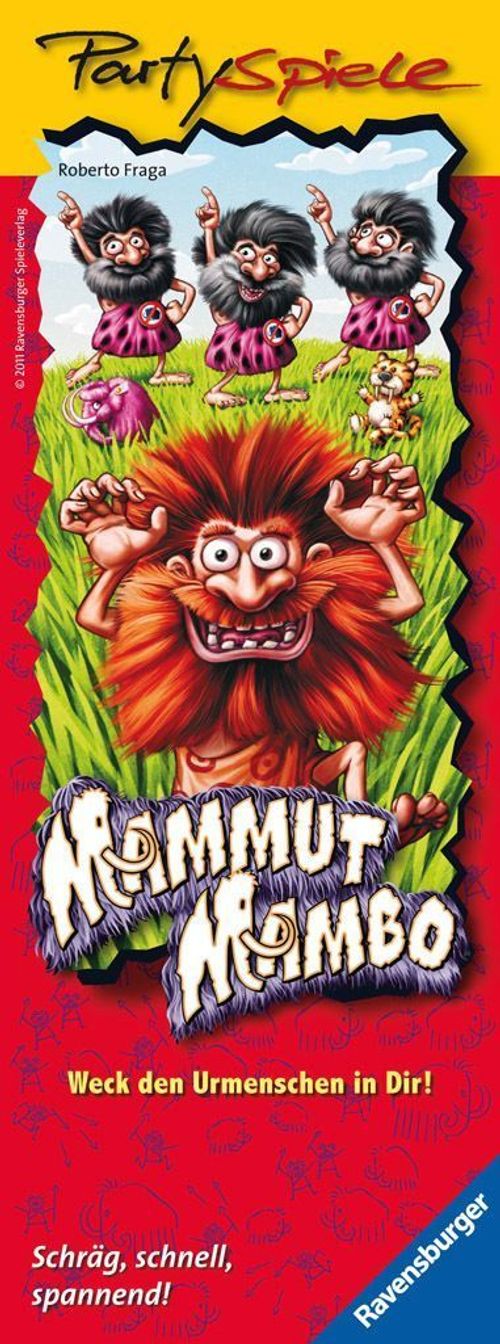
Mammut Mambo
Mammut Mambo Rulebook
Table of Contents
Table of Contents
Contents
60 Mambo cards, of which:
- 53 gesture cards
- 7 hunt cards
5 wooden mammoths (4 brown, 1 pink)
1 tribal leader stand
1 timeline with a Stone Age stone
Setup
Shuffle the Mambo cards well and deal them face down, evenly, to all players. Each player keeps their cards in a face-down pile in front of them.
Then place one wooden mammoth fewer in the middle of the table than there are players. The pink mammoth is always in play. Mammoths form loose herds, so do not place the figures too close together. The herd should be easy for everyone to reach.
Now assemble the tribal leader stand and set it up in front of the player who most resembles a Homo neanderthalensis (small tip: pronounced brow ridges and dense body hair are clear indications ...). That player is the tribal leader.
Place the timeline somewhat apart on the table. Put the Stone Age stone on the Neanderthal at the far left of the timeline.
Object of the Game
The players try to get rid of all of their own cards. To do so, they must dance the Mammut Mambo as error-free as possible. A player who does not perfectly master the choreography collects the played cards as a penalty. The same fate befalls the player who comes away empty-handed in the mammoth hunt.
Gameplay
The Mambo cards show Neanderthals making seven different gestures, each combined with a shout. Each gesture always goes with the same shout. Each gesture appears with two different backgrounds, once in the cave and once outdoors. Some Mambo cards show mammoths instead of gestures; their elephantine meaning is explained later.
Translator's note: the German manual promises that the meaning of the mammoth cards is explained later, but the text does not state it explicitly in a separate passage; it appears only in the mammoth hunt (Step 4) and its illustration. The text is reproduced as printed.
Tip: The very first Mammut Mambo?
- Before the first game, look at all the gestures and shouts together and try them out.
- To work your way into the Mammut Mambo slowly, skip Step 3 at first.
- Look at the examples.
Step 1: The Mambo basic step
- The tribal leader begins. They turn over the top Mambo card of their pile as quickly as an arrow. To avoid any advantage, they turn the card face up away from themselves. The card is laid face up and clearly visible in front of their pile.
- As soon as the card is laid out, all players (as simultaneously as possible) call out the word printed on the card and simultaneously make the gesture shown.
- If nobody has made a mistake (see page 5), the next player clockwise takes their turn: they likewise turn over their top card and lay it face up in front of their pile. All players first perform the shout and gesture of the newly turned card, and then the shouts and gestures of all cards already lying face up, starting with this card and working through them again. The next player clockwise then turns over their top card, and the dance again starts with this card and runs through all face-up cards, and so on.
Basic step correct? For the direction of play, the card background is important ...
Step 2: Cave Mambo
If the newly turned card shows the Neanderthal outdoors, all face-up cards are danced clockwise (shout and gesture). If it shows the Neanderthal in the cave, all face-up cards are danced counterclockwise.
As a reminder: new cards are always turned clockwise, but the dancing sometimes goes counterclockwise.
Example Step 1: Basic step. Player 1 begins. They draw the card Bunga from their pile and lay it face up in front of them: all players simultaneously call out "Bunga" and make the matching gesture. Then it is Player 2's turn. They turn over the card Umba: all players now first do Umba and its gesture, and then Bunga and its gesture.
Example Step 2: Cave Mambo. Player 3 is up. They draw the cave card Roarrr. Because the Roarrr card shows the Neanderthal in the cave, the dance goes counterclockwise after Roarrr and its gesture. That means all players next do Umba and its gesture, and then Bunga and its gesture. If the Roarrr card had shown the Neanderthal outdoors, the players would have danced the cards clockwise.
Step 3: Identical cards
If two or more cards with the same gesture lie face up, you perform only the gesture for each of these cards, not the shout! The background and the position of these cards do not matter. All cards that lie face up only once are danced as usual, with gesture and shout.
Mambo Star: The error-free round! If no player has made a mistake for one full round, each player now has one face-up card in front of them. The game simply continues. The newly turned card covers the card already lying face up. So only one card per player is ever visible at a time (see the example "new round").
Mambo Dud: One dancer steps out of line! If one of you makes a mistake in the choreography, they are punished! A mistake counts as any of the following three things. A player ...
- makes the wrong gesture or the wrong shout,
- makes a shout even though the card is shown more than once (Step 3),
- lags too far behind the rest of the tribe (or does nothing at all).
As a penalty, they take all the played cards and place them face down under their pile. In borderline cases, the tribal leader decides whether someone has made a mistake. If several of you make a mistake at the same time, the face-up cards are divided evenly among those players. If cards are left over, the tribal leader decides who receives the surplus cards. For harmony within the tribe, they divide them as fairly as possible.
What happens next? A new round begins: whoever made the mistake now turns over the first card. If several players made a mistake, the one of them who sits closer to the tribal leader in clockwise order begins.
Example Step 3: Identical cards. Player 4 is up. They draw the cave card Bunga from their pile. Because another Bunga card already lies face up (with Player 1), all players perform only the gesture, not the shout. Since it is also a cave card, the dance continues counterclockwise: Roarrr (shout and gesture), Umba (shout and gesture), Bunga (gesture only!).
Example new round. Player 1 is up again. They draw the card Toc Toc Toc and cover their Bunga card with it. Now all players perform the gestures and shouts of the four visible cards according to the rules. (Because only one Bunga card now lies face up, in contrast to example 3, the players must give the shout again alongside the gesture.)
Step 4: Mammoth hunt
When a hunt card is turned over, the whole tribe goes on a mammoth hunt. Each player tries to snatch a mammoth from the middle of the table as quickly as possible (and each player only one mammoth!). But a mammoth is not just a mammoth. The "hunter of the pink mammoth" is especially honored: they become the new tribal leader!
- As a reward, they receive the tribal leader stand and distribute 1 card each from their pile to two players of their choice.
- There is work for them too: on the timeline they move the Stone Age stone forward one space.
- The mammoths venture back into the middle of the table.
- The mammoth hunter who came away empty-handed must place all face-up cards under their pile. They begin the new round.
Example Step 4: Mammoth hunt. Player 2 turns over a hunt card from their pile. Now all players try to catch a mammoth as quickly as possible. Whoever does not catch one receives all the face-up cards. The hunter of the pink mammoth may give two of their cards to other players.
Game End
The game ends immediately if either of the following occurs:
a) A player has turned over the last card of their pile and, while dancing through the cards afterwards, has made no mistake. This player becomes the "Neanderthal of the Month". The same applies if the tribal leader no longer has a card because of dealing cards.
or
b) After the 7th mammoth hunt the Stone Age stone reaches the last space of the timeline. The mammoths have now sadly become extinct, and rewards and penalties are handed out one last time. Then all players count their cards. Whoever has the fewest cards in their pile becomes the "Club King" and wins the game.
In the event of a tie, the tribal leader decides which of those tied has won.
Variant: For an even more turbulent game
The tribal leader distributes the wooden mammoths in the cave (or in the room, if you are playing there) instead of placing them in the middle of the table. All players must know where the mammoths are. For safety reasons, it is advisable not to hide the mammoths among the expensive wine glasses or in the basket of the biting house dog.