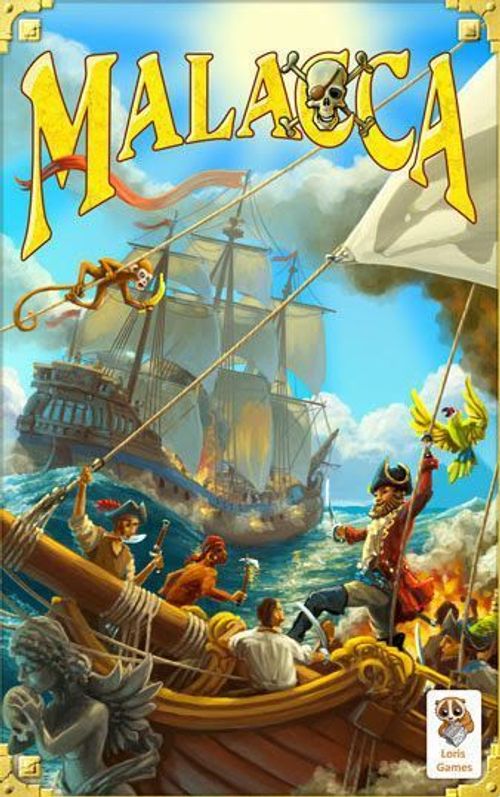
Malacca
Malacca Rulebook
Table of Contents
Table of Contents
Components
- 12 ship cards
- 24 common action cards, of which:
- 8 red Attack (+1) cards
- 8 blue Defence (+1) cards
- 8 green Trade (×1) cards
- 16 special action cards, of which:
- 4 red Attack (+2) cards
- 4 blue Defence (+2) cards
- 4 green Trade (×2) cards
- 2 red-blue Wait cards: Attack or Defence
- 2 blue-green Wait cards: Defence or Trade
- 40 silver coins
- 20 gold coins (worth 5 silver coins each)
- 15 double-sided chest tokens (worth 10 / 20 silver coins)
- 1 captain card
- 8 character cards
- 12 equipment cards, of which:
- 4 Attack + 3 silver equipment
- 4 Defence + 4 silver equipment
- 4 Trade + 5 silver equipment
Setup
- Shuffle the ship cards and place them face down in the middle of the table. Place the money tokens beside them.
- Shuffle the special action cards and place them face down next to the ship deck.
- Each player receives 3 common action cards: Attack, Trade and Defence, and 5 silver coins.
- Determine the captain by lot. The captain places the captain card in front of them.
Goal of the Game
- The outcome of each round depends on how the other players act. If you can guess their intentions, you can use this to your own advantage. The goal of the game is to have the most money at the end of the last round. In case of a tie, the tied players share the victory.
Round Overview
Each round consists of the following phases:
1. Arrival of a Ship
Take the top card from the ship deck and place it face up in the middle of the table. Place on the ship card a number of silver coins equal to the value of the cargo it carries.
2.1 Pirate Actions: Betting
Starting with the captain, all players place one action card face down in front of them, together with any number of coins as their bet for the round (it is not necessary to bet anything). When all players have played, all action cards are turned face up at once and the result is resolved. One of the following situations may arise:
- a) If the total of all Attacks on the played action cards is higher than the total of all Defences, the ship is captured.
- b) If the total of all Attacks on the played action cards is equal to or lower than the total of all Defences, the ship is defended.
2.2 Pirate Actions: Payout
Traders (players who played a Trade card)
- a) Captured ship
- Traders lose all the money they bet. This money is added to the ship's cargo and is divided among the attackers.
- b) Defended ship
- Traders take back all the money they bet and, in addition, take from the bank the same amount they bet.
- Special rule: Scrubbing the Deck: If a player has no money at all, they may still play a Trade card. Even if they bet nothing, they take 2 silver coins from the bank in this case.
Attackers (players who played an Attack card)
- a) Captured ship
- Attackers take back their own bet.
- They divide all the money from the ship and all the bets of the defenders and traders among themselves. Money is always divided one silver coin at a time, clockwise, starting with the player holding the captain card.
- b) Defended ship
- Attackers lose all their bets, which are divided among the defenders.
- In addition, they hand over to the bank half of all their remaining money (rounded down), as they were caught attempting piracy.
Defenders (players who played a Defence card)
- a) Captured ship
- Defenders lose all their bets. This money is added to the ship's cargo and is divided among the attackers.
- Special rule: Tragic Hero: If a player was the only one to play a Defence card and all other players played Attack cards, that player still loses their bet, but may take one special action card from the face-up pile in the middle.
- b) Defended ship
- Defenders take back all their bets and, in addition, divide among themselves all the bets of the attackers.
- At the same time, each defender takes one special action card from the face-up pile in the middle as a bonus.
- CAUTION! Pointless (unnecessary) defence: If nobody played an Attack card, the defenders receive no money and do not take a special action card; they may only take back all their bets.
3. End of the Round and Moving the Captain
- Players take back into their hands the common action cards they played.
- The captain card moves clockwise to the next player.
4. End of the Game
- The game lasts a total of 12 rounds, which corresponds to the 12 ship cards that pass through the Strait of Malacca one after another. The game ends after the last ship has passed through the Strait of Malacca.
Special Action Cards
- Each player obtains a special action card by successfully playing a Defence card.
- A player may play a special action card at any time during the game instead of a common action card.
- Special action cards are single-use. After the round in which a special action card was played, it is placed at the bottom of the special action card deck.
The special action cards are:
- Attack +2: Counts as a common Attack card with an Attack value of 2.
- Defence +2: Counts as a common Defence card with a Defence value of 2.
- Trade ×2: Counts as a common Trade card, but on a successful trade the player receives from the bank twice the amount they bet.
- Wait Attack / Defence: After all played action cards have been revealed, the player chooses whether to play either a common Attack action or a common Defence action.
- Wait Trade / Defence: After all played action cards have been revealed, the player chooses whether to play either a common Trade action or a common Defence action.
Captain Morgan's Advice: Basics of Strategic Thinking
Malacca has simple rules, but it opens a wide range of strategic options that beginners can easily be confused by. There is no randomness in the game; everything depends on correctly estimating the intentions of the other players. So what should you orient yourself by? For well-considered decisions it is important to understand when it is advantageous to play which action:
Trade
The greatest profits can be achieved if you manage to double your stake by trading. However, if everyone thinks the same way, i.e. they all play Trade and bet heavily, a single attacker is enough to capture not only the ship's wealth but also all the traders' stakes. If you suspect that the ship will be defended even without your contribution, bet everything you have on the Trade card.
Attack
Attack is especially worth playing when you are convinced that the other players are trading and have bet a lot of money. If the players before you have placed a lot of money on their cards, you can try to steal it from them. Attack is also good when a rich trading ship is in the harbour.
If you have little money, it is not always best to attack only – rich players will then easily play Defence and gain further advantage in the form of special cards.
Defence
The Defence action is played especially against rich pirates, who can thus lose up to half of their fortune. With a successful Defence you additionally gain a special action card, which can help you a lot. The worst case is playing Defence when everyone else is trading – you get nothing and they calmly double their stakes.
When deciding, the following factors may also help you:
Size of the bets
Trade is the only action on which it really pays to bet some money. Betting on Attack or Defence only pretends that you are trading, in order to confuse the others.
- A high bet provokes the other players to attack – if you really did play Trade and the ship was not captured, you would gain an advantage over them.
- A low bet suggests that you are probably not trading, because it would pay you too little.
Position at the betting
If other players still act after you, they may judge from your bet what you most likely played. A high bet indicates that you are trading. Conversely, no bet most likely indicates Attack or Defence.
- As the last to bet, you have the chance to guess the actions of the others, and therefore a great advantage. You may, for example, afford to play Trade and bet a lot if you think the ship will be defended.
- If you play Attack or Defence last, bet nothing – there is no one left to deceive, and you could lose your bet in case of failure!
Value of the ship
It is more profitable to attack large ships, because there is more money on them. Small ships are more often traded on. This basic logic can, however, be turned against the other players and used to outwit them.
- If a ship with a small cargo arrives, try to pretend to trade with a medium-sized bet, but attack in fact. If the others take the bait and trade, they will also be the ones who lose their bets to you.
- If a large ship arrives, its cargo is a great temptation. You may therefore try playing Defence to catch the other players attacking. Playing Trade on a large ship is quite risky, precisely because someone will likely try to capture it anyway.
Wealth of the pirates
- The richer you are, the more it hurts to be caught in a failed attack – you lose half of the money you have accumulated. For this reason, rich players usually attack less than players without much wealth. This can be exploited, for example, by betting large amounts on Trade against rich players and thus slowly catching up with them.
- Conversely, the poorest pirate often attacks out of desperation. Defence can easily be played against them, gaining a special card in the process.
Morgan's Advice for Intermediate Players
Once players understand the basic dynamics of the game, Malacca reveals further intricate layers of strategic thinking. If you want to win, you must find a way to gain an advantage over the others.
Know your enemy!
The basic tactic is to understand how the others think, and then to be tougher, bolder and more impenetrable than they are. Imagine that you are in the situation of your fellow players, weighing risks and making the choice that should secure you victory. Consider how the players before you and after you played, who risks what and how much, who stands between you and victory, and who is irrelevant. If you understand how the others want to win, you can make decisions yourself that gain you an advantage or minimise the risk of loss.
Set a trap!
The last players in each round have a strategic advantage, because they know the bets of the players before them and can decide better. Beginning players need not despair, however. They can influence the others with their bet.
- If at the right moment I bet a large amount, I can make the other players believe that I am trading. This will provoke an attack. But if I actually bet the amount on Attack and not on Trade, I join my strength with their attack against the defending players.
- In the same situation, it may be better to play Defence instead. If the attacking players have more money than the defenders, a successful defence lets me take half of their wealth, which may be much more than I would gain from sharing the spoils as an attacker.
Use the special rules!
Show off your piratical skill with an unexpected decision.
- A rich ship has arrived in the harbour. The beginning players attacked, and the others looked at it and joined them. It is clear that the ship will be captured. Trading no longer makes sense, but the Tragic Hero allows you to gain a special card, which is more valuable than a share of the loot divided among many pirates.
Extension: Characters
When setting up the game, each player draws a character card and places it face up in front of them. They tell the others for whom they are playing and what their special ability is. At the start of the game, instead of 5 silver coins, they receive the amount shown on their character card.
- Henry Morgan: starts with 5 silver coins.
- If they successfully play a Defence card, they take 3 silver coins from the bank.
- This also applies to a successful Defence +2 special card, or to a Wait Trade / Defence or Wait Attack / Defence special card, if they choose to use the Defence.
- Pierre Le Picard: starts with 3 silver coins.
- At the end of each round, they take 1 silver coin from the bank.
- Rodrigo Orgoñez: starts with 9 silver coins.
- Has no special ability, but a lot of money to start with.
- Black Caesar: starts with as many silver coins as there are players in the game.
- If all players play the same type of action card, they receive as many silver coins as there are players in the game. This also applies if one of the played cards was a special action card of that type (Attack, Defence or Trade), or a special Wait card, if the player finally chose an action of that type.
- Zheng He: starts with 3 silver coins.
- If they successfully play a Trade card, they take an extra 3 silver coins from the bank at the end of the round. This also applies to a successful Trade ×2 special card or a Trade / Defence special card, if they choose to use the Trade.
- Sayyida al Hurra: starts with 5 silver coins.
Extension: Equipment
At the start of each round, before the new ship card is turned over, each player in order starting from the starting player may buy one equipment card. Each equipment card costs 5 silver coins. The player lays it in front of them, and it stays with them until the end of the game. It is possible to buy more than one equipment card of the same type during the game; their rewards are then added together. When equipment cards run out, no further equipment of that type can be bought. There are three types of equipment cards in the game:
- Better Attack: When successfully playing an Attack card (the ship is captured), the player with this equipment card takes an additional 3 silver coins from the bank.
- Better Defence: When successfully playing a Defence card (the ship is defended, provided at least one player attacked), the player with this equipment card takes an additional 4 silver coins from the bank.
- Better Trade: When successfully playing a Trade card (the ship is defended), the player with this equipment card takes an additional 5 silver coins from the bank at the end of the round. Better Trade cannot be used if the player bet nothing on the Trade card.