Makruk
Makruk Rulebook
Table of Contents
Table of Contents
Beginning the Game
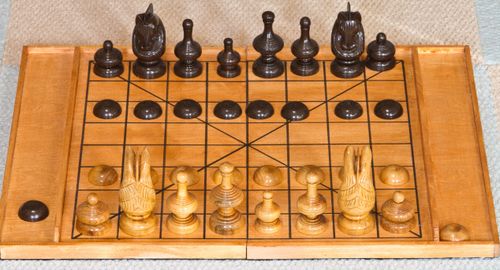
- The game begins with the pieces set out as in Illustration 1.
- The player controlling the white pieces begins the game.
Illustration 1: Mak-ruk pieces set out ready for play. From the bottom left the pieces are the boat, horse, nobleman, lord and minister, with cowries out in front.
How to Play
Mak-ruk is played by two players on a board of eight rows of eight squares, each having a set of sixteen pieces. The pieces are the lord, the minister, two noblemen, two horses, two boats, and eight cowries.
Moving the Pieces
-
A player in his turn moves one of his pieces according to that piece's particular mode of movement:
(i). the lord can move to an adjacent square in any of the eight directions;
(ii). or on his first move of the game, the lord can move as a horse: see rule 3(vi);
(iii). the minister can move to an adjacent square in any of the four diagonal directions;
(iv). or on his first move of the game the minister can move two squares directly forwards;
(v). the noblemen can move to an adjacent square in any of the four diagonal directions, or to the adjacent square straight forward;
(vi). the horse moves one square in a vertical or horizontal direction, and one further square diagonally away from his current position, jumping over any piece that might be in the way;
(vii). the boat moves as many squares as is convenient in a straight line horizontally or vertically, though it cannot jump over pieces in the way;
(viii). the cowrie moves one square directly forward.
-
When a cowrie reaches the sixth row, it is turned upside down and moves from then on like a minister.
-
There is no limit to the number of such promoted ministers in play at one time.
Illustration 2: the moves of the Mak-ruk pieces. Note that the cowrie moves differently when capturing.
Capturing Enemies
-
A cowrie may capture an enemy piece by moving one square diagonally forwards to land on that enemy.
-
Other pieces capture enemies by landing on the enemy in the course of their usual move.
-
Captured pieces are removed from the board and take no further part in play.
-
A lord may not be captured, but may be threatened with capture.
-
If a lord is threatened with capture, termed check, his player must immediately remove the threat by moving the lord out of danger, capturing the piece that threatens him, or otherwise interposing a piece to protect the lord.
Ending the Game
-
The game is ended when a player's lord is threatened with capture such that threat cannot be evaded. This is checkmate, and the player whose lord is thus threatened loses the game.
-
The game is also ended when a player cannot move any piece without exposing his lord to the threat of capture. This is stalemate, and is a draw.
-
When one player's army is reduced to just his lord, his opponent must win the game within a prescribed number of moves, otherwise a draw is declared. The number of moves depends upon the composition of the stronger player's pieces, and is given in Table 1.
-
If the stronger player has some composition of pieces not listed, then no limit on the number of moves applies.
Table 1: number of moves allowed for checkmate against a lone lord.
| Pieces Left | Moves |
|---|---|
| Two boats | 4 |
| One boat | 13 |
| Two noblemen | 18 |
| One nobleman | 41 |
| Two horses | 29 |
| One horse | 63 |
| One minister | draw |
| Minister and two cowries | 83 |
| Minister, nobleman, horse, boat | 10 |
Further Information
Readers interested in finding out more about the game of Mak-ruk can look in the following books:
- Bell, R. C. Board and Table Games from Many Civilizations, vol. 2, pp. 31-33. New York: Dover Publications, Inc., 1979.
- Bell, R. C. Discovering Old Board Games, p. 26. Aylesbury: Shire Publications Ltd., 1980.
- Murray, H. J. R. A History of Chess, pp. 113-117. Oxford: The Clarendon Press, 1913.
- Parlett, D. The Oxford History of Board Games, p. 295. Oxford: Oxford University Press, 1999.