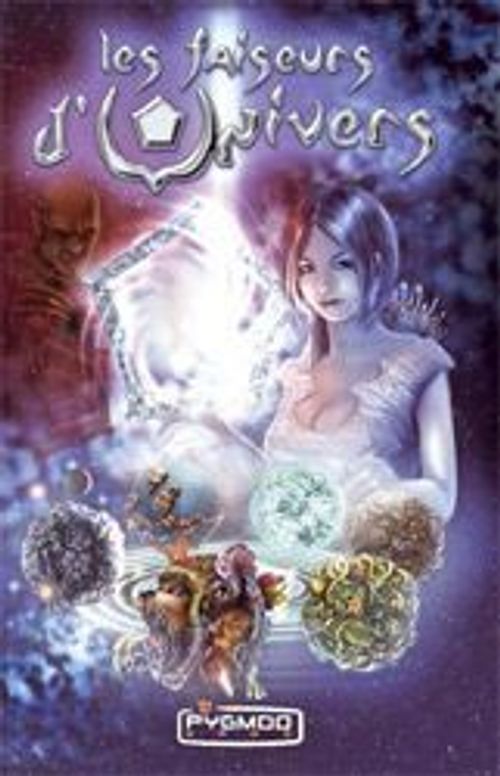
Makers of Universe
Makers of Universe Rulebook
Table of Contents
Table of Contents
Game Contents
The card game "The Makers of Universe" consists of:
- 110 playing cards
- 10 Character cards
- 18 Machine cards
- 15 Door cards
- 67 Resource cards
- 30 blue tokens "Energy Units" (UE)
- 1 black "Preum's" pawn
- 1 rules sheet
Goal of the Game
You are one of the "Makers of Universe" and your goal is to be the first to build a world. To do so, you must obtain creation Machines and develop your world while hindering your opponents.
Setup
Each player is given 5 UE tokens and 5 Resource cards. The remaining UE tokens are set aside and make up the "Bank".
Each player also receives 3 Door cards, which they place in front of them: 2 face "inactive" and 1 face "active". The youngest player receives the "Preum's" pawn.
A draw pile is made of the Machine cards, and a pile is made of the Resource cards. The Character cards are set aside.
The Characters
Shuffle the Character cards. Once shuffled, each player chooses one of them face down. Once the card has been drawn, each player may read their character aloud and then place it in front of them face up.
Each character is unique and has a particular power stated on its card. Each power is powerful enough to swing a game. Do not neglect it, and build your strategy around it.
Card Details
The printed diagram of a card labels four elements:
- Card type symbol
- Card title
- Creature type symbol
- Card text
The diagram shows the card "CERBERUS" as an example. Its text reads: "Faithful monster, the Cerberus spends its life protecting the greatest fortunes. When attacking, it allows taking 2 UE from the bank. When defending, it allows protecting its UE from enemy attacks."
Symbol List
- Traps (skull and crossbones)
- Creature (seahorse)
- Action (hand)
- Evolution (planet)
- Attack creature (flame)
- Defence creature (snowflake)
- Machine (gears)
- Character (figure of a person)
Sequence of Play
The game is played in turns. A turn consists, in order, of a buying phase and an action phase.
Buying Phase
Take a Machine card from the draw pile and place it face up on the table.
Each player then bids to buy the machine: to do so, they put into their closed fist the number of UE they wish to bet. When all players have extended their closed fist towards the centre of the table, open all the fists and reveal your bids.
The player who made the highest bid takes the Machine card, and their bid is returned to the Bank. The other bids return to the hands of their owners.
In case of a tie, the tied players hold a new bid between them. If the tie lasts for more than 3 rounds, the sale is cancelled and the machine returns to the draw pile.
The purchase of a machine obliges the player to bring it immediately into their world. To do so, they must activate as many doors as specified on the Machine card they have just won. The player simply turns one or more of the Door cards they have in front of them to their "active" face. The player chooses which doors to activate. Once this duty is fulfilled, they place their newly acquired Machine card in front of them, in their world.
A player may have as many Machine cards as they wish in their world, even identical ones: all the creation points of the Machine cards count.
When two machines have been put up for auction, the game moves on to the action phase.
Notes on Machines
The Palace cannot be destroyed, neither by a Ravager Cannon nor by any creature. If a second Palace is installed on a world, that world yields only one victory point from it.
The Ravager Cannon can only be used against a world if that world has an active, untrapped door.
Activating a Door
On their turn, a player may, if they wish, activate one or more of their doors by simply turning the corresponding Door card over to its "active" face.
WARNING: the reverse is not possible, and an active door can never be deactivated!
Destroying an Enemy Machine
Certain creatures or certain Action cards allow destroying enemy machines. When a player has a machine destroyed, they must count the cards in their hand: if they hold more than 8, they must discard half of them, rounded down.
Note: some cards have an action using the formula "half of ...". In these cases, halves are always rounded down.
End of Turn
When a player has finished their actions, they pass the turn to the player on their left. That player then plays, and so on until the end of the round of the table. The player who began the turn then passes the "Preum's" pawn to the player on their left, and a new turn begins: it is time for a new buying phase.
End of Game
If, at the end of a turn, one or more players have reached or exceeded the number of creation points required, the game ends.
- If only one player has reached or exceeded the number of points required, they are declared the winner.
- If several players have reached or exceeded the number of points required, the player with the greatest number of points is declared the winner. In case of a tie, the player who reached the required number of points first wins.
Creation points are shown on the cards by stars:
- Machine cards are worth 0 to 3 creation points.
- Evolution cards are worth 2 creation points.
The table below is a suggestion that you may modify by common agreement with the players for each game.
| Number of players | Number of points required to claim victory |
|---|---|
| 3 | 11 |
| 4 | 9 |
| 5 | 7 |
Action Phase
During this phase, players use the cards they hold to take actions. As its name indicates, the player holding the "Preum's" pawn begins.
- Draw: On their turn, a player has the choice between drawing 2 "Resource" cards, taking 2 "UE" tokens, or taking one of each.
- Actions: On their turn, a player may play the cards they hold, until they no longer wish or are able to act.
The player may then carry out the following actions:
- Play one or more creature cards (defend their world, attack a world, destroy an opponent's machine, etc.)
- Trap a door
- Place an Evolution card
- Discard
- Activate a door
Playing a Creature Card
Creature cards may be played to attack a world (see "Attacking a World"). The player is free to play as many as they wish, on different worlds or on the same one.
If the card specifies it, a creature may also serve for defence: in this case the player places it in front of them, in their world. A creature placed in defence may perfectly well be launched in an attack on the following turn.
ATTENTION: A player may not have two identical defence creatures in their world.
Trapping a Door
To trap a door, the player places a "Trap" card, face down, under one of their doors. A player may trap an active or an inactive door, and may trap all of their doors if they wish.
A card placed under a door can no longer be recovered by its owner.
TIP: Since they are placed face down, players are free to put any card under a door, whether or not it is a Trap card. A card placed under a door that is not a trap will not stop a creature trying to pass, but will play the role of a decoy, which may dissuade your opponents from attempting the attack.
Attacking a World
To attack a world, the player must place a Creature card in front of an active enemy door, in the hope that their creature will be able to cross the inter-dimensional passage.
- If the door is not trapped, the creature enters the attacked world, and the effects of the creature are applied immediately. The creature is then discarded.
- If the door is trapped, the attacked player must reveal the card they placed under the door.
- If that card is in fact a Trap card, the effects of the trap apply, then the card is discarded (unless a special note on that card states otherwise).
- If that card is a decoy, it is discarded and the creature enters the world. The effects of the creature are applied immediately, then the creature is discarded.
ATTENTION: It is forbidden to attack a world during the first turn of the game.
Placing an Evolution Card
To place an Evolution card in their world, the player must use the corresponding Machine card. The machine to use is shown at the bottom of the Evolution card.
- Either the player owns that machine in their world, in which case they have the right to place their Evolution card without further process.
- Or the player does not own it, and may then attempt to use the opponent's machine by means of a Scientist Android (creature card). To do so, they must send the android into the universe concerned (see "Attacking a World").
ATTENTION: A player may not have two identical Evolution cards in their world.
Using an Action Card
You may use Action cards at any time in the game: on your turn, during your opponents' turns, during the buying phase or during the action phase.
You may also play these cards on an opponent without needing to enter their universe, and therefore without needing an active door to pass through.
Discarding
During their turn, a player may exchange cards from their hand with the draw pile, at a rate of 3 discarded cards for 1 card drawn.
Turn Summary
This section reproduces the "Résumé d'un tour de jeu" quick-reference panel printed on the rules sheet.
Phase 1: Machine Purchase
- Draw a Machine card and place it face up on the table.
- Each player puts a certain number of UE in a closed fist in front of them to buy the machine.
- The player with the highest bid takes the machine and activates the number of doors required.
- Players repeat this phase for a second machine.
Phase 2: Actions
- Draw: On their turn, each player may choose between drawing 2 Resource cards, taking 2 UE tokens, or taking one of each.
- Actions: On their turn, each player may play cards from their hand, until they no longer wish or are able to act. The player may then carry out the following actions:
- Play one or more creature cards (defend their world, attack a world, destroy an opponent's machine, etc.)
- Trap a door
- Place an "Evolution" card
- Discard
- Activate a door
Action Cards
At any moment, each player may play one or more "Action" cards.
The Winner
If, at the end of a turn, one or more players have reached or exceeded the number of creation points required, the game stops.