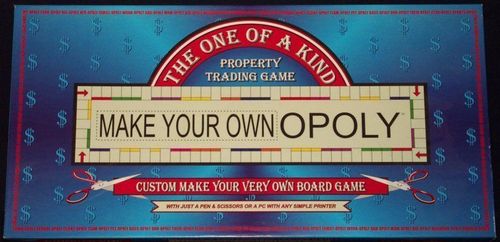
Make Your Own Opoly
Make Your Own Opoly Rulebook
Table of Contents
Table of Contents
The Object of the Game
To accumulate the most wealth by buying, selling and trading properties, collecting rents and various other means.
Equipment
You should have 1 Game Board, 2 Dice, 6 Colored Game Tokens, 12 Good News Cards, 12 Bad News Cards, 24 Property Deed Cards and 50 each of the 4 denominations of Play Money.
The Set-up
Choose a Treasurer as the distributor of the cash and property deed cards. Each player receives The following bills: 2- $5,000 bills; 4- $1,000 bills; 5- $500 bills and 5- $100 bills.
Set the game board up and place the Good News and Bad News Cards in their respective places on the board. After each player chooses a color and places his or her token on the starting space, play is ready to begin.
Game Play
Players each take a turn throwing the dice. The player with the highest total goes first by throwing the dice again and moving the appropriate number of spaces clockwise around the board. Play continues as each player takes a turn in a clockwise rotation.
Throwing Doubles
A player who throws doubles receives another turn. There is no limit to the number of consecutive doubles thrown.
Buying an Unowned Property
Each property has a purchase value indicated by a price shown at the top of each board space. When landing on an unowned property space, a player may purchase that property by paying the Treasury the price shown. In exchange, the player receives that property deed card.
Landing on an Owned Property
When a player lands on a property that is own by another player, a rental fee must be paid by that player to the owner. Rental rates are specified on each deed card.
Rental Fees
If a player owns more than one property in a color group, the rental rate of each property increases. They also increases if a player owns an entire color group or an entire side of the board. See each deed card for details.
Selling or Trading a Property
During a turn, each player may offer to buy, sell, trade or auction properties. The time allotted for negotiation is 2 minutes. A player may make 2 transactions per turn.
Mortgaging a Property
If a player does not have enough cash to pay a rental fee or penalty, that player must either sell or mortgage properties. A mortgaged property deed card must be turned face down. No rentals may be collected on a mortgaged property. The loan value of a mortgaged property appears on each deed card. To release the lien on that property, the owner must pay back to Treasury that loan amount plus 10% interest.
Board Spaces
START
Players collect $2,000 each time they pass or land on the starting space.
LOSE A TURN
A player landing on the space must throw doubles to get out.
FREE SPACE
Fines and penalties are deposited on this space. A player who land on this space collects all the cash that has been collected there.
Good News/Bad News
When landing here, pick the top card from the appropriate stack and perform what is stated.
FATE
Players landing here throw the dice again. Throw an even number and pick a Good News card. Odd numbers must pick a Bad News card.
PLAY LOTTO
Land here and bet from $100 to $500 on another role of the dice. Odds payoffs are listed on each Lotto space. Players do not move again on their second roll of the dice. Lost bets go to the Free Space.
The End of the Game
The game shall end when:
-
A pre-determined amount of time has expired (usually 60 to 90 minutes) or
-
When two players have become bankrupt.
The player with the highest net worth, as determined by adding cash to the value of the properties owned, is the winner.