Make 'n' Break: Party
Make 'n' Break: Party Rulebook
Table of Contents
Table of Contents
Components
- 1 game board
- 1 stopwatch
- 10 building blocks
- 100 building cards
- 60 object cards
- 1 pair of cardboard glasses
- 3 wooden pawns
Object of the Game
Each team tries to complete as many tasks as possible. The better the team performs the tasks, the faster it advances along the game board to the finish.
Setup
Place the game board in the middle of the table, with the stopwatch and the glasses beside it. Each team places its pawns on the start space, marked with a yellow arrow.
Shuffle the building cards and place them face down on the left side of the game board. Shuffle the object cards and place them face down in the middle of the game board. The right side is left free and is used for played cards.
How to Play (Basic Game for 4–6 Players)
The team that starts takes 10 building blocks. Before the game starts, the team assigns roles within the team.
One player from the team takes a building card or an object card and does not show it to the other members of their team. The other players must build what is pictured on the card, following the instructions of the single player who saw the card. Each turn the players change roles. If the task is completed correctly, the team moves 1 step forward.
The other team, usually the team that moves next, starts the timer and watches it, and also makes sure the active team does not break the rules. To do this, it must also look at the card.
The game contains building cards, purple, with pictures and words at the bottom, and small green object cards with words.
There are 100 building cards in total. 80 of them show buildings that must be built vertically. 20 show emotions, which must be laid out flat on the table.
Object cards have 2 words on them, one black and one red. Before the turns, the players must choose which colour of words they will build for during the game.
Depending on which space the team's pawn is on, the completion of the task differs somewhat.
Board Spaces
-
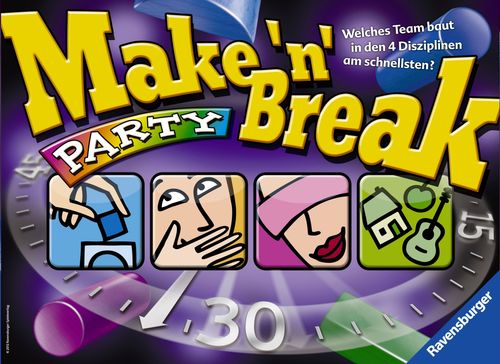
Blue space with a picture of a hand, a dark-blue die and an arch (Normal). The game proceeds without change under the rules described above. One player describes and gives instructions, the others build. If the team completed the task correctly and the time has not yet run out, they may, without risk of losing a point, take one more card, break the previous structure and begin the new task. After completing the second task they may again break it down and take another card, and so on. Accordingly, when time runs out they may move forward 1, 2, 3 or more spaces.
-
Yellow space, a person covering their mouth with a hand (Forbidden Words). The player who describes the structure on the card is forbidden to say certain words in any form. They are written at the bottom of the card. The checking team must know these words and make sure they are not said. Otherwise the rules remain unchanged.
-
Pink space, a person with blindfolded eyes (Blindfolded). Only one player from the team takes part in the building. They must put on the cardboard glasses and build the required figure blindfolded!
Tip: before putting on the glasses and starting to build, the builder is advised to lay out the building blocks in some kind of system, so that they are easier to identify by touch.
-
Green space with a picture of a guitar, a house and an apple. An object card is played. The player whose turn it is to take a card says nothing and becomes the builder themselves. They must build a symbol, image or structure that reflects the word on the card. No words may be spoken during this! Sounds, gestures and the like are allowed. When the building is finished, the other players on the team must guess the word written on the card. The checking team, as always, makes sure the rules are followed.
End of the Game
The game ends as soon as a team has completed a full circuit and returned to the start space. That team wins.
Variations
For 9 players: It is usually assumed that each team has 2 players, but there may be 3. Therefore the maximum number of players is 9. The rules do not change. A team may have 4 or even 5 players, but this is left to the discretion of the players.
For 3 players: If only three players are playing, then at the end of a turn one player moves to the other team. For example, first A+B, then B+C, then C+A. The rules otherwise do not change.