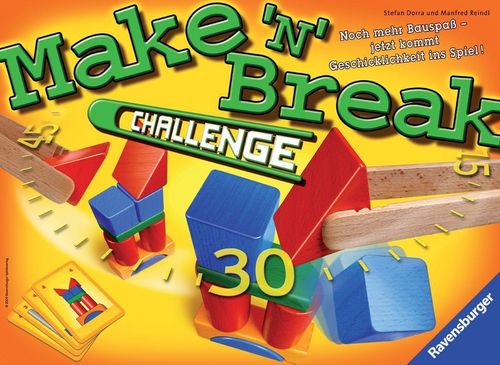
Make 'n' Break: Challenge
Make 'n' Break: Challenge Rulebook
Table of Contents
Table of Contents
Game Materials
- 20 Wooden Pieces (2 identical sets of 10 pieces)
- 2 Forceps
- 80 Building Cards
- 1 Card Holder
Before the first game, the transparent card holder must be assembled. It can be put back into the box this way and no longer needed to be assembled again in future.
Preparation
The card holder is placed at the center of the table. The building cards are well shuffled and put aside as a draw deck. The playing pieces are sorted separately into two identical groups (see illustration) and laid out on the table. A pair of forceps is placed with each group of playing pieces.
Goal of the Game
The players try to create the target illustrated on the building cards as fast as possible with their forceps and playing pieces. Who is more skillfully, will have the most points at the end and wins the game.
Rules for Three and Four Players
The competition is always a duel between two players. Each round consist of three duels. After each player has a duel with their opponents, the game ends.
First, the youngest player compete with the oldest player. These two players are the Active players of the round. The other players are the Inactive players of the round.
Both Active players receives an identical set of playing pieces (a set of 10 wooden pieces) and one pair of forceps. Everything lies before them on the table and may not be touched yet!
One of the Inactive players draw one building card from the draw deck and insert it into the transparent card holder. Then, he/she places the card holder between the two Active players so they can see the card easily. Now, the Inactive player gives a start signal by calling "Challenge" or "Build now".
The both Active players immediately take the pair of forceps in their hand. The other hand rests on the thigh under the table. With the help of the forceps, the players grasp a piece after the other one and build the target, which is illustrated on the building card ("Make").
The following actions are allowed with the forceps:
- Grasp a game piece
- Erect a game piece
- Re-position and/or rotate game pieces
- Build game pieces
The following actions are not allowed:
- Touch game pieces with Hand
- Use the second hand to help
- Grasp the forceps with the bottom half
- Shake/Move the table to collapse the work of the opponent
Whoever had completed the target as required on the building card immediately shouts "Stop!". All players are not allowed to act any more. Now, one of the Inactive players check whether the completed work matches the target of the building card:
- If the work is correct, the faster player receives building card.
- Otherwise, the slower player receives the building card.
The player places the collected building card in front of him and keeps it until the end of the game. Then, both work are destroyed ("Break").
Each Active player again takes all 10 building pieces and his pair of forceps and places them in front of themselves on the table. Now, a new building card is drawn and inserted into the transparent cardholder. On the command of the Inactive player, both Active players build the second work similarly.
The Active players compete three duels against each other each round; i.e., they must complete successively three building cards in the speed contest. The role of Active player is changed after these three duels.
With four players, the Active players become Inactive players, vice versa. With three players, the older Active player continues to play. He/she now competes against the previous Inactive player.
The competition schedule is:
| With 4 players | With 3 players | |
|---|---|---|
| Round 1 | A against D | A against C |
| Round 2 | B against C | A against B |
| Round 3 | A against B | B against C |
| Round 4 | C against D | A against C |
| Round 5 | A against C | A against B |
| Round 6 | B against D | B against C |
Building Cards
There are three kinds of building cards:
- Card that shows an illustration with colored pieces. These cards show, which building must be built exactly.
- Cards with the one large red number (3, 4, 5 and/or 10) and a red arrow pointing upward. This number indicates, how many pieces of arbitrary shape and color must be built on each other. Important: Regardless of the number of pieces, only two building pieces can touch the table!
- Cards, which show grey shapes. These cards show which shapes must be used, without color assignment. Each illustrated shape corresponds to a stone. Important: Regardless of the number of pieces, only two building pieces can touch the table!
In addition, there are with the other grey cards, showing the organ pipes. To fulfill these cards, the Active players must erect six own pieces next to each other from left to right in descending height.
The small red numbers on the top-left and top-right on the building cards indicates the difficulty and at the same time the value of the cards: 1, 2, 3 or 4.
Game End and Scoring
The game ends after the 4th round, after each player has competed against each other opponent once. With three players, the game ends after each player has completed each other opponent twice. (Please refer to the schedule on p.4)
Then, the winner is determined. Each player calculates the total of his/her collected cards. The player with the highest total is the winner. If two players have the same total, they compete each other with an extra duel.
Rules for Two Players
If only two players compete against each other, most of the rules are as described with the following differences:
- To prevent a player has an advance, if a building card is seen previously, the players draw an alternate card and put it into the card holder.
- Six duels will be played. Who has the most points after the six duels is the winner. In case of a tie, they compete each other with an extra duel.
Expert Rules
If players want to reduce luck, sort the building cards according to point value. Card with value 1 are not need and put back in to the box.
The cards with value 2, 3 and 4 are sorted into three separate piles:
- Card of value 2 is used in the first duel.
- Card of value 3 is used in the second duel.
- Card of value 4 is used in the third duel.
In case of a tie at the game end, the final duel is played with building card of value 4.
Tips for Playing with Young Players
Players can agree to play with the building cards of value 1 and 2 first. After some practices, cards of value 3 into are added to the game. Finally, all cards are added to the game.