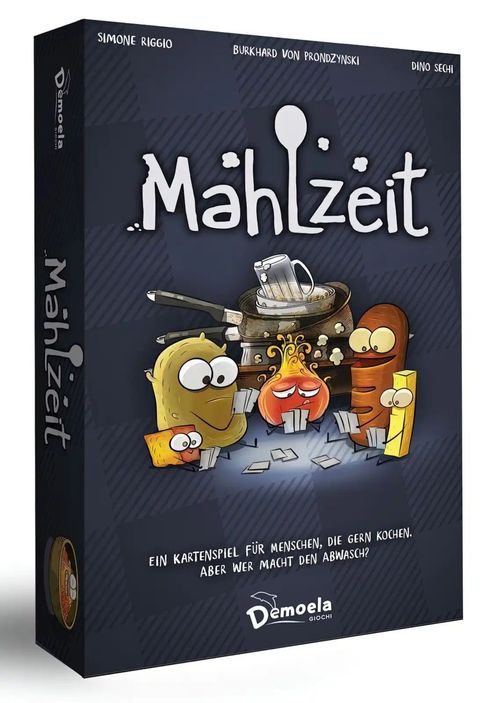
Mahlzeit: Ein Kartenspiel über die traditionelle deutsche Küche
Mahlzeit: Ein Kartenspiel über die traditionelle deutsche Küche Rulebook
Table of Contents
Table of Contents
Contents
- 110 cards:
- 23 dish cards (with light back)
- 83 cards (with dark back):
- 60 ingredient cards, 13 drink cards, 1 Dirty Pots card, 4 Cooking Spoon cards, 5 special cards (variant for advanced players)
- 4 overview cards
- These rules
Setup
- Take the 23 cards with the light back and lay them out as shown (Picture A), sorted by type of dish, starting with the lowest value, in 6 vertical rows. These are the dish goals (Spielziele).
- Now take the cards with the dark back and set aside the Dirty Pots card (Dreckige Töpfe-Karte). Place it to one side.
- Also set aside the 5 special cards (Cooking Hat, Dish Towel, 2x Cutlery and Apron). These are explained later and are needed only for the variant for advanced players. Shuffle the remaining cards and deal 6 cards to each player.
- Lay 5 ingredient cards face up next to each other on the table (Picture B).
- Now shuffle the Dirty Pots card back into the stack and place the stack face down next to the 5 open cards (Picture B).
The person who most recently did the washing-up in a WG begins. If nobody in the group has yet washed a mountain of dirty pots, the youngest person begins.
Dish Goals
These are the dishes according to recipe and point value, laid out on the table.
The dish cards are laid out as in Picture A, sorted by dish and by point value from lowest to highest. The drink icon at the top right of each dish card shows which drink goes with it.
| Dish | Point values (lowest to highest) | Ingredients needed | Drink shown on card |
|---|---|---|---|
| Thüringer Klöße (Thuringian dumplings) | 1, 1, 1, 2, 2 | Kartoffeln (potatoes), Brotwürfel (bread cubes) | Beer or wine (see note below) |
| Rheinischer Sauerbraten (Rhenish sauerbraten) | 2, 2, 3, 3 | Beize (marinade), Bratenfleisch (roast meat) | Beer |
| Currywurst | 2, 2, 3, 3, 4 | Bratwurst, Pommes (fries), Currysauce (curry sauce) | Beer |
| Bayrische Brotzeit (Bavarian snack platter) | 3, 4, 4, 5 | Brezel (pretzel), Süßer Senf (sweet mustard), Weißwurst (white sausage) | Beer |
| Käsespätzle (cheese spätzle) | 5, 6, 7 | Rostzwiebeln (fried onions), Käse (cheese), Spätzle | Wine |
| Rote Grütze (red fruit pudding) |
Note on the table: the printed rules state for Thüringer Klöße that wine or beer may be laid down with it. The drink for Rote Grütze is shown on the card as a cup icon; the scoring section names the coffee with rum as the drink worth 7 points. The drink assignments above follow the icons as printed.
Playing a Turn (Spielrunde)
A turn consists of phase 1 (mandatory), phase 2 (optional) and phase 3 (if needed).
Phase 1 (mandatory): Draw 2 Cards or Take 1 Card
The player looks at their hand cards and checks which ingredients they have and which dishes those ingredients suit. Are there ingredients on the table that they need for a dish? To lay down a dish, all of its ingredients are needed. The drink is an add-on, so it is optional; it earns bonus points.
The player must then choose one of the following two actions:
- Draw 2 cards from the stack, or
- Take the top ingredient card from one of the 5 rows on the table. If the player takes a card and that row is then empty, the empty row is restored with a card from the stack (example: Picture C). If the player chooses a Cooking Spoon card (the joker) from the table, it cannot be played immediately. The player must wait until the next round to use it.
Example turn: Max has chosen the fried onions. The row is now empty and must be refilled with a card from the stack.
Phase 2 (optional): Lay Down a Dish
After phase 1 the player may lay down a dish if they consider it advisable and have all the ingredients together. They place the card combination in front of them and receive the matching dish card: the first free dish card of the respective column. A drink card may be combined with the dish, which gives extra points.
Important: the type of drink is shown at the top right of the dish card.
The laid-down ingredient cards go into the box. In each turn a player may also lay down more than one dish, provided they hold all the ingredients needed for them.
Note: for Thüringer Klöße a player may lay down wine or beer with it.
Example turn: Silke already has the ingredient card Weißwurst and a beer card in her hand. She draws two cards from the stack and receives the Bratwurst and the Pommes. Silke decides to lay down the dish Currywurst and combine it with the beer card. She takes the first open dish card, Currywurst, from the table and places it face up in front of her together with the beer card. The ingredient cards go into the box.
Phase 3: Excess Hand Cards
After phases 1 and 2, the player may hold at most 6 cards in hand. Excess cards must be laid down. The player may freely decide in which of the 5 open rows to place the ingredient cards.
Important: the Dirty Pots card may never be discarded!
Example turn: Player Max has drawn two cards from the stack but cannot complete any dish and now has 8 cards in hand. He places the two excess cards either in two different rows or both together in one of the 5 rows.
Action of the Cooking Spoon Card
The Cooking Spoon card is a joker with which a player can uncover face-down ingredient cards from one of the 5 rows for themselves. This move may be used, if necessary, before phase 1, when a player wants to take an ingredient card from the table but it is covered by other ingredients.
The player places the Cooking Spoon card on the top ingredient card of the desired row and moves it, together with one or more of the cards beneath it (as many as desired), into another row, so that the desired ingredient card is now exposed (Picture D). As soon as this action has been carried out, the player moves on to phase 1 and can take the exposed ingredient card into hand.
Picture D shows the state before ("Vorher") and after ("Nachher") the move. After the move the Pommes lie face up and can be taken in phase 1.
From this moment on, the Cooking Spoon card stays in its new position on the table and may be taken by everyone during the following turns as a card from the table.
The Dirty Pots Card
Whoever holds the Dirty Pots card may, as soon as someone lays down a dish, exchange it for a random hand card of the player laying down the dish. The exchange is not compulsory.
Example: Koko has just laid down Rote Grütze as a dish. Thorsten decides to exchange the Dirty Pots card in his hand for one of Koko's hand cards. Without looking, he draws a card. If Koko has no cards left in hand, the exchange is cancelled and Koko simply receives the Dirty Pots card.
Important: whoever still holds the Dirty Pots card at the end of the game has 10 points deducted from their final score. If the Dirty Pots card is drawn from the stack during the game in order to refill an empty row, it is placed there like an ingredient card and may be taken by any player during their turn.
End of the Game
The game ends when a player draws the last card from the stack. This can also happen by replacing a card in an empty row. The player whose turn it is may still lay down dishes.
Important: if a dish is laid down in this final phase, the player who lays it down can no longer receive the Dirty Pots card.
Who Wins?
To determine each player's total score:
- add the points of the dishes laid down,
- add the points of the drinks laid down (3 points for beer, 5 points for wine and 7 points for coffee with rum), and
- subtract the points for the drink cards still in hand (values as above) and 10 points for the Dirty Pots card.
The player with the highest score wins. In case of a tie, the person who has collected the most points from drinks wins. If there is still a tie, the victory is shared.
Example Scoring
Laid-down dishes and drink cards: 3, 3, 7, 5, 3, 5, 8 = 34 points
Remaining hand cards: Beize, Bratwurst, Bier (−3), Brezel, Dirty Pots card (−10) = −13 points
Total score at the end of the game: 34 − 13 = 21 points
Variant for Advanced Players: Special Cards
These cards make the game more variable and invite more tactics. How are the special cards used?
The 5 special cards are shuffled into the stack of ingredient cards with the dark back before the game starts. Each player is then dealt 6 cards as described in step 3 under "Setup".
Cutlery (Besteck)
The Cutlery card may be laid down together with the dishes Thüringer Klöße, Bayrische Brotzeit, Rheinischer Sauerbraten and Currywurst. It is important, however, that the dish must be combined with a drink! The Cutlery card is worth 4 points in the final scoring.
Apron (Kochschürze)
The Apron card may be laid down together with any dish, whether combined with a drink or not. The player receives no points for the Apron card, but is immune to the Dirty Pots card: there is no card exchange. After use, the Apron card is set aside in the box.
Dish Towel (Geschirrtuch)
The Dish Towel card may be laid down with any dish that has been combined with a beer or a wine. The drink card then receives double its value in the final scoring. The Dish Towel card is laid down in front of the player together with the dish and the drink.
Cooking Hat (Kochmütze)
If the player keeps this card in hand until the end, they may lay down one of their remaining drink cards in hand at the end of the game without a point deduction.
Have fun playing!