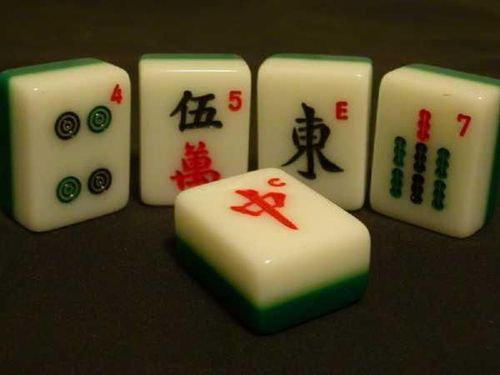
Mahjong
Mahjong Rulebook
Table of Contents
Table of Contents
Setup
- All actions proceed counterclockwise.
- Each player builds a wall: 18 tiles in a row, stacked two tiles high. The four walls are then arranged into a square.
- Players take turns rolling two dice. Whoever rolls the higher number becomes East. South sits to East's right, and so on around the table.
- East rolls two dice and, starting with themself, counts around the table to determine whose wall will be broken. The player whose wall is broken then rolls the dice, adds the result to East's result, and counts that many stacks from right to left along their own wall. They remove the two tiles that follow the counted stack and place them to the right of the break. These are the loose tiles.
- The last 14 tiles of the wall are marked off by offsetting the 7th stack from the end of the wall. This is the dead wall.
- East takes 4 tiles from the left of the break, then South, and so on, until each player holds 12 tiles. Then everyone, starting with East, takes one more tile each.
- If players hold Flower or Season tiles, they lay them face up in front of themselves. Tiles laid out this way are replaced with loose tiles, starting with East and continuing in turn order. The loose tiles are replenished from the end of the wall once both have been taken (they may also be taken later, during play, after laying out a Flower/Season or after forming a Kong). If only one loose tile has been taken, there is no need to replenish it yet.
- A game lasts 4 rounds of 2 hands each (8 hands total). The rounds are, in order: East, South, West, and North.
Turn of Play
- East plays first.
- A player's turn: draw the end tile from the wall, then discard any one tile to the discard pile. The discard pile forms in the center of the table, with discarded tiles laid out 6 to a row.
- Play continues until one of the players completes Mahjong (4 combinations plus a pair of matching tiles) or all tiles except the dead wall have been drawn.
- A player may take the most recently discarded tile if, together with tiles from their own hand, it can form one of three combinations: Chow, Pung, or Kong. The combination must then be laid face up in front of the player.
- Combinations formed entirely from tiles in hand (not from the discard pile) are concealed; combinations formed with the help of a discarded tile are exposed.
- Chow — a run of tiles in one suit. A player may take a tile from the discard pile to form an exposed Chow only if that tile was discarded by the player seated to their left. If another player wants the same tile for a Pung, the Pung takes precedence.
- Pung — 3 identical tiles. Any player may take a tile that has just been discarded to form an exposed Pung with it, provided they already hold 2 matching tiles in hand.
- Kong — 4 identical tiles. There are 3 ways to form a Kong:
- A player holds a concealed Pung in hand. Someone discards the 4th matching tile. The player may take that tile and lay an exposed Kong in front of themselves; in this Kong, the claimed tile is turned sideways. The player then takes one of the loose tiles and discards one tile from their hand to the discard pile.
- A player has previously formed an exposed Pung. If they later draw the matching 4th tile from the wall on their own turn, they may add it to their exposed Pung to form an exposed Kong. All the tiles of this Kong lie face up — only this variant of Kong can be robbed for Mahjong.
- A Kong is assembled during play entirely from tiles drawn from the wall into the hand. This is a concealed Kong. On their turn, the player must lay it face down in front of themselves — all four tiles of a concealed Kong lie face down. The player then takes a loose tile and discards any tile from their hand to the discard pile. If a concealed Kong is never declared, it is scored at the end of the game only as a concealed Pung.
Mahjong (Winning)
- If a player is missing only one tile to complete Mahjong, they must declare themselves a waiting hand. Otherwise, the player has no right to declare Mahjong, and on their turn must discard one of their tiles to the discard pile as normal. A player may otherwise continue assembling combinations as they see fit.
- A player who has declared themselves a waiting hand has priority over other players when a discarded tile is needed to complete Mahjong. They have the right to take that tile out of turn — not only for a Pung, but also for a Chow or to complete the pair.
- If the same discarded tile completes Mahjong for two players at once, the winner is whichever of them sits farther from the discarder, counting counterclockwise.
- On their own turn, a waiting-hand player may also rob a Kong (see above) to complete Mahjong. In this case, instead of drawing a tile from the wall, the player takes the needed tile from another player's Kong — one where all 4 tiles are fully exposed — and completes Mahjong.
Settling Payments
- If the wall is drawn down to the dead wall and no player has completed Mahjong, the hand is considered a draw and no scoring takes place.
- If Mahjong is completed, all players calculate the value of their own combinations according to the scoring table below.
- The value of a Mahjong hand cannot exceed 500 points.
- If a limit hand is present, individual combinations are not scored separately.
- The three losing players each pay the winner, individually, the full value of the winner's hand.
- The losing players also settle among themselves. Each settles individually with each of the other two. The player with the lower point total pays the player with the higher total the difference between them.
- In every settlement with each of the other players, East receives or pays double.
- If East wins, East remains East. Otherwise the winds rotate counterclockwise: whoever was South becomes the new East, and so on.
Player Conduct
- During play, it is recommended to announce combinations aloud (Chow, Pung, or Kong). Announcing discarded tiles is not required.
- After drawing a tile from the wall, a player should discard a tile from their hand to the discard pile within 10 seconds.
- A tile accidentally exposed must be discarded on that turn or the next.
- If a player is found to have the wrong number of tiles in hand, they lose the right to declare Mahjong for the current hand, but continue playing and forming combinations.
Scoring
Base points
-
Chow — 0
-
Pair of own wind — 2
-
Pair of round wind — 2
-
Pair of dragons — 2
-
Pung of suit tiles (other than 1s and 9s) — exposed 2, concealed 4
-
Pung of terminals (1s and 9s) — exposed 4, concealed 8
-
Pung of winds — exposed 4, concealed 8
-
Pung of dragons — exposed 4, concealed 8
-
Kong of suit tiles (other than 1s and 9s) — exposed 8, concealed 16
-
Kong of terminals (1s and 9s) — exposed 16, concealed 32
-
Kong of winds — exposed 16, concealed 32
-
Kong of dragons — exposed 16, concealed 32
-
For Mahjong — 20
-
Winning on the last tile of the wall — 2
-
Winning tile is the only possible tile — 2 (completing a pair from a single tile, or completing a run in the middle, or completing a run open at only one end)
Doublings (apply for all players)
- Pung or Kong of dragons — ×2
- Pung or Kong of own wind — ×2
- Pung or Kong of round wind — ×2
- One suit, with honor tiles (dragons and winds) — ×2
- One suit, without honor tiles (dragons and winds) — ×6
- Own or round Flower/Season (East–1, South–2…) — ×2
Doublings (apply for the winner only)
- All Pungs only — ×2
- No-point hand — ×2
- Mahjong completed on a loose tile — ×2
- Mahjong completed on the last tile drawn before the dead wall — ×2
- A Kong was robbed to complete this Mahjong — ×2
- Three combinations plus a pair of winds — ×4
- Two combinations plus a pair of dragons — ×2
- Terminals and honors in every combination, including the pair — ×2
- Fully concealed hand — ×2
- Two or three Kongs — ×2
- Mahjong completed on a tile that is evidently the last of its kind (the 4th copy) remaining — ×2
- Waiting hand declared on the first deal — ×2
When several doublings apply, they are multiplied together.
Limit hand — 500
- Buried Treasure: no Chows, all tiles of one suit, all combinations concealed.
- The Emperor's Retinue: Mahjong on winds and dragons.
- Heads and Tails: Mahjong entirely on terminals (1s and 9s).
- Imperial Jade: all Pungs (Kongs) and the pair are green (Bamboos and Green Dragons).
- Heavenly Twins: seven pairs, of dragons and winds, or of one suit.
- The Three Great Scholars: Pungs (Kongs) of all three dragons, plus a Pung (Kong) and a pair of one suit.
- Four Blessings Entered the Door: Pungs (Kongs) of all four winds, plus a pair.
- Four Times Four: four Kongs and a pair.
- Thirteen Wonders of the World: 13 different tiles — the 1s and 9s of every suit, one of each dragon and each wind — plus a final tile that pairs with any one of them.
- Fishing the Moon from the Bottom of the Sea: Mahjong completed on the last tile drawn before the dead wall, and that tile is the 1 of Dots.
- Growing Grapes on the Flat Roof: Mahjong completed on a loose tile, and that tile is the 5 of Dots.