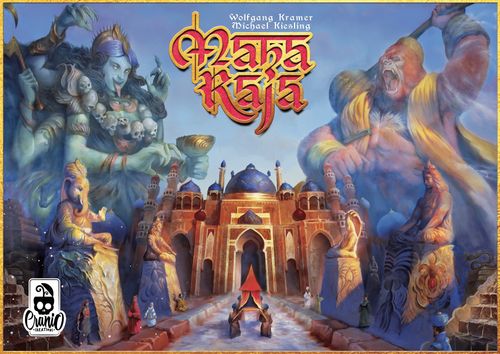
Maharaja
Maharaja Rulebook
Table of Contents
Table of Contents
Components
- 1 Map
- 7 City Flags
- 8 Reward Tiles
- 16 Character Tiles
- Prestige Points (25 x 1, 15 x 5, 15 x 10)
- Coins (20 x 1, 10 x 5, 5 x 10)
- 1 Maharaja
- 7 Action Tokens
- 80 Shrines (20 in each player's color)
- 28 Statues (7 in each player's color)
- 4 Priests (1 in each player's color)
- 2 Maharani Tokens
- 4 Player Boards (with spaces for your components)
- 4 Action Discs
- 4 Special Rules Tiles
- 4 Final Scoring Tiles
Before starting the first game, assemble the Action Discs by clipping one Disc and two arrows together.
Solo Version
- 12 Action Tiles
- 3 Setup Tiles
Setup
A. Place the Map at the center of the table.
B. Shuffle the Character tiles. Randomly pick a number of tiles equal to the number of players +3 and place them face up next to the Map, to create the Characters' display. Put the remaining Character tiles back in the box.
(For your first 4-player game, we suggest using Character tiles 1, 2, 5, 9, 12, 14 and 15.)
C. Place all the Prestige Points, Coins and Action tokens next to the Map to create the general supply.
D. Randomly place the Reward tiles face up in their designated spaces on the Reward Track, from bottom to top. Place the Maharani tokens in their designated space next to the Reward Track.
E. Randomly place the City Flags face up in their designated starting spaces of the Maharaja Track (leave the first two spaces on the left empty).
F. Place the Maharaja next to the Map.
Each player must choose a color:
G. Place the Priest of your color in the starting space on the Map.
H. Take a Player board and place it in front of you.
I. Take 8 Shrines of your color and place them on your board in their designated space. All the other Shrines are placed next to the Map in the general supply.
J. Place all the 7 Statues of your color on your board in their designated space.
K. Take 1 Action Disc.
L. Take 15 Coins and place them on your board in their designated space.
M. Take 3 Prestige Points and place them on your board in their designated space.
Put the components of the remaining colors back in the box.
Put the Special Rule tiles and the Final Scoring tiles back in the box; they won't be used in the introductory games.
The board also carries a Reward Track, a City Scoring Chart, the Maharaja Track, a General Rules Summary, and a Final Scoring Summary.
Important Rules
The game is divided into rounds. Each round you will perform two actions. Some actions allow you to build statues and shrines on the map which provide Prestige Points at the end of the game; additionally, they may give you bonuses and income, each round, if you have placed them in the city the Maharaja is visiting.
Your total Prestige Points is secret to the other players while your Coins are not.
Statues
You can build Statues only inside Cities and only when the Priest is the City you chose.
Building a Statue in the City where the Maharaja is, costs 12 Coins.
Building a Statue in all other Cities costs 10 Coins.
When you build a Statue, you must place it on one of the available Statue spaces. Each City has 1 central Statue space and 6 external Statue spaces. Two external spaces in each City have a bonus illustrated inside: if you build a Statue there, you immediately receive that bonus.
Statues in the central space are worth 3 Worship Points during the City Scoring phase.
Statues in the external spaces are worth 2 Worship Points (see "City Scoring Phase").
Example: if the red player builds a Statue in the city above, they must pay 10 Coins. If the Statue is built in the city below, currently visited by the Maharaja, they must pay 12 Coins instead.
Shrines
You can build Shrines inside Cities or inside Villages.
Building a Shrine costs 1 Coin.
When you build a Shrine inside a City, place it anywhere on the external circular Shrine area. There is no limit to the number of Shrines built inside a City.
Shrines inside a City are worth 1 Worship Point during the City Scoring phase (see "City Scoring Phase").
When you build a Shrine inside a Village, place it in one of the available Village spaces (there can be only 2 Shrines in each Village).
There can be only 1 Shrine for each color inside each Village. The Shrines inside the Villages are used to move your Priest (see "Priests").
Note: in a 2-player game, there can be only 1 Shrine in each Village, i.e. you cannot build a Shrine in a Village where there's already one.
Priests
You can build a Statue or a Shrine inside a City only if your Priest is currently inside that City.
You can freely move your Priest during your turn, before, during or after performing your action. You can freely move your Priest from one City to another any number of times and in any direction, following these rules:
- The Priest can only move along the illustrated roads on the Map.
- The Priest can only move through Villages where there is at least one Shrine built (by any player).
- If you move your Priest through a Village where you have built a Shrine, you can move it for free.
- If you move your Priest through a Village where you haven't built a Shrine yet, you must pay 1 Coin to each player who had built their Shrines in that Village.
- Moving your Priest through a City, or through the starting space, has no cost.
Therefore, in order to move your Priest from one City to another, you must check if there's a road that connects them, directly or through other Cities, and that has at least 1 Shrine in each of its Villages.
Priests inside a City are worth 1 Worship Point during the City Scoring phase (see "City Scoring Phase").
Example: the red Priest can move from the City below to the City above for free because there are red Shrines in the Villages of that road. It can also move to the City on the right by paying 1 Coin to the yellow and blue players.
The green Priest can move from the City above to the City below by paying 2 Coins to the red player and 1 Coin to the yellow player.
The yellow Priest can move from the City on the right to the City above (through the City below) by paying 1 Coin to both the red and blue players.
Before You Start
Before the first round, players make some important decisions. Since these decisions involve important strategic consequences, make sure you read the entire rulebook carefully before playing.
Randomly choose a player who will choose an available Character tile from the display and place it face up in its designated space of the Player board.
In clockwise order, each player chooses an available Character tile from the display and places it on their own Player board (for an explanation of all Characters, see the Appendix).
Then, following the Characters' tile order, from the lowest to the highest number, each player must place 1 Shrine from the Player board inside an available Village space for free. Remember that there can only be 1 Shrine of your color in each Village.
Continue until each player has placed 4 Shrines on the Map (4 Shrines remain available to each player on their Player boards).
Gameplay
Each round is divided into 5 phases to be played in this order:
- Maharaja Phase
- Planning Phase
- Actions Phase
- City Scoring Phase
- End of Round Phase
1. Maharaja Phase
Perform the following in this order:
- Place the Maharaja on the City indicated by the first City Flag on the left of the Maharaja Track. The Maharaja will be visiting this City until the next round. There is no other way to move the Maharaja.
- Then move that City Flag on the first empty space on the right of the Track.
The first City Flag on the left is the blue one. Place the Maharaja on the same symbol on the Map. In the first round, it will be the number 1 space.
2. Planning Phase
This phase is played simultaneously by all players. Players will secretly plan the actions they may perform later, during the Actions phase. There are 9 different actions illustrated on the Action Disc.
Decide which actions you want to perform by pointing at them with the arrows of your Action Disc. You can decide to point at the same action with both arrows if you plan to perform the same action twice. After you have planned your actions, place your Action Disc face down in front of your Player board; you cannot take it back and change the direction of the arrows.
The Planning phase ends once all players have placed their Disc face down.
Note: it might happen that you won't be able to perform all the planned actions due to the other players' choices, so choose them carefully!
3. Actions Phase
This phase is played following the order indicated by the Character tiles in front of the players, from the lowest to the highest number.
During your turn, flip your Action Disc face up and perform both actions you have planned, choosing their order. You are not obliged to perform an action in case you don't have the necessary amount of Coins. However, it is possible to perform only part of the planned action (for example, building one piece only instead of two).
Action Tokens
Some external Statue spaces with bonuses and some Characters will reward you with an Action token. When you receive one, place it on your Player board in its designated space.
If you have an Action token in your supply, you can use it to perform an additional action of your choosing. Put the Action token back in the general supply and perform the action. You can perform any action illustrated on the Action Disc, except for the "Changing Character" action.
You can use only one Action token per turn.
The Actions
There are 9 possible actions:
-
Building 1 Statue with a discount. Place 1 Statue from your Player board into an available Statue space, following the general building rules. Pay its price with a discount of 1 Coin.
-
Building 1 Shrine with a discount. Place 1 Shrine from your Player board into an available Village space or into a City, following the general building rules. Discount the price by 1 Coin, making this action free.
-
Building 1 Statue and 1 Shrine. Place 1 Statue from your Player board into an available Statue space and place 1 Shrine from your Player board into an available Village space or into a City, following the general building rules. You can choose the order.
-
Building 2 Shrines. Place 1 Shrine from your Player board into a City and 1 Shrine from your Player board into a City or an available Village space, following the general building rules. You must build at least one of the two Shrines into a City. You can choose the order.
-
Taking 3 Coins. Take 3 Coins from the general supply and place them in their designated space on your Player board.
-
Taking 2 Shrines. Take 2 Shrines of your color from the general supply and place them in their designated space on your Player board.
-
Paying 3 Coins in exchange for 2 Prestige Points. Pay 3 Coins to the general supply and receive 2 Prestige Points from the general supply. Place them in their designated space on your Player board.
-
Changing Character. Put your Character tile back in the display. Then, take any other Character tile from the display or from another player. If you take it from another player, that player will immediately take a new Character tile from the display (they may choose the one you just returned).
Example: in the example above, the City Flag should move to an occupied space on the Maharaja Track: slide the overtaken tiles to the right. All the other City Flags must not be moved. In this case, only the blue Flag on the left slides to make room. In this example, the City Flag moves to an empty space, therefore the pink Flag doesn't slide.
Note: remember that you can move your Priest before, during and even after performing any action. For example: when performing the "Building 1 Statue and 1 Shrine" action, you can move your Priest into a City to build a Statue, then move it to another City to build a Shrine, then move it again to another City.
The Actions phase ends once all players have played their turn.
4. City Scoring Phase
During this phase, the Maharaja rewards players based on their Worship Points in the currently visited City. Calculate each player's total Worship Points (WP) in this City, according to the following values:
- Statue in the central space = 3 WP
- Statue in any external space = 2 WP
- Shrine inside the City = 1 WP
- Priest inside the City = 1 WP
Each piece inside the City provides a Worship value. Note: some Character tiles have effects that are relevant during the City Scoring phase (see Appendix).
After this calculation you will have the players' Worship value ranking: the first player in the ranking is the one who has the most WPs, and so on. Ties are broken by Character tiles; the player with the lowest number wins the tie.
Example: Red Player: 6 WPs, Yellow Player: 4 WPs, Green Player: 5 WPs, Blue Player: 2 WPs. With regards to the example above, red is ranked first, green second, and so on.
Players will gain a reward of Coins according to their WP ranking and the chart illustrated on the board (depending on the number of players).
Then, starting with the player in first WP ranking order, then down, each player with at least 1 WP will choose an available Reward tile and immediately apply its effect (for a clarification of all Reward tiles, see Appendix). After performing the effect, move the tile you chose to the first available empty space of the Reward Track, directly above the top-most tile.
Note: in a 2-player game, only the first 3 Reward tiles can be chosen. In a 3-player game, only the first 4 Reward tiles can be chosen. In a 4-player game, only the first 5 Reward tiles can be chosen. This is illustrated by the icons to the left of the Reward Track.
If you don't have any Worship Points during the City Scoring (there isn't a piece of your color in the City and you don't have any Character that provide WPs), you get a compensation reward of 3 Coins, but you do not choose any Reward Tile.
5. End of Round Phase
Perform the following in order:
-
If there are empty spaces between City Flags on the Maharaja Track, slide City Flags to the right to close the gaps.
You will do this only if the "Changing the Maharaja Track" action has been performed by moving one of the City Flags on the far left, creating a gap.
-
Slide all Reward tiles down.
The available Reward tiles change each round.
-
If already taken during the previous round, put the Maharani tokens back on their designated space next to the Reward Track (see Appendix).
End of the Game
The end of the game is triggered when at least one of the following conditions are met:
- The seventh round has just been completed.
- One, or more, players have built all of their Statues. If this occurs, finish the round as normal, then proceed directly to Final Scoring.
Final Scoring
At the end of the game, players score additional Prestige Points, based on what they have built.
First, return all Character tiles back to the supply; their effects may not be used during Final Scoring.
Players receive Prestige Points (PP) as follows:
- 3 PP for each Statue of your color anywhere on the Map.
- 1 PP for every 5 Coins you have in your supply (no rounding).
- 2 PP for each City you have the most Worship Points in.
If there is a tie for having the most WP in a City, all tied players receive 1 PP.
The player with the most Prestige Points wins the game! Ties are broken in favor of the player who built the most Statues. In case of a further tie, the player with the most Coins between them wins. In case of a further tie, those players share the victory.
Example: the final scoring will take place after the game ends. In the example above, players will receive 3 PP for each statue they built and 1 PP every 5 Coins left in their supply. Then, they must calculate who is the player with the most WP in each City; only Statues, Shrines and Priests count. Players will finally add their PP received during the game.
The green player is first with 5 WP (one central Statue=3, one Shrine=1, one Priest=1) and receives 2 PP.
The red player is first with 6 WP (two external Statues=4, one Shrine=1, one Priest=1) and receives 2 PP.
The blue player is first with 4 WP (one central Statue=3, one Priest=1) and receives 2 PP.
The yellow player is first with 6 WP (two external Statues=4, one Shrine=1, one Priest=1) and receives 2 PP.
The red and the green players are first with 5 WP (one central Statue=3, two Shrines=2 for the red; one external Statue=2, three Shrines=3 for the green) and receive 1 PP each.
The yellow player is first with 5 WP (one central Statue=3, one external Statue=2) and receives 2 PP.
The blue and the green players are first with 4 WP (one central Statue=3, one Shrine=1 for the blue; two external Statues=4 for the green) and receive 1 PP each.
Variations
During the setup, choose or pick randomly one or more Special Rule tiles and/or a Final Scoring tile and place them on their designated spaces on the Map, replacing the similar icons if needed.
The special rules are applied during the entire game.
Special Rule tiles:
- During the City Scoring phase, the first player in the ranking will also receive 1 PP.
- During the City Scoring phase, Statues in external spaces are worth 1 WP.
- Building a Statue in a City not currently visited by the Maharaja costs 12 Coins.
- When you perform the "Changing Character" action, you can only take Character tiles available in the display, not from other players.
At the end of the game, you will score additional Prestige Points following the Final Scoring tile rules, ignoring the standard rules.
Final Scoring tiles:
- 3 PP for each City where you have the most WP (2 PP for all tied players).
- 1 PP for each City where you have at least 1 Statue or 1 Shrine.
- 2 PP for each road where you have built 1 Shrine in both Villages (roads with 1 Village only don't count).
- 2 PP for each City where you have built at least 2 Statues.
- Lose 1 PP for each Shrine of your color left in the general supply.
You can choose any number of Special Rule tiles to use and/or only one Final Scoring tile during the same game.
Appendix
Characters
Every Character has a special ability that is applied in different phases of the game:
- 1x: You can use this special ability once per round, during your turn.
- Continuous: You can always use this special ability.
- Scoring: You can use this special ability during the City Scoring phase.
- No effect.
- Take 1 Shrine of your color from the general supply.
- You can pay 2 Coins to take 1 PP or vice-versa; you can do this up to 3 times.
- You can pay 1 PP in exchange for an Action token.
- Your Priest is worth +1 WP.
- Take 1 PP.
- Each set of 2 Shrines you have built inside the City is worth +1 WP.
- You have +1 WP (even if you have no pieces in the City).
- Your Priest moves for free; other players are not given Coins when you move your Priest.
- Perform a "Changing the Maharaja Track" action.
- Each time you receive PP, add 1 additional PP.
- You can build Statues and Shrines in any City, even if your Priest is not there.
- Build a Shrine taking it directly from the general supply. You can build it in any City even if your Priest is not there.
- Take 1 Action token.
- Each time you build a Statue, pay 3 Coins less.
- When you apply the effect of a Reward tile, apply it twice.
Reward Tiles
-
Take 3 Coins.
-
Take 3 Shrines of your color from the general supply.
-
Take 1 Prestige Point and 1 Coin.
-
All other players must pay 2 Coins (if able) to the general supply. If they only have 1 Coin, they must pay that Coin, and receive no further penalty.
-
Take 2 Prestige Points.
-
You may pay 1 Coin in exchange for 1 Prestige Point. You can do this up to 3 times.
-
Build 1 Shrine from your personal supply for free. You can build it inside any City even if your Priest is not there.
-
Take 1 Maharani token and place it on any Character tile in the display (not owned by any other player). You can use that Character's special ability until the end of the next round, even if that Character tile is taken by another player (the token stays on it). If the Character has a 1x ability, immediately remove the Maharani token when you use the ability. Otherwise, the Maharani token is removed at the end of the round.
(If you choose this Reward tile while you have the Character tile 16, place 1 Maharani token on two different Character tiles in the display.)
Brahmabot: A Solo Mode for Maharaja
by David Turczi & Simone Luciani
Maharaja can be played in a solo mode. As a single player, you can challenge an opponent automa player, Brahmabot, with 3 levels of difficulty.
Brahmabot will perform actions, use Coins and receive Prestige Points following special rules. It will follow the indications given by one Action tile available in a display, yet you don't know which one. While two of these tiles are visible, one is hidden; this way, you have only partial information about its decisions.
Setup
Setup a 2-player game, with the following changes:
-
Choose a level of difficulty (easy – medium – hard).
-
Randomly select one of the Setup tiles. Brahmabot will place 1 Shrine in the marked Villages. If you're playing with the easy level, place 4 Shrines on the green marked Villages only; with the medium level, place 6 Shrines on the green and blue marked Villages; with the hard level, place 8 Shrines on all green, blue and red marked Villages.
With the easy level, Brahmabot will place 1 Shrine in all Villages marked with a green circle.
-
Brahmabot will take 1 Player board, 7 Statues and 20 Shrines (it begins the game with all Shrines already available).
-
Shuffle all the Character tiles and create a face down stack and place it next to the Map. Brahmabot will take the first Character tile from the stack. Draw 3 Character tiles and place them face up to create the display. Put them in a row, so there is a "right" and a "left" end of the display.
Pick a Character tile by choosing it from the 3 tiles in the display, draw a new tile from the stack and place it on the right end of the display.
Even if you pick the Character tile in the left or central position of the display, then draw a new one and add it to the display on the far right.
-
Brahmabot will take Coins and Prestige Points according to the level of difficulty.
Level Coins PP Easy 0 2 Medium 2
Gameplay
The Maharaja phase is performed as usual.
During the Planning phase, draw the first 3 Action tiles from the stack. Place two of them face up and one face down in a row. Then, select your actions on your Disc as usual.
Brahmabot will perform its actions following one of the 3 Action tiles in the display.
The Actions phase is performed as usual, following the order indicated by the Characters' numbers.
You can perform your actions normally, with the following changes.
When you perform a "Changing Character" action, the Character tile you return is removed from the game. After taking a new Character tile (you can take it from Brahmabot or from the display), draw a new Character tile from the stack and place it on the right end of the display. If you took Brahmabot's Character, it will take the Character on the left of the display.
If you have to pay Coins to Brahmabot (for moving your Priest using its Shrines), just place them on its Player board.
When it is Brahmabot's turn, it decides which Action tile must be performed. Turn the first Action tile from the stack and look at its lower section: the "check" symbol will indicate which of the three tiles in the display must be performed. If the face down tile must be performed, flip it face up.
Each Action tile has three sections:
- Upper Section — the action Brahmabot performs.
- Middle Section — where Brahmabot moves its Priest.
- Lower Section — which tile in the display must be performed (the "check" symbol).
- Brahmabot performs the actions illustrated in the upper section of the tile.
- Brahmabot moves its Priest to the City indicated on the middle section of the tile. It might be a specific City (City symbol) or the City where the Maharaja currently is (Maharaja symbol).
If Brahmabot's Priest cannot reach that City from its current location (there are no roads with at least 1 Shrine in all their Villages), it will build the Shrines it needs to move there, without paying for them. It will choose the path that needs less Shrines and it will move its Priest there. For each of the Shrines it uses, you will receive 1 Coin from your general supply (Brahmabot's Priest moves for free).
Then, Brahmabot's turn ends.
Example: Brahmabot must move its yellow Priest to the lower City on the left, which is not connected to the City where its Priest is. The best possible path to connect them is the one illustrated, where Brahmabot needs to build only 1 Shrine in the depicted Village. Brahmabot will build the Shrine there for free and it will move its Priest. Then, its turn will end.
If that City is already connected, Brahmabot will move its Priest to that City. If there are more than one possible path, it will select the one with the least number of your Shrines (you receive Coins from the supply accordingly).
Only after Brahmabot has moved its Priest to an already connected City, it will perform one of the following:
If it owns 6 or more Coins, it will spend 6 Coins and build a Statue in its Priest's location.
Otherwise, if it owns 5 or less Coins, it will build a Shrine in its Priest's location for free and receive 1 Coin.
Then, Brahmabot's turn ends.
Example: Brahmabot must move its yellow Priest to the lower City on the right, which is already connected by different paths. B. will choose, among the paths illustrated above, the one depicted with a continuous line because it has only two of your Shrines. You will receive 2 Coins if B. owns 6 Coins, it will pay them to build a Statue in the lower City on the right. Otherwise, B. will receive 1 Coin and build a Shrine.
The City Scoring phase is performed as usual, with the following changes:
If you are the first player in the ranking (you have the most WP), you will receive 12 Coins as usual; Brahmabot will receive 1 Prestige Point instead of Coins.
If Brahmabot is the first player in the ranking, it will receive 4 Prestige Points instead of Coins; you will receive 6 Coins as usual (if you have at least 1 WP).
Brahmabot never takes Reward tiles.
If you have to take a Reward tile, you can choose it only from the first two tiles from the lowest part of the Reward Track. Apply its effect, then remove it from the game.
If you're not taking a Reward tile (because you have no WP during the City Scoring), remove the first tile in the lowest part of the Reward Track from the game.
During the End of Round phase, remove the performed Action tile from the game and shuffle the rest together back in the stack (including the two tiles remained in the display).
Note: Brahmabot will never use its Character's special ability! Brahmabot's Character tiles are used only for the turn order.
Building Concerns
Brahmabot never pays to build Statues and Shrines as its main action (those illustrated on the upper section of the Action tiles), nor does it pay to move its Priest. Only at the end of its Priest's movement (if it moved without building Shrines), it can build an additional Statue paying 6 Coins.
When Brahmabot builds a Statue, it will build it following this priority order:
- In the central space, if available;
- In the top external space with bonus, if available (the bonus is not applied to Brahmabot);
- In the bottom external space with bonus, if available (the bonus is not applied to Brahmabot);
- Any other space.
Brahmabot has all its Shrines already available on its Player board from the beginning of the game. In case it needs to build a new Shrine but has already placed all the available ones, it must move one of the already built Shrines to the new space instead. The Shrine will be taken from the City on the far right of the Maharaja Track where it has one Shrine.
Brahmabot's Actions
- Build a Statue in the City currently visited by the Maharaja.
- Build a Shrine in the City currently visited by the Maharaja.
- Build a Statue in the City on the far left of the Maharaja Track.
- Build a Statue in the first City from the left on the Maharaja Track with the central space still available.
- Build a Statue in the first City from the left on the Maharaja Track in which Brahmabot is second in the ranking and with the smallest difference in WP between you and it.
- Move a City Flag by 4 spaces to the left. The City Flag to be moved is the one corresponding to the City in which Brahmabot is first in ranking and with the biggest difference in WP between you and it. In case of a tie between more Cities, move the first from the left on the Maharaja Track.
- Receive the illustrated number of Coins.
- Brahmabot removes its Character tile from the game and takes your Character tile. Then, you pick one of the available Character tiles from the display. Draw a new tile from the stack and place it on the right of the display.
Final Scoring
At the end of the game, you will receive Prestige Points as usual, following the basic rules or according to the Final Scoring tile currently used.
Brahmabot always receives:
- 2 Prestige Points for each City where it has the most Worship Points.
- 1 Prestige Point if it ends the game with at least 1 Coin (regardless of the Final Scoring tile).
- 3 Prestige Points for each Statue of its color on the Map.
- Additional PP given by the Final Scoring tile used.
If you have more Prestige Points than Brahmabot, you win.