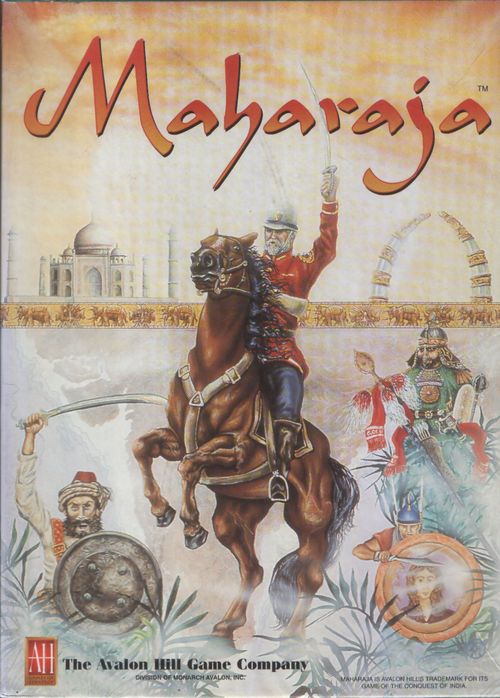
Maharaja (1994)
Maharaja (1994) Rulebook
Table of Contents
Table of Contents
- 1.0 Introduction
- 2.0 Game Components
- 3.0 Starting the Game
- 4.0 Sequence of Play
- 5.0 Movement
- 6.0 Overpopulation
- 7.0 Invasions
- 8.0 Battle
- 9.0 Leaders
- 10.0 Population Increase and Other Force Changes
- 11.0 Submission and Alliance
- 12.0 Factories and Arms
- 13.0 Raj Points
- 14.0 Control of Nations
- 15.0 Winning
- 16.0 Player Notes
1.0 Introduction
Maharaja is a game for three, four or five players covering the wars and migrations of the Indian subcontinent from roughly 1500 BC to 1850 AD — from the Aryan invasions through the British conquest. Each player controls several of the game's nationalities. Nations earn Victory Points in various ways, most commonly by occupying specified map areas at specified times. Most of a nation's pieces are armies, moved on the board and used to attack pieces belonging to other players; battles are resolved with dice. Nations grow through natural population increase and receive reinforcements from their homelands across mountains or seas.
The game runs 16 turns. The first 11 turns each represent roughly 250 years; the final five turns represent progressively shorter periods. At the end of Turn 16, the player whose nations have the largest combined Victory Point total wins. A full game runs up to four hours; the short three-player game (14.2) takes about two hours. The four-player game is recommended for the best balance and interaction.
2.0 Game Components
- One 24" x 22" game board
- 240 die-cut cardboard counters
- Rules booklet
- 17 Victory Point Cards plus one Nation Control Chart card
- Five dice
2.1 The Game Board
The board depicts the Indian subcontinent divided into 36 land areas, surrounded by six foreign areas and three sea areas. Land areas shaded green are mountain/jungle terrain, referred to throughout as "hilands."
2.11 Indian regions. India is divided by red borders into four regions:
- Himalayas (4 areas): Assam, Bhutan, Ladakh, Nepal
- North India (18 areas): Agra, Baluchistan, Bengal, Bihar, Bundelkhand, Delhi, Gandhara, Gujarat, Jaunpur, Kashmir, Lahore, Magadha, Malwa, Orissa, Oudh, Punjab, Rajputana, Sind
- South India (12 areas): Andhra, Berar, Bidar, Bijapur, Golconda, Gondwana, Karnatak, Kerala, Khandesh, Maharashtra, Malabar, Mysore
- Ceylon (2 areas): Lanka, Simhala
2.12 Foreign areas. Six brown foreign areas border India: Afghanistan, Burma, Central Asia, China, Persia, Tibet. Five of these (all but Burma) are sources of foreign invasion, most often Afghanistan, Central Asia and Persia. Many nations originate in these areas, but no counter may ever remain in or move through a foreign area.
2.13 Sea areas. Three blue sea areas touch India's coast: the Arabian Sea, the Bay of Bengal, and the Indian Ocean.
2.14 The board also carries the Turn Record Track, Turn Record Chart, Increase Population Track, British Alliance box and Order of Play chart, all described below.
2.2 The Playing Pieces
- 2.21 Armies — colored circular pieces depicting a soldier of the nation, with the nation's name printed alongside. Background colors match the four-player assignment of nations to players (14.1).
- 2.22 Leaders — hexagonal pieces depicting a turban, named for a historical figure.
- 2.23 Increase Population markers — circular pieces with a solid silhouette, one per Indian nation. The British, Dutch, French and Portuguese have none, since these Colonial powers do not increase population.
- 2.24 Colonial Factories — square pieces depicting a trading post, color-coded to their Colonial nation (rule 12.1).
- 2.25 Colonial Arms — square pieces depicting a flintlock musket, color-coded to their Colonial nation (rule 12.2).
- 2.26 Turn Marker — a single circular piece depicting a tulwar (Indian sword), labeled "Turn."
2.3 Victory Point Cards
There are 17 Victory Point Cards, one per nation, each stating what that nation must do to score points (point values shown in parentheses), printed in the nation's color and bearing its counter art plus player notes specific to that nation.
2.4 Charts
- 2.41 Turn Record Chart — lists each turn's new invasions, leader arrivals, reinforcements, etc.; printed at the bottom of the board.
- 2.42 Turn Record Track — tracks the current game turn via the Turn marker.
- 2.43 Order of Play Chart — lists the order nations act each turn.
- 2.44 Increase Population Track — tracks each nation's population growth toward new armies.
- 2.45 British Alliance Box — tracks which nations have allied with the British.
- 2.46 Starting Areas Chart — lists nations that start on the board and where (see 3.0).
- 2.47 Nation Control Chart — lists which player controls which nations for a given player count (14.1).
- 2.48 Victory Point Records — optional photocopiable scoring sheets (in the printed booklet's back pages, not part of this OCR file).
3.0 Starting the Game
Place the Turn marker on the Turn 1 box of the Turn Record Track. Consult 14.1 to see which nations each player controls for the current player count (note that the counters' background colors match the four-player assignment). Each player takes the pieces and Victory Point Card for their nations.
Starting pieces are then placed: one army in each area on the Starting Areas Chart, plus six Mauryan armies in Afghanistan and six in Central Asia (per the Turn Record Chart).
Starting Areas Chart
| Nation | Starting areas |
|---|---|
| Pandyas | Khandesh, Malwa |
| Cholas | Bundelkhand, Gondwana |
| Harappans | Baluchistan, Delhi, Gandhara, Gujarat, Kashmir, Lahore, Punjab, Rajputana, Sind |
The remaining 23 land areas start vacant. Once all pieces are placed, Turn 1 begins; players should read and refer often to section 4.0, Sequence of Play.
4.0 Sequence of Play
At the start of every turn, players consult the Turn Record Chart. Pieces listed as "invading" may be placed in their land or sea area(s) as a reminder before their nation's actual turn.
Nations act in the order fixed on the Order of Play Chart (e.g., Pandyas, then Greeks, then Afghans, then Marathas, and so on) — unlike most games, order of play is by nation, not by player. A nation with no piece on the map and no scheduled invasion that turn simply has no turn. Each nation completes its entire sequence before the next nation acts. Phases 4.5 and 4.6 apply only to the four Colonial nations (British, Dutch, French, Portuguese), not to the 13 Indian nations.
4.1 Increase Population Phase. The controlling player totals the economic value of areas occupied by the nation's armies and, if possible, places newly raised armies (10.0).
4.2 Invasion Phase. The controlling player places the nation's invading pieces, if any, per the Turn Record Chart (7.0).
4.3 Movement Phase. The controlling player moves the nation's pieces (5.0).
4.4 Battle Phase. If, after movement, the nation's pieces share a land or sea area with another nation's pieces, battle occurs (8.0).
4.5 Factory Phase. Colonial nations may build factories (12.1).
4.6 Arms Phase. Colonial nations may supply arms to an Indian nation (12.2).
4.7 Victory Point Count Phase. The player checks the nation's Victory Point Card and scores any points earned this turn (15.0) — usually for temporary capture of areas or destruction of enemy pieces rather than for holding areas. After every nation has played, several (or all) nations may also be required to count Victory Points as flagged on the Turn Record Chart; where a card simply says "Turn 4" or "Turn 7," that means the end of the whole game turn, not the end of that nation's own turn.
The turn then ends: the Turn marker advances to the next box, and the next turn begins. Players may negotiate at any time, though doing so on another player's turn saves time. Play continues through the end of Turn 16, at which point every player totals the Victory Points of all nations they control; the highest total wins, regardless of any single nation's fortunes in Turn 16 or its overall map presence.
5.0 Movement
5.1 Procedure.
- 5.11 All, some, or none of a nation's pieces may move on its turn; all movement resolves before any combat.
- 5.12 An army may move up to two areas per turn (e.g., Gujarat → Rajputana → Delhi), but must stop upon entering a hiland area. See 9.1 for the leader exception.
- 5.13 No piece may enter a sea area except as allowed by 5.4 or 7.3, and no piece may ever enter a foreign area, even one it originated from (7.1).
- 5.14 Colonial armies (British, Dutch, French, Portuguese) may move up to three land or sea areas per turn — an exception to 5.12 — but still stop on entering a hiland area.
- 5.15 Malwa, Bundelkhand, Khandesh and Gondwana all meet at a single point on the map; direct movement is not possible between Malwa–Gondwana or between Bundelkhand–Khandesh.
- 5.16 A single straits symbol connects Karnatak and Lanka; pieces may cross it as a bridge, but the crossing consumes an entire turn (the piece must start the turn in one connected area and end it in the other). Retreats may also use the straits.
5.2 Stacking. A nation may normally have no more than three armies in a non-hiland area, or two in a hiland area. As an exception, a nation may instead keep an unlimited group in one non-hiland area, or a group of up to four in one hiland area (not both at once). These limits apply at the end of every Movement Phase, not during movement itself. They may not be exceeded during the Increase Population Phase (5.21) or as a result of retreats.
5.3 Encountering other pieces. Moving into an area held by another nation's armies triggers battle (8.0); a piece must normally stop there. However, if pieces already stopped in that area outnumber the defenders at least 2-to-1, additional friendly pieces may continue moving through without stopping, movement allowing.
5.4 Boat building. On turns marked "Boats" (followed by the nations involved) on the Turn Record Chart, each army of the named Indian nation may cross one sea area (matching its background color) and must return to land before ending its turn — effectively a two-area move using a different sea for each army if desired, but no army may cross more than one sea area in a turn.
- 5.41 Colonial armies always have "Boats" and may remain at sea freely. An Indian "Boats" nation needs permission from every Colonial nation with armies in a sea area it wants to cross; if permission is refused, it must instead attack and eliminate those Colonial armies (8.2) before crossing.
5.5 Sea areas. Any number of armies of any number of nations may occupy the same sea area; the presence of Colonial armies there may trigger sea battle (8.2).
6.0 Overpopulation
At the end of an Indian nation's turn, if it has more than twice as many armies as land areas its armies occupy, the excess must be removed (controlling player's choice) — e.g., a nation occupying four areas may keep at most eight armies. This check applies at the end of both movement phases of a Major Invasion (7.4). Colonial armies are exempt.
7.0 Invasions
Starting Turn 1, and in nearly every subsequent turn, new pieces enter play in the areas specified on the Turn Record Chart, representing historical waves of peoples entering India.
7.1 Foreign invasions. Mauryans, Greeks, Rajputs, Muslims, Mughals and Afghans arrive from the foreign areas to the north (Afghanistan, Central Asia, China, Persia, Tibet). When the Turn Record Chart schedules an invasion from a given foreign area, the invading armies must all enter Indian land area(s) bordering that foreign area, and may then move one or two land areas under normal movement rules. They may never remain in, or move to/through, any foreign area.
7.2 Indigenous invasions. The Sinhalese, Marathas and Sikhs originate within India. Their armies enter play, per the Turn Record Chart, in specific land areas during their nation's Invasion Phase and may then move into surrounding areas if desired. Any other nation's armies already occupying the entry area are removed immediately — no combat is fought.
7.3 Colonial invasions. British, Dutch, French and Portuguese invading armies enter a specified sea area and may then move up to three areas (land or sea), or stay put.
7.4 Major invasions. Certain nations (Mauryans, Rajputs, Guptas, Muslims, Mughals, British) may be granted a "Major Invasion" on a turn indicated by the Turn Record Track: all of that nation's forces get two consecutive move-and-fight cycles (move, fight, move again, fight again) in the one turn, representing an especially large coordinated push.
8.0 Battle
8.1 Battle on land. If armies of two different nations occupy the same land area at the end of a Movement Phase, battle is mandatory. If an army of one nation shares a land area with a factory of another, battle is optional, at the choice of the army's controller and only on that nation's own turn (a factory can never initiate battle but may fight back).
8.2 Battle at sea. Sea combat is always optional for Colonial-vs-Colonial encounters — it happens only if the moving player chooses. An Indian nation with boats may choose to attack Colonial armies at sea, but must return all its own armies to land (a vacant area, or one held solely by itself) once the sea battle ends. If more than one Colonial nation shares the sea area, the attacking Indian nation must eliminate one force entirely before engaging the next, choosing the order.
8.3 Battle resolution. Land and sea battles resolve identically: each side's controlling player rolls one die per army and/or factory present; the rolls determine how many opposing pieces are eliminated (removed from the board).
- Indian armies are eliminated on a roll of 5 or 6.
- Colonial factories are eliminated on a roll of 5 or 6.
- Colonial armies are eliminated only on a roll of 6.
- Any defending army or factory in a hiland area is eliminated only on a roll of 6.
- Colonial armies add +1 to their own die rolls, so they eliminate Indian armies or Colonial factories on a 4, 5 or 6, and eliminate other Colonial armies or any hiland defenders on a 5 or 6.
Combat is simultaneous — both sides roll their full set of dice for that round regardless of who rolls first.
8.4 Retreats and continuing battle. After a round with survivors on both sides, the defender may retreat; if it declines, the attacker may retreat instead (the attacker may not retreat if every defending army has retreated). A nation may retreat some surviving armies while keeping others in place. If both sides still hold armies in the area after the retreat option, another round of battle is fought; this repeats until only one nation (or neither, if mutually eliminated) remains.
8.5 Where the defender retreats. The defender may split its retreat between: (a) adjacent land areas occupied solely by its own pieces; (b) adjacent land areas that are vacant and not themselves adjacent to the attacker's armies (other than the battle area itself); Colonial nations may also retreat to any adjacent sea area. A defender may never retreat into the area the attacker came from, nor into a foreign area. If no legal retreat area exists, the defender must stay and fight again.
8.6 Where the attacker retreats. The attacker must retreat to the specific area(s) its armies entered the battle from. If that area now holds another nation's army, the attacker cannot retreat there and must instead stay and fight again; the same is true if the attacker came from a foreign area (retreat there is never allowed).
9.0 Leaders
A leader piece represents a single figure of exceptional ability; it is not an army. A leader may occupy an area to score Victory Points or to help qualify it toward Raj points (13.0), but cannot fight and cannot block the movement of enemy pieces — if an enemy army moves into an area held only by a leader, the leader is eliminated immediately. Leaders scheduled on the Turn Record Chart enter play during their nation's Population Increase Phase and may be placed in any area the nation already occupies. A leader never enters play if its nation has already been eliminated.
Alexander, Timur and Abdali are removed at the end of their nation's own turn (see 10.3). Ashoka and Chandra are removed at the start of the following game turn (see 10.4). Every other leader is removed at the start of its nation's next turn, before that turn's Population Increase is calculated — so a leader is on the board for at most one full game turn, though the precise moment of removal matters for battle resolution.
9.1 Leaders and movement. A leader, and any armies moving with it, may move up to three areas and need not stop upon entering a hiland area (an exception to 5.12–5.13). An Indian boat-movement army accompanied by a leader may still cross only one sea area, but may combine that with up to two land-area moves (before, or split before/after, the sea crossing).
9.2 Leaders and battle. A leader present at a battle adds +1 to the die roll of every friendly army and factory in that fight; the leader itself has no combat strength and rolls no die. A leader is eliminated automatically (no roll needed) if friendly losses leave it alone in the area with enemy armies present. Two opposing leaders alone together in an area simply ignore each other, and neither controls the area for any purpose.
10.0 Population Increase and Other Force Changes
10.1 Counting occupied territory. An Indian nation grows its army count by occupying Indian land; the potential growth depends on the combined agriculture/economic value of the areas it occupies. Colonial nations never increase population this way (though the British get scheduled reinforcements, 10.7); armies in foreign or sea areas never count. During its Increase Population Phase, the controlling player totals the value of its occupied land areas (hiland areas count as one-half each) and adds any fractional carry-over recorded on the Increase Population Track from the previous turn. Every full 3 points of total value yields one new army (drawn from eliminated/unused pieces); any remainder up to 2½ is saved for next turn on the Increase Population Track, but nothing beyond 2½ can be carried forward. A nation is also hard-capped by however many of its pieces exist in the physical counter mix.
10.2 Placing new armies. New armies from Population Increase are placed in areas the nation already occupies, at most one new army per area — unless every occupied area is already at its stacking maximum (5.2), in which case doubling up is allowed.
10.3 Removals. Certain leaders and armies are scheduled to leave the board regardless of combat:
- At the end of the Greek Turn 4: two Greek armies and the leader Alexander are removed.
- At the end of the Mughal Turn 11: two Mughal armies and the leader Timur are removed.
- At the end of the Afghan Turn 15: two Afghan armies and the leader Abdali are removed.
10.4 Mauryans and Guptas. At the start of Turn 5, all six Mauryan armies and the leader Ashoka are removed (the empire collapses). At the start of Turn 6, every surviving Mauryan army is replaced one-for-one by a Gupta army — the Guptas are a distinct nation with their own Victory Point objectives. The Guptas in turn decline: at the start of Turn 8, eight Gupta armies and the leader Chandra are removed; at the start of Turn 9, another eight Gupta armies are removed.
10.5 Population Increase restrictions.
- The Mauryans cannot increase population during Turn 5.
- The Guptas cannot increase population after Turn 7.
- The Cholas cannot increase population after Turn 9.
- From Turn 12 on, the Muslims may only count South India areas toward Population Increase (not toward Overpopulation limits).
- During Turns 15–16, the Mughals may only count South India areas toward Population Increase (not toward Overpopulation limits).
10.6 Chola and Maratha reinforcements. The Cholas receive Turn 9 reinforcements, added as Increased Population; if all Chola armies have already been eliminated, these reinforcements (and the leader Rajaraja) instead enter any vacant South India area (both pieces may share one area). If there are no Chola armies and no vacant South India area, neither the leader nor the reinforcements appear. The Marathas receive an equivalent Turn 14 reinforcement, handled the same way with their leader Rao.
10.7 British reinforcements. The British never increase population; instead, at the start of British Turns 15 and 16 they receive enough reinforcements to bring their on-board strength up to six armies, entering via the Indian Ocean. If they already have six or more armies on the board, no new ones appear.
11.0 Submission and Alliance
11.1 Submission. Certain nations may submit to an attacker rather than keep losing territory, once reduced to a threshold number of areas in a specific region:
- Sinhalese: one area left in Ceylon.
- Sikhs: one area left in North India.
- Rajputs: two or fewer areas left in North India.
- Pandyas, Marathas, Muslims: two or fewer areas left in South India (each independently).
- Mughals: North India and South India count separately for submission purposes; from Turn 11 on, Mughals in North India may submit at two or fewer areas there, and Mughals in South India may submit at one area there (before Turn 11 the Mughals cannot submit at all).
A qualifying nation may submit to any enemy with armies on its territory; the attacker cannot refuse. Once submission is accepted, the attacker cannot attack that nation again for the rest of the turn, and any of its armies sitting on the now-submitted territory must immediately withdraw — either back the way they came or into an area it wholly controls — with no further move that phase (though during a Major Invasion's second Movement Phase, such armies may pass through, but not stop in, the submitted areas). Areas outside the specified region for that nation are unaffected and remain open to attack. Submission may be declared after any battle, any round of dice, or any Movement Phase, lasts only one turn, and may be repeated against any number of attackers in later turns; the submitting nation may still freely increase population, move and attack on its own turn. The attacker may count submitted areas toward Raj points (13.0) at the end of that same turn, but earns no other Victory Points for them; if a nation submits to multiple attackers in the same turn, each may count those areas toward Raj points. Whenever an Indian nation submits to a Colonial nation, it must also allow that Colonial nation to build factories in its coastal areas that turn if it wishes and is able (12.1); the Indian nation remains free to attack those factories on future turns (submission permitting).
11.2 Alliance with the British. From the British Turn 12 onward, any Indian nation may ally with the British by giving up either all future Population Increase or a single army. To give up Population Increase, the nation moves its Increase Population marker permanently into the British Alliance Box (free of any real cost for the Guptas and Cholas, who by then no longer increase population anyway). To give up an army instead, it removes one army from anywhere on the board into the Alliance Box, where it stays. Alliance may be declared at any time, even mid-battle, and lasts the rest of the game. A nation that submits (11.1) to the British, or to any British ally, must ally with the British immediately.
Neither the British nor any British ally may attack a nation allied with the British; any British or allied armies already on such a nation's territory must withdraw immediately (as under submission), with no further move that phase. Allied nations likewise may not attack British armies or factories. At the end of every British turn, the British may count areas held by allied nations toward Raj points; British armies may pass through, but not end their turn in, allied territory, and the British may build factories in eligible areas controlled by allies.
12.0 Factories and Arms
12.1 Colonial factories. The four Colonial nations may build factories only in these 12 eligible coastal areas: Andhra, Bengal, Bijapur, Golconda, Gujarat, Karnatak, Kerala, Lanka, Maharashtra, Malabar, Orissa, Sind. Factories may never be built inland, nor in the coastal areas of Assam, Baluchistan or Simhala. Only one factory may exist in a given area at a time, though a destroyed or relocated factory's spot may be rebuilt by any Colonial nation. A factory may coexist in an area with any nation's armies. To build, the target coastal area must be either occupied by the builder's own armies, or occupied by a "friendly" nation that itself touches a sea area holding at least one of the builder's armies; building in an area held by another nation this second way requires that nation's permission (automatic if the same player controls both nations, otherwise governed by 11.1/11.2).
A Colonial nation may build up to two factories per its own Factory Phase, and may also relocate one factory per Factory Phase by removing it (before building) and rebuilding elsewhere. Maximum factories on the board at once: three each for the Dutch, French and Portuguese; six for the British. A factory behaves like a normal (non-Colonial) army that cannot move, cannot initiate battle, but can fight back when attacked. Any defending armies of any nation sharing the factory's area must first submit or be eliminated before the factory itself can be destroyed; an attacker may also choose to destroy the defending armies and then simply coexist with the surviving factory rather than press the attack further.
12.2 Colonial arms. A Colonial nation may supply its one Arms marker, during its Arms Phase, to an Indian nation that (a) shares a land area with one of that Colonial nation's factories, and (b) shares the map with at least one of that Colonial nation's armies. If either condition later lapses, the Arms marker is removed from the game at once. Arms may be freely withdrawn or reassigned to a different Indian nation in a later Arms Phase (subject to the same conditions); a Colonial nation may never use its own Arms to accompany its own armies. Arms confer the same movement and battle bonuses as a Leader (9.1, 9.2); an army with both a Leader and Arms adds +2 to its combat die roll. An Arms piece is removed if friendly losses leave it alone in a vacant area or with enemy armies present. Arms enter play during the next Population Increase Phase of the Indian nation supplied, placed in any area that nation occupies, and remain in use until removed for one of the reasons above.
13.0 Raj Points
At the end of their own turn, the Mauryans/Guptas, Muslims, Mughals and the British may score "Raj" Victory Points for controlling large swaths of India: 9 land areas earns the title of Raja (King) and 1 Victory Point; 18 areas earns Maharaja (Great King) and 2 points; 27 areas earns Maharajadhiraja (King of Kings) and 3 points; all 36 areas earns Chakravartin (Emperor) and 4 points.
The four Indian nations among this list count two kinds of area toward control: areas occupied by their own armies, and areas that submitted to them that same turn. The British count four kinds: areas held by British armies; areas holding British factories (regardless of whose armies also occupy them); areas held by nations allied with the British; and vacant areas. An area is never double-counted even if it qualifies under two of the British criteria, and if two different nations could each legitimately claim the same area (e.g., a British factory coexisting with an Indian army), neither may count it. Seven physical "Raj" counters mark the achieved titles and may be placed on the relevant Victory Point Card as a reminder until the turn's points are formally recorded.
14.0 Control of Nations
14.1 Nation Control List. Every nation is assigned to a player, labeled A–E for five players, A–D for four, and A–C for three. Counter background colors match the four-player assignment (Green = A, Blue = B, Purple = C, Yellow = D). The booklet's control table (by player count, including the three-player short-game column) covers all 17 nations — Pandyas, Greeks, Afghans, Marathas, Mauryans, Harappans, Sinhalese, Rajputs, Guptas, Muslims, Mughals, Portuguese, Dutch, French, British — together with each nation's total army allotment (e.g., 8 for the Pandyas, 12 for the Rajputs, 22 for the Mughals, 3 each for the Portuguese and French, 8 for the British). The full box of pieces also includes 16 leaders, 15 factories, 4 Arms markers, 12 Boats markers, 13 Increase Population markers, 1 Raj marker and 1 Turn marker; because of prior losses there may sometimes be too few physical armies to place everything the Turn Record Chart calls for.
14.2 Three-Player Short Game. This variant starts with the fall of the Gupta Empire and runs about half as long as the full four-player game — Turn 9 through Turn 16, with the Guptas skipping their normal start-of-Turn-9 removal. Nations are assigned to the three players as in the 14.1 table's three-player short-game column. At setup, Assam, Bhutan, Gandhara and Kashmir are vacant; every other listed area holds exactly one army:
- Pandyas: Bijapur, Kerala, Malabar, Mysore
- Marathas: Berar, Gondwana, Khandesh, Maharashtra
- Cholas: Andhra, Bidar, Golconda, Karnatak
- Sinhalese: Lanka, Simhala
- Rajputs: Delhi, Gujarat, Lahore, Malwa, Punjab, Rajputana
- Guptas: Agra, Bengal, Bihar, Bundelkhand, Jaunpur, Ladakh, Magadha, Nepal, Orissa, Oudh
- Muslims: Baluchistan, Sind
15.0 Winning
15.1 General. The player with the largest total Victory Points at game end wins. Points are tracked per nation and summed per player only at the very end. Each player may keep a running tally for their own nations, or one player may be delegated to score for the whole table; sample score sheets are provided in the printed booklet (not included in this OCR file). Any player may ask the scorekeeper for the current total of any nation or player at any time, and must be told.
15.2 Tallying. Most Victory Points are awarded at the close of specific whole game turns (Turns 4, 7, 10, 13 and 16), with individual exceptions noted on particular Victory Point Cards — players should check their own and their opponents' cards often. Any player may ask to see another's Victory Point Card and must be shown it.
15.3 Points. There are four scoring methods, all detailed on the individual Victory Point Cards: (1) occupying a specified area at the end of a given turn; (2) destroying specified enemy pieces, even on another nation's turn; (3) capturing an area — i.e., occupying it at any point, not only at turn's end; and (4) Raj points (13.0), available only to the nations listed there. A nation can score in more than one of these ways within a single turn.
16.0 Player Notes
Maharaja deliberately keeps the leader unclear for most of the game: each player's nations accumulate points at different rates — some (such as the Mauryan/Gupta player) score heavily early, others (such as the British player) score mostly late. Experienced players learn to judge who is ahead of or behind their nations' normal pace, and may gang up on a player who appears to be pulling away.
The game does not force strict historical play, but it is designed so that moves far removed from history tend to score poorly. Because several players are always in the mix, any player is effectively outnumbered; a spiteful move made purely to hurt one opponent tends to leave both the actor and the target worse off while benefiting everyone else at the table. Pursuing each nation's own historical objectives naturally creates plenty of chances to interfere with opponents anyway.
A single player may sometimes control two nations with competing goals, and it is legal for one of a player's own nations to attack another. That player still makes all retreat decisions for both sides, but should have someone else roll the dice for at least one side of such a fight.