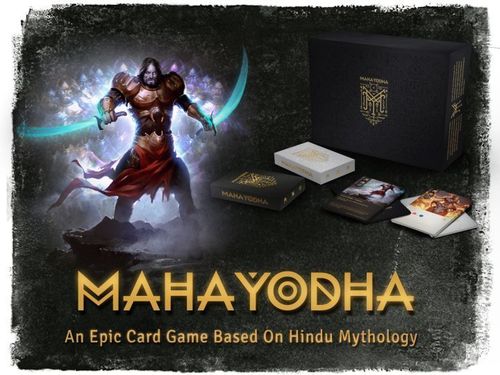
Maha Yodha
Maha Yodha Rulebook
Table of Contents
Table of Contents
Game Objective
To win Maha Yodha you must reduce your opponent's life total from 20 to zero. Each player starts with 20 life. Each turn, by placing Warriors on the battlefield and attacking, you deal damage to your opponent equal to the difference between the attack level of your Warriors and the defence level of the defending player's Warriors. But be careful: if the attack level of your Warriors is lower than the defence level of the defenders, you take the damage.
Know Your Card
Types of Cards
There are three types of cards: Warrior, Weapon and Scroll.
Basic information on a card (on the left side, top to bottom)
- Card type
- Attack (red icon)
- Defence (blue icon)
Also on the card: the name and category; the properties (e.g. "Special: +1 attack OR -1 defence"); and a historical fact.
Icon on the right (lightning): the number in the icon shows the card's cost in Valor points. This is the number of points the player must pay to bring the card onto the battlefield from the hand.
Types of Cards
Warrior
These cards are used to attack the opponent. They show attack levels (red icon) and defence levels (blue icon). Some Warriors also have special properties and abilities, given in the card text. A player may bring onto the battlefield any number of Warriors that he has enough Valor for.
Weapon
These cards can be used together with Warrior cards, adding a bonus to the attack level (red icon) and/or defence level (blue icon). A player may place Weapon cards on the battlefield only if his Warrior cards are there. Any number of Weapon cards may be assigned to one Warrior.
Each Weapon combines best with one specific Warrior. The Warrior's name is given in the Weapon card's text, and when the Weapon is assigned to that Warrior a combination is created that gives the player a special bonus (as a rule, an additional Valor point for that turn).
Note: if a Warrior or Weapon card has no red or blue icon, that parameter (attack or defence respectively) is considered equal to zero for that card.
Scrolls
These cards have special properties described in the card text. The card's properties are active while the card is on the battlefield.
Scroll cards can be played without having Warrior cards on the battlefield. Any number of Scrolls may be played that you have enough Valor for.
Game Setup
Each player chooses a deck and shuffles it. To determine the first player, flip a coin or roll a die. The first player decides whether to go first or to give this right to the opponent.
First player's turn
The first player draws 6 cards from the deck. Before the Placement phase begins he must discard one card. On his first turn the first player cannot attack, since there are no cards of the second player on the battlefield. The best strategy on this turn is to bring onto the battlefield cards with the maximum defence level.
Second player's turn
The second player draws 5 cards from the deck. He can attack the first player's defenders, playing cards according to his Valor supply.
Turn Sequence
Each player's turn in Maha Yodha consists of four phases:
- REGROUP (Перемирие). Remove all active Scroll cards from the battlefield and put them in the discard pile. Take the Warrior and Weapon cards from the battlefield into your hand. If you now have more than 5 cards in hand, discard the excess. During the Regroup phase the player may discard several cards. Note: the Regroup phase is not needed on the first turns of both players.
- DRAW. On each turn you may draw from the deck any number of cards while you have fewer than 5 cards in hand. To move on to the Draw phase, the Regroup phase must be fully completed; the cards the player has chosen are discarded.
- PLACEMENT. After drawing, the player may play cards from hand onto the battlefield. On each turn the player has 5 Valor points for placing cards, if this amount is not affected by combinations and/or Scrolls.
- ATTACK. Count the damage dealt.
- END OF TURN.
1. Placement
On the first turn you have 5 Valor points, which you can spend to place cards on your half of the battlefield according to their cost in Valor points. With each card played, its cost is subtracted from your Valor supply for this turn. You cannot place a card whose cost is higher than the Valor you currently have. Note that some Scrolls and "Warrior + Weapon" combinations give you an increase to your Valor supply.
Example: to begin with, you play the card RAMA (Warrior) for 3 Valor points. You have 2 Valor points left. Now you can play the card KODANDA (Weapon) for one Valor point, assigning it to the Warrior RAMA. Since KODANDA gives a bonus of one Valor point in combination with RAMA, you now have 2 Valor points in your supply instead of one.
2. Attack
Add up the attack levels of your Warriors, Weapons and Scrolls. If the total attack level of your cards is higher than the total defence level of the opponent's cards, you deal him damage equal to the difference of these levels (attack minus defence). However, if the total attack level of your cards is lower than the total defence level of the opponent's cards, you take damage from the counterattack equal to the difference of these levels (defence minus attack). Note that you can attack the opponent only if you played at least one Warrior card this turn. If you do so, you MUST attack at the end of the turn.
Example (diagram: Player 1 has RAMA, VANARAS and VISHWAKARMA'S FORGE; Player 2 has RAAVAN and JYESTHA'S BOON; Total Defence is counted first, then Total Attack, 1+1+2-2): you played RAMA (1 attack and 3 defence), AINDRASTRA (+1 attack and +1 defence) and the Scroll VISHWAKARMA'S FORGE (+2 attack or +2 defence). You chose +2 attack. Thus your total attack level is 4. Your opponent, on his turn, played RAAVAN (3 attack and 1 defence). He also has on the battlefield the Scroll JYESTHA'S BOON (-2 to the opponent's attack level and -2 to defence level), which lowers your total attack level to 2. Thus you deal the opponent 1 point of damage, with your attack level of 2 against his defence level of 1.
Reminder
- Each player starts with 20 life.
- The first player draws 6 cards from the deck, one of which he must discard before the Placement phase begins. The first player cannot attack on his first turn.
- The second player can attack on his first turn. However, he draws only 5 cards from the deck.
- The game ends when one of the players has 0 life left.
- When a card is discarded during the game, it is placed face up in that army's discard pile.
- When a player's deck runs out, the discard pile is shuffled and placed face down as that player's new deck.