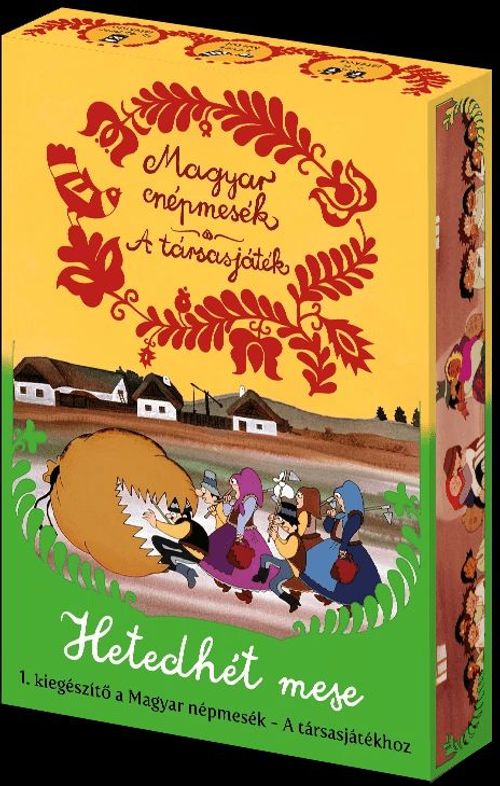
Magyar népmesék: Hetedhét mese
Official rulebook: Kard és Korona Kft. (Korona Games) · PDF
Magyar népmesék: Hetedhét mese Rulebook
Table of Contents
Table of Contents
- Components
- Using The Expansion
- Choosing a Story
- Rabbit Shepherd (Nyúlpásztor)
- Silk Meadow (Selyemrét)
- Singing Grapes, Smiling Apple, Ringing Peach (Szóló szőlő, mosolygó alma, csengő barack)
- The Two Komas (A két koma)
- King Little Miklós (Király kis Miklós)
- The Little Gömböc (A kis gömböc)
- Fox Koma (Róka koma)
- Additional Rules and New Heroes
Components
- 3 dragon figures
- 3 folktale hero figures (King Little Miklós, and the two komas)
- 2 character sheets
- 1 wolf wooden figure
- 1 pig wooden figure
- 1 fox wooden figure
- 1 sack / little gömböc wooden figure
- 1 four-sided die
- 12 glass pebbles
- 24 devil soldier / rabbit tokens
- 8 peach tokens
- 8 apple tokens
- 8 grape tokens
- 7 story sheets
- 15 building location cards
- 24 animal location cards
- 39 location cards
The components list above is taken from the printed list on the rules booklet's cover page. Each story below also names the components it uses.
Warning printed on the cover: this expansion can only be played together with Magyar népmesék: A társasjátékkal (the base game).
Using The Expansion
The expansion's own rules are set out below. Where a story's rules differ from the base game, the story says so under "Differences from the base rules". The following general rules apply to all stories:
- Do not use the base game's Folktale cards (mesekártyák).
- Pinkó does not help on adventure fields and does not go into any player's satchel.
- If a player lands on a special field, its effect is carried out in the same way as in the base game.
- Location cards are sorted by the colour of their frame according to what each story's setup requires. Each card belongs to one adventure field on the board. Each adventure field appears on three cards, one with the sun, one with the moon and one with the star on it.
- The sun, moon and star symbols on the location cards are called Sun (Nap), Moon (Hold) and Star (Csillag) in the story rules.
Choosing a Story
Choose a story and read its description. There you will find the components needed and the special rules for that story.
Stories are grouped by complexity:
- Simple (one icon)
- Similar in complexity to the base game (two icons)
- A new challenge with several interesting solutions (three icons)
Stories are grouped by length:
- 10–15 minutes (one hourglass)
- 20–30 minutes (two hourglasses)
- 30–45 minutes (three hourglasses)
Stories are grouped by play mode:
- Cooperative (Együttműködő): every player works toward the shared goal; the players win together or lose together.
- Competitive (Versengő): as in the base game, the players compete against each other.
- Duel (Párbaj): the players form two teams and fight against each other.
Rabbit Shepherd (Nyúlpásztor)
Collect as many of the rabbits that have scattered from the king's court as you can!
Components: 24 rabbit tokens, 24 animal location cards.
Setup
- Take out the Rabbit Shepherd story sheet and place it next to the board.
- Shuffle the green-framed location cards and place them face down next to the story sheet as the draw deck.
- Place rabbits on every adventure field that shows animal characters: place as many rabbits as the field has neighbouring fields (2 or 3 per field, 19 in total). Place the remaining 5 rabbits on the story sheet.
- Tip: if there are fewer rabbits, the player who draws the card decides which neighbouring fields receive them.
- Choose the starting player. Everyone chooses a folktale hero, takes its starting set and places its figure on the Village (as in the base game).
Gameplay
Before each player takes their turn, they must draw a location card. (If the draw deck runs out, shuffle all the cards again.)
- Find the adventure field shown on the card.
- If rabbits are on that adventure field, each rabbit there jumps onto one neighbouring field.
- If a rabbit would jump onto a folktale hero figure, it runs away and is placed on the story sheet.
- If rabbits are on fields neighbouring the adventure field, they all jump into the adventure field.
- If none of the above applies and there are still rabbits on the story sheet, place one of them on the adventure field.
There are two ways to catch rabbits:
- If a rabbit stands on a field that is not an adventure field, and a player ends their move there, the player catches it immediately and places it on their character sheet.
- If a rabbit stands on an adventure field and the player must take a test there, then, in addition to the usual reward, a result of at least 6 also catches the rabbit (= 6+). The rabbit is placed on the character sheet.
Goal
The first player to collect enough rabbits wins, and the game ends immediately.
Choose a short or long game. Use the table to mark the target number on the story sheet with a glass pebble:
| Game length | 2 players | 3 players | 4 players | 5–6 players |
|---|---|---|---|---|
| Short (one hourglass) | 7 rabbits | 6 rabbits | 5 rabbits | 4 rabbits |
| Long (two hourglasses) | 10 rabbits | 8 rabbits | 6 rabbits | 5 rabbits |
Advanced variant
The player who obtains the Magic Whistle can also win the game: when the whistle is blown, all the rabbits run to that player. If a player holds 5 different magical items at the same time, an old woman appears beside them and gives them the whistle in exchange for the items. That player wins the game immediately.
Silk Meadow (Selyemrét)
Cut down the evil devil soldiers that the ugly iron-nosed hag makes to destroy the Green King!
Components: 24 devil soldier tokens, 39 location cards.
Setup
- Take out the Silk Meadow story sheet and place it next to the board.
- Shuffle the location cards and place them face down next to the story sheet as the draw deck.
- Place one devil soldier token on each adventure field that shows a person or a folktale creature (11 in total). Place the remaining 13 devil soldiers on the story sheet.
- Choose the starting player. Everyone chooses a folktale hero, takes its starting set and places its figure on the Village (as in the base game).
Gameplay
- If all the devil soldiers have run out of the story sheet, no more cards need to be drawn.
- If a player takes a test on an adventure field where a devil soldier is located, then, in addition to the usual reward, a result of at least 6 also defeats that devil soldier. The player places it on their character sheet.
Goal
When one player enters the Witch adventure field, they take one last test; when the test ends, the game ends immediately. The Witch and all the devil soldiers escape from the board. The player with the most defeated devil soldiers wins. If there is a tie, there can be more than one winner.
Advanced variant
During setup, place a glass pebble on the Witch adventure field. The Witch escapes only if the devil soldier on that field is defeated. So when a player rolls at least 6 on a test on the Witch's adventure field and cuts down the bodyguard devil soldier, the player also receives the glass pebble. The glass pebble counts as a devil soldier when the players are counting at the end.
Before each player's turn, draw a location card. If the drawn card shows the moon, the Witch weaves a new soldier: place a devil soldier on the adventure field shown on the card.
Singing Grapes, Smiling Apple, Ringing Peach (Szóló szőlő, mosolygó alma, csengő barack)
Collect the singing grapes, the smiling apple and the ringing peach, so that the princess can turn the pig back into a prince!
Components: 24 fruit tokens, 24 animal location cards, 8 glass pebbles, pig wooden figure.
Setup
- Take out the Singing Grapes story sheet and place it next to the board.
- Shuffle the location cards; they form the draw deck.
- Shuffle the fruit tokens face down, and place one at random on each fruit field and each advice field (14 in total), then turn them face up. Place the remaining fruit tokens face down on the story sheet.
- Place one glass pebble on each adventure field showing an animal (8 in total).
- Choose the starting player, and place Pinkó and the draw deck in front of them as a reminder. Place the pig figure beside the deck.
- Everyone chooses a folktale hero, takes its starting set and places its figure on the Village (as in the base game).
Gameplay
At the beginning of each new round, the starting player reveals a location card.
- If the card shows the sun, the pig finds a new treat and jumps to the adventure field shown on the card. Remove the glass pebble from that field. Place a fruit from the story sheet, face up, on the field the pig left.
- If there are no glass pebbles left on the board, no more cards need to be drawn, and the pig no longer moves.
- If a player steps onto a field (or onto any field of an adventure field) where there is a fruit they do not yet have, they immediately take it and place it on their character sheet. If the fruit there is one they already have, they must leave it on the board.
Goal
The game is won by the player who first collects 3 different fruits and then enters the same adventure field where the pig is, or takes the fruits to the princess in the Palace.
The Two Komas (A két koma)
Control one of the komas so that it outwits the other koma!
Components: 2 koma figures, sack wooden figure, four-sided die.
Setup
- Place the sack on the Town.
- Choose the two teams. The teams do not need equal numbers of players.
- Determine the starting team by lot. The starting team chooses a koma. The other team chooses the starting place (the Cat or the Axe), where the komas are placed.
- Each player draws one biscuit at random, with the same number of biscuits for each team.
Gameplay
- The teams take turns in turn order, and within each team the players also take turns; a different team member rolls each time.
- The first koma that enters the Town takes the sack.
- The team that has the sack rolls the four-sided die instead of the white die. The other team rolls the white die.
- If the two teams' komas land on the same field, they duel for the sack. One player from each team rolls the four-sided die. If the result is a tie, roll again. The higher roll takes the sack, and may move the sack the difference between the two rolls in any direction on the board.
- After a duel, the losing side rolls the white die and the chase continues.
- Movement-modifying areas and the other special fields have no effect on the komas.
Differences from the base rules
- The players have no figures of their own. The team members jointly control "their koma".
- When a koma lands on a field that gives a biscuit, its team randomly receives one biscuit.
- Once per round, the koma may move using a biscuit, either before or after the roll.
Goal
The game is won by the team whose koma enters the Village together with the sack.
Advanced rule
- At the start of the game, both komas receive 5 advice tokens each.
- If a koma lands on an advice field, its team receives one advice token.
- In a duel, after the dice rolls, one player from each team secretly hides any number of advice tokens in their hand, so that the opponent cannot see them. With secret bidding, each advice token increases the rolled value by one. For example, if a player rolled a 2 and places two advice tokens, the final value is 4.
- The player with the higher final value takes the sack and may move the difference on the board.
- If the result is a tie, the dice are rolled again, and the advice tokens bid are returned to the players who bid them.
- Otherwise, when a player wins the bid, both sides lose the advice tokens they used.
- The number of advice tokens each side holds is public until the bidding begins, when both sides hide them in their hands.
King Little Miklós (Király kis Miklós)
Help King Little Miklós to recover the sun, the moon and the stars from the three dragons in time!
Components: 3 dragon figures, 39 location cards, King Little Miklós figure.
Setup
- Take out the King Little Miklós story sheet and place it next to the board.
- Shuffle the green location cards and place them face down next to the story sheet as the draw deck.
- Place one dragon on the Town, one on the Palace and one on the Castle.
- Draw animal location cards from the deck depending on the number of players: 2 players draw 1 card, 3–4 players draw 2 cards, 5–6 players draw 3 cards. Place the cards under the story sheet at the matching icons.
- Place the King Little Miklós figure on the Village. Choose the starting player, and place King Little Miklós's character sheet to the starting player's right.
- Everyone chooses a folktale hero and takes its starting set (as in the base game).
- From the grey location cards, take out the three wells; shuffle the rest. Each player draws one card and places their figure on the adventure field shown on it. The building cards are not needed after this.
Differences from the base rules
- King Little Miklós is controlled jointly by the players.
- Movement-modifying areas and the other special fields have no effect on Miklós.
- Nothing can be bought in the Town or the Palace while a dragon stands there.
Gameplay
- At the end of each round, Miklós also moves: one player rolls the yellow die and moves the King Little Miklós figure exactly as many spaces as rolled.
- If Miklós enters a dragon's space, he immediately cuts that dragon down and recovers the stolen celestial body (turn the dragon's cards face down).
- After each move, a new location card must be drawn.
- Collected cards are placed under the dragon that stole the celestial body, according to the body shown on the card: under the 3-headed dragon the stars, under the 7-headed dragon the moons, and under the 12-headed dragon the suns.
- If the folktale heroes ever roll a blank side with the white die, the dragons sense that something is afoot: a new location card must be turned over.
- Animals find it hard to bear the lack of celestial bodies, but the folktale heroes can calm them: if a player takes a test of at least 6 on an animal adventure field, then, in addition to the usual reward, they return one card from the story sheet belonging to that field to the bottom of the draw deck.
- If Miklós moves onto a field that gives out a biscuit, draw a biscuit for him, which he eats at once: he moves exactly as many spaces as the number on the biscuit. The players can also help Miklós: if they are on the same field as him, they can give him a biscuit from their supply.
Goal
The players win together if King Little Miklós successfully cuts down all three dragons.
The players lose together if at least 7 sorrowful animal cards have gathered under any one dragon: that celestial body is lost forever.
If victory is too easy or too hard, the players may choose a different difficulty before the game:
- Easy: the players lose on 8 cards.
- Normal: the players lose on 7 cards.
- Hard: the players lose on 6 cards.
Advanced variant
King Little Miklós has lost his magic sword, and cannot cut down the dragons until a folktale hero hands him their own magic sword. To do so, the hero must step onto the same field as Miklós. If Miklós arrives at a dragon without a sword, they stare each other down: the players do not roll the yellow die, but a new location card must still be drawn.
King Little Miklós's movement also changes:
- On every red field he must stop his movement until the next round, unless a player gives him a Wishing Table.
- On blue fields he may roll the blue die again.
- The Magic Cloak can also be given to Miklós if a player steps onto a field together with him; wearing the cloak, he may move up to seven spaces once.
- After the first dragon is defeated, two location cards are drawn each time King Little Miklós moves.
The Little Gömböc (A kis gömböc)
Stuff the little gömböc so that it bursts before it reaches the Town and eats everyone!
Components: little gömböc figure, 39 location cards, 20 question-mark tokens, 4 glass pebbles.
Setup
- Take out the little gömböc story sheet and place it next to the board.
- If fewer than 6 players are playing, for each missing player place one glass pebble into the gömböc's stomach (on one of the 20 spaces shown on the story sheet).
- Shuffle all the location cards and place them face down next to the story sheet as the draw deck.
- Choose the starting player. Everyone chooses a folktale hero, takes its starting set (as in the base game), and places its figure on the Village or on the Town, as they choose.
- Place the little gömböc figure on the Village.
Differences from the base rules
- Movement-modifying areas and the other special fields have no effect on the little gömböc.
- Panic has broken out in the Town, so nothing can be bought there. It may be covered with Pinkó.
Gameplay
Before each player's turn, draw a location card. Animal cards go to the discard pile; building cards are grouped by the adventure field shown on them.
If all three grey building cards from one location have been collected, the little gömböc figure immediately sets off toward the Town. Before each player's move, it rolls on along the left edge of the board to the next food (the token placed on its path).
The players may place tokens (gold, advice, biscuit) on its path to feed and slow the little gömböc:
- A player may only place tokens from their own supply, and only on the space where their figure currently stands.
- Any number of tokens may be placed on the Town, but each player may place only one token per round.
- On every other field only 1 token may be placed.
- Placed tokens may not be picked up again later.
- After every token placed, place one question-mark token on the story sheet.
- Tokens that have been eaten are placed on the story sheet, replacing one question-mark token each.
- The little gömböc also eats the players if they meet on the path (the player is the next food, or the player tries to run past it). In that case the folktale hero figure goes into the gömböc's stomach, but the tokens the hero carries do not.
Tip: if the question-mark tokens have already filled all the places in the stomach, enough tokens have been placed on the board, and the players have already won.
If the little gömböc reaches the Town without its stomach being full, it eats everything and everyone, and the players lose.
Goal
Burst the little gömböc at the latest when it reaches the Town. This happens when all twenty spaces of its stomach are filled. The heroes it ate earlier are freed, and all players win together.
Advanced variant
The little gömböc does not move backwards. It always moves forward toward the Town. If there is no more food on its path, it rolls straight to the Town without stopping anywhere.
The players do not receive any gold in their starting set. Tokens may no longer be placed on the Town; the gömböc's bottomless stomach must first be filled completely.
Fox Koma (Róka koma)
Lead the foolish wolf after the cunning fox, so that both can feast well at the wedding!
Components: 12 rabbit tokens, 12 glass pebbles, four-sided die, wolf wooden figure, fox wooden figure.
Setup
- Place 12 glass pebbles on the Village.
- Take out the Fox Koma story sheet and place it next to the board.
- Place rabbit tokens on the marked path, counting from the fox adventure field, depending on the number of players:
- 2 players: 5 rabbits (on every 5th field)
- 3 players: 6 rabbits (on every 4th field)
- 4 players: 8 rabbits (on every 3rd field)
- 5–6 players: 12 rabbits (on every 2nd field)
- Everyone chooses a folktale hero and places it on the fox adventure field.
- Choose or draw the starting player, who will be the fox. Place the fox figure on the fox adventure field, and place the starting player's own figure in front of them.
- Place the wolf figure beside the others.
Differences from the base rules
- Movement-modifying areas and special fields have no effect.
- The players use only their folktale hero figures. Character sheets, items and other components are not needed.
Gameplay
- The players roll the white six-sided die and move, with one exception: the player who leads the fox rolls the red four-sided die.
- After moving, the player leading the fox may hand the fox to any fellow player who is within 4 spaces of them, in either direction. The former owner's figure is then placed on the board in place of the fox, and the new fox owner swaps their own figure for the fox.
- If a player steps onto a field where a rabbit token is, they remove the rabbit token from the board.
- If the wolf steps onto a rabbit token, the rabbit token is removed from the board. The wolf has eaten it, is full, and may not move in the next round (lay the figure down).
- After the wolf has moved (or rested), take one glass pebble from the Village and place it on the story sheet.
- At the end of every complete round, the wolf steps onto either the fox or a rabbit token, whichever is closer.
- The wolf does not move if the nearest rabbit token or the fox is more than 4 spaces away.
Goal
The glass pebbles stand for the food at the wedding. If they run out before the wolf's figure and the other players reach the Village, the wedding is over, the furious wolf catches the cunning fox by the scruff of the neck, and the players lose.
The booklet prints only this losing condition for the story. It does not print a separate winning condition; reaching the Village with the wolf and the other players is the only outcome it describes.
Additional Rules and New Heroes
The elements of the expansion may also be used in the base game, according to the base game's rules.
- Sack starting item: a sack lets you carry 3 more items than the satchel's five slots, so you can carry eight in total. (The sack also takes up a slot, of course.)
- 3 fruit starting items: on the character sheet, place them in the place of the biscuits. When you pass through a red field, any of them may be given in place of a biscuit.
- New folktale heroes: King Little Miklós and The Two Komas.