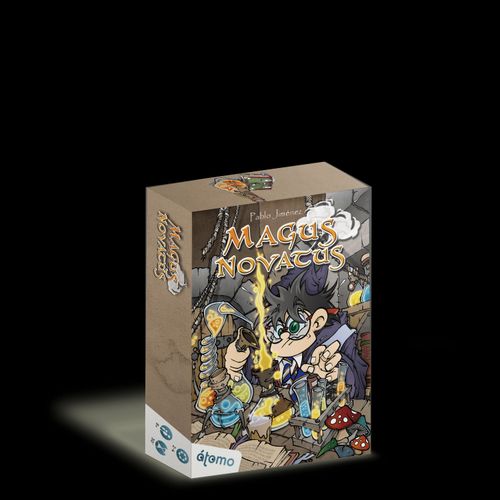
MAGUS NOVATUS
MAGUS NOVATUS Rulebook
Table of Contents
Table of Contents
Components
- 64 Potion Cards
- 30 Spell Cards
- 8 Magical Item Cards
- 1 Magical Cube
- 1 Measuring Cylinder marker
- Rulebook
Concept of the Game
The goal in NOVICIUS WIZARDUS is to be the player with the most point at the end of the game. In order to do so, players will try to get as many Spell cards as possible, which will grant 2, 3 or 4 points depending on their difficulty.
Game Setup
First, create a deck with all the Potion cards, shuffle them and place 25 cards on the table facing up to form a 5x5 Potion grid.
Then, shuffle the remaining Potion cards together with the Magical Item cards to create a deck. Place this deck facing down next to the 5x5 Potion grid.
Also, prepare the 3 Spell decks according to their difficulty (2, 3 and 4). Shuffle them separately and place them facing up (showing the mix of potions) on the other side of the 5x5 Potion grid.
Finally, place the Measuring Cylinder marker on top of the first column of the Potion grid (as shown in the example) and leave the Magical cube within reach of everyone. The starting player will be the one who has been in a laboratory most recently. Otherwise, the youngest player.
Game Turn
A player's turn is divided into the following phases:
- Phase I: Get Potions
- Phase II: Cast a Spell (optional)
- Phase III: Replenish Potions
Phase I: Get Potions
The active player takes the Magical cube and throw it to any part of the Potion grid. Keep in mind that you must respect the minimum height indicated by the Measuring Cylinder, i.e. the hand must be always higher than the imaginary line indicated by the Measuring Cylinder.
The Potion card where the Magical cube has fallen on shows the column (vertical line) and the row (horizontal line) from which the active player may gather Potions. Depending on the Potions they need to get the mix indicated on the Spell cards, the active player must choose one of these two options:
- Take Potions of only one colour from the row or the column
- Take Potions of only one number from the row or the column
The cards drawn from the grid are secretly kept in their hand, keeping them out of other players' sight.
Note 1: If the Magical cube gets out of the Potion grid, the active player may repeat their throw. If it happens again, the player to their left chooses on which Potion card the cube is placed.
Phase II: Cast a Spell (optional)
Once the active player gets the Potions, and if they managed to gather the mix of potions shown on any Spell card, they discard these cards (the mix) and place them on a discard pile next to the Potion deck. The remaining Potion cards in hand are placed on their play area on the table, with the Skull side facing up. Each Skull card will subtract 1 point from their final score when the game ends.
Then, the active player must choose a Spell card matching their mix of potions and must look if there is any effect on its back. If so, the effect is triggered immediately (see the Spell Cards section).
During this phase, a player may use the different Magical Items they have.
Lastly, the active player must to move the Measuring Cylinder one position.
Note 2: The Potion discard pile is placed next to the drawing deck facing up. If it runs out of cards, shuffle the discard pile and place it face down to create a new drawing deck.
Note 3: You cannot cast 2 Spells on the same turn.
Note 4: When having a mix of potions in hand that matches a Spell card, it is not mandatory to discard these cards and to get that Spell card immediately. Maybe, you are not interested in doing so right now.
Phase III: Replenish Potions
The active player must replenish the empty spaces left by the cards they got from the Potion grid. To do so, they must draw cards (one by one) from the Potion deck. Empty spaces must be always replenished from left to right and from top to bottom.
If a Magical Item is drawn while replenishing Potions, the active player will keep it to use it in future turns. However, if more Magical Items are drawn, they will be dealt to the other players in clockwise order.
For example, in a 3-players game, if a first Magical Item is drawn during the Replenish phase, the active player will keep it. If a second Item is drawn, it will be dealt to the player no. 2 to the left of the active player. And if a third Item is drawn, it will be dealt to the player no. 3 to the left of the player no. 2, so on and so forth.
Finally, the turn passes to the next player in clockwise order.
Types of Cards
Potion Cards
Potion cards are represented by a potion with a specific colour (red, yellow, green or blue) and a number (1, 2, 3 or 4). With these cards, you will try to have in hand any mix of potions shown on the revealed Spell cards.
These cards also have a Skull on their back. When you complete a Spell with the cards in hand, you discard those cards. However, it is possible that you don't use all your cards; in that case, place your remaining cards in your play area with the back facing up (Skull) as a penalty. At the end of the game, each Skull will subtract 1 point from your final score.
Spell Cards
Spell cards are represented by a number indicating the final points that Spell grants (with values of 2, 3 and 4). They also have a series of potions which you should gather in your hand in order to get that Spell card.
Obviously, the series will be more difficult on Spells with a higher score. The different icons in a series of potions in Spell cards can be:
Colours
- The colour of a Potion: It indicates the colour of the Potion you need to gather.
- Black/grey Potions: Each black/grey colour represents a colour of your choice. If there are black Potions and grey Potions on the same Spell card, you must choose and gather different colours, i.e. one for the black and one for the grey.
- Multicolour Potions: They represent any colour.
Numbers
- The number of a Potion: It indicates the number of the Potion you need to gather. If the Potion doesn't have a number, you can use any number as long as you respect the colour.
- Icons with symbols: The symbols represent the different numbers to choose and they must be always different from each other. However, numbers can be repeated in a series of Potions with a different colour.
Example (page 9 of the rulebook): You need 3 Potions of a chosen colour (black Potions) and other 3 Potions of a chosen colour different from the previous one (grey Potions). Numbers must be different in a single colour, but the same number can be repeated in both colours (black and grey).
When a player gets a Spell, they place them in front of them on the table so all players can see the points each other has at all time.
Additionally, the back of some Spells has an effect that must be triggered the moment a player gets that Spell. These effects are the following:
- GREATESTE THIEVESI: Starting with the active player and in clockwise order, all players draw 1 card from the Potion deck and put it in their hands. If a Magical Item card is drawn, it must be left on the table (see Magical Item Cards section).
- SHAKUM THINGSIS UP: All players lose 1 Magical Item card (except for Curses).
- UNLEASHUS CURSUS: Players with a Curse pass it to the player on their left.
- GOUS BACKUS: The Measuring Cylinder marker is moved 1 space back.
- CIAO DEVILUS: Simultaneously, all players pass 1 Skull card (one they have on the table) to the player on their left. If a player doesn't have a Skull card on the table, they pass nothing.
- PRESENTIS FOR YOUM: Simultaneously, all players pass 1 card from their hand to the player on their left. If a player doesn't have cards in hand, they pass nothing.
Note 5: Spell cards with a closed book on their back have no effect to trigger.
Magical Item Cards
The Magical Item cards grant some advantages and benefits. When a player is replenishing the Potion grid on the table, they may draw a Magical Item card. If this happens, that player places the Item on their play area facing up and continues replenishing the grid. If this happens again, the next player will keep the Item, so on and so forth until the Potion grid has been completely replenished.
The Magical Items will be accumulated on your play area facing up. There is no limit of Magical Items you may have and they can be only used during phase II of your turn. You may use as many as you want during your turn and, once they have been used, they are discarded into the discard pile.
- HEALING PLANTS: It allows you to discard 1 Skull card from your play area, so it won't count negatively at the end of the game.
- ELIXIR: It is a wild Potion that grants you any colour and number. It will make easier to complete Spells.
- MAGIC WAND: It allows you to look at the discard pile and draw 1 Potion card of your choice to put it in your hand.
- CURSE: You cannot cast a Spell while you have a Curse on your play area and you cannot have more than 1 Curse. So, if a player draws a second Curse, the next player gets it, etc.
A player may discard 2 Potion cards from their hand to remove the Curse (it will be placed into the discard pile), or they may discard 3 cards from their hand to give the Curse to another player.
Measuring Cylinder Marker
It is the Cylinder placed on top of the Potion grid (on the left). When a player gets to cast a Spell, they must move the Measuring Cylinder 1 space forward. Doing so, the game will end when the Cylinder reaches the position indicate of the scheme and then points will be scored. The position will depent of players number.
The rulebook's diagram shows the cylinder at its starting position and after casting a Spell, with three end positions labelled: A. End of the game 2 players; B. End of the game 3 players; C. End of the game 4 players.
End of the Game
When a player moves the Measuring Cylinder to its last position, the other players must discard their cards in hand and so the game ends.
Now, players tally their points from their Spell cards and subtract -1 point for each Skull card they have on their play area. The player with the most points is the winner of the game. In case of a tie, the player with the least Skulls is the winner. If there is still a tie, the player with the most 4-points Spells is the winner. If the tie continues, the player with the most 3-points Spells is the winner. If, even so, there is still a tie, the player with the most 2-points Spells is the winner. In the strange situation that the tie persists, the tied players will be accepted in the Ludikah School of Witchcraft.
Additional Game Modes
Outstanding Students
For those who enjoy thinking in different options and avoiding chance, all they have to do is to play without the Magical cube. During phase I of a turn (Get Potions), the active player will directly choose a row or a column to gather the necessary Potions to cast a Spell.
Infant Students
For the children of the house, you may start with the easiest game mode. It consists of removing the Magical Item cards from the game and playing with this only one condition to cast a Spell: it will be only necessary the mix of colours, don't take into account the numbers/symbols on the Potions of the different Spell cards. Likewise, don't take into account the effects some Spells have (the ones on their back). The player who first gains 9 points is the winner.