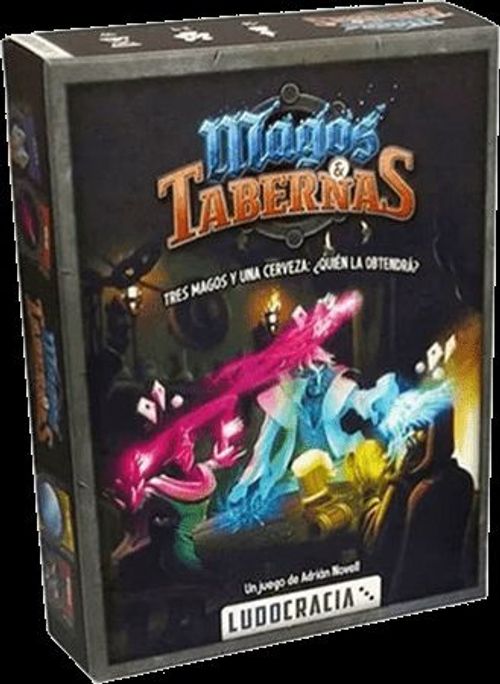
Magos y Tabernas
Magos y Tabernas Rulebook
Table of Contents
Table of Contents
Symbology
- Instant card
- Spell card
- Object card
- Orb (●)
- Gem (◆)
- Life Gem (red ◆)
Introduction
A group of seasoned and powerful mages finds itself in a tavern, where they realize that only one beer is left. They decide to compete through an ancient card game of magic: the first to condense their energy into precious Gems (◆) will get their drink. However, it won't be easy, since those Gems can be destroyed, copied, and so on.
To win the beer they need to generate three Gems. However, to add some spice, each mage has put two cards down as obstacles. Lacking imagination, they decided that each card is also obtained with three Gems.
They take turns, each having one action, which can be used to generate an Orb (●), use a card, or draw one.
Components
- 40 Cards
- 9 White Gems
- 6 Red Gems
- 1 Beer (fake!)
- 9 Orbs
- 1 Rulebook
Setting Up the Game
Layout (see the setup diagram in the manual):
- A. The beer in the middle of the table. It is the objective to get!
- B. Two cards at random (without looking at them!), face down in front of each player. These protect the objective. If you obtain them, you level up!
- C. The three cards each player starts with in hand. Careful: the opponent must not see them!
- D. General deck: powers are obtained from here.
- E. Discard pile: where the cards that have been used go.
- F. Gems and Orbs at hand! They will let you get your objective.
The most drunk mage starts!
The Beer: Go For It!
To get the beer, each player needs 3 Gems (◆). But first they must obtain the cards that protect it.
Gems and Orbs
How are the cards that keep us from getting the beer obtained? The same as the beer: with 3 Gems (◆)! The diagram shows how a player goes from having 2 Gems (A) to having 3 (B). That third Gem instantly gives the player one of the cards that protect the beer (C), and the player levels up.
Levels:
- On obtaining the first card, the player increases their hand limit from 3 to 4.
- On obtaining the second card, the player increases their maximum number of objects in play from 3 to 4.
How do I get a Gem? Automatically, by gathering 3 Orbs (●)!
Start and Turn
Once the table is set up and each player has been dealt their three starting cards at random, the game begins: the most drunk mage is the first to play!
On each turn, players have 1 action point, which can be used to do one of the following:
- Obtain an Orb (●)
- Draw a card from the general deck
- Play a card
If the action point is not used, it is lost (it does not accumulate). The player may also decide to pass their turn.
Example of turns (from the manual's diagram):
- Merlin: uses a Spell card! (end of turn)
- Gandalf: draws a card. (end of turn)
- Houdini: draws an Orb. (end of turn)
The Cards!
There are 4 different types of cards: Spell, Instant, Object, and Object with Gem. Understanding how they are used is key!
Spell Card
- Costs 1 action point to use.
- When used, its effect is executed and the card goes to the discard pile.
Example of use: I use the Spell card Atacar (Attack). Since using it requires 1 action point, I can only do it on my turn, and after using it my turn ends.
Instant Card
- Costs 0 action points to use.
- Can be used at any moment, so it is not necessary for it to be your turn.
- When used, its effect is executed and the card goes to the discard pile.
Example of use A: I play 1 Instant card on an opponent's turn.
Example of use B: On my turn I play an Instant card, and since I still have 1 action point, I use it to draw a card.
Object Card
- Costs 1 action point to LAY IT DOWN (bajarla).
- Once on the table, the object can be consumed. This may cost 1 or 0 action points, depending on the card.
Example of use: With 1 action point, I lay down the object Anulador and end my turn. Some turns later I decide to consume the object with another action point, activating its effect and ending my turn.
VERY IMPORTANT: The first time each object is used, its effect is NOT executed; instead, it is laid down on the table. Only once it is on the table can it be consumed. Consuming them usually costs another action point, which means they take 2 turns to use (one to lay down the object, another turn to consume it). Therefore: its effect CANNOT be played directly from hand. This must be perfectly clear!
Objects are laid down and placed beneath the cards to be obtained.
Once laid down, objects do not need to be consumed; they can stay there indefinitely. There can be up to 3 objects on the table per player.
Object with Gem Card
- Costs 1 action point to lay it down.
- Once on the table, it has a passive effect that lasts as long as it is in play.
- These cards have life gems (red ◆). Life gems can be removed by cards that destroy red ◆.
- If an object is left without any ◆, it is destroyed.
- They usually have consume effects like other objects. When consumed, the object is broken and its passive effect is lost.
Using the Cards
The manual's diagram summarizes where each card type goes:
- Instant: play at any moment; discarded immediately.
- Spell: play on your turn; discarded immediately.
- Object: laid down on the table; when consumed, it is discarded.
The discard pile is the Discard (Descarte).
Other Rules
- You cannot end your turn with more than 3 cards in hand. If you end your turn with 4 cards, you must discard one or use it.
- When the deck runs out, the cards in the discard pile are gathered, shuffled, and a new general deck is formed.
- When cards that interact with the effects of other cards are used, the effect of the last card played is resolved first, then the one before it, and so on until reaching the first card played at that moment.
- There is no player priority when playing Instant cards. Anyone can play one at the moment they see fit, and afterwards the effects are resolved accordingly.
- There are surely many things this manual does not explain: the idea is that they are resolved with the players' common sense! The discussion that arises is part of the game.
Other Game Modes
Quick mode: Instead of placing 2 cards before the beer, you may place just one. This reduces the playing time of each game.
2 vs. 2: Two pairs face off; if one of them wins, the pair wins. Keep in mind that many card effects are global, meaning they can be used to help the pair.
Card Explanations
If you have started playing and some cards are confusing or hard to understand, here is an explanation for some of them.
- Plagio: Can copy the effect of another card that has been played this turn. It cannot copy the effect of an Object that is being laid down (bajado). It only copies the effect of the Object when it was consumed.
- Anulador: Canceling an action means that anything a player is doing is interrupted. For example: playing any type of card, drawing an Orb, or drawing a card. If a card is canceled, that card is lost, meaning it goes to the discard pile. This logic also applies to the card Interrupción.
- Flash: Turns any card into an Instant, including Objects! For example, I can play Gem + Flash (directly from my hand), thereby automatically obtaining a Gem (◆). The Flash card cannot be played alone.
- Agujero Negro: Only the player who laid down this card can use their turn to draw an Orb (●) while this card is in play. However, cards that give Orbs can be used normally. At any moment it can be broken to obtain 2 Orbs (●) in exchange.