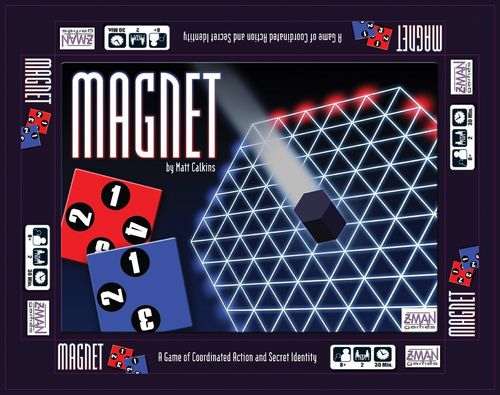
Magnet
Magnet Rulebook
Table of Contents
Table of Contents
Object
The object of the game is to control the center vertex with your king, or to capture your opponent's king.
Components
The board has 91 vertices, on which the 24 pieces (12 red, 12 blue) may reside during the game. The center vertex is labeled with a white starburst. Setup vertices are marked with a red or blue glow.
One black hexagonal pillar is used to represent the magnet.
Each player has twelve pieces:
- Three Fours (inward face shows 1, 2, 3, 4)
- Three Threes (inward face shows 1, 2, 3)
- Three Twos (inward face shows 1, 2)
- Two Traps (inward face shows 1, 2 and an X by the 2; one trap also shows 3)
- One King (inward face shows 1 and a crown)
The outward face of all pieces is identical (it shows only the number 1 at the top, and the numbers 2, 3, 4 are shown in the same positions on every piece).
Each of these pieces has an inward face, on which its value is revealed, and an outward face, on which it appears identical to other pieces.
Setup
Each player arranges his/her twelve pieces in any order into the twelve starting vertices on his side of the board. These twelve vertices are marked with the player's color.
Random variant: allocate pieces into starting spaces at random.
All pieces are arranged with identical outward faces pointing toward the opponent so that their values are concealed. All pieces begin with the number "1" pointing upward on their outward face.
Pieces: Rank and Value
Each piece (including the king and the traps) has a rank and a value.
Rank is the number currently positioned at the top of the inner and outer faces (always the same number). Rank indicates the distance a piece can move in a single turn. Rank can increase during the game. All pieces begin with a rank of 1, but they may be promoted after movement. (The king's rank is always 1.)
Value is the greatest number printed on the inward face (1-4). This is the highest rank a piece may attain. Once a piece's rank equals its value, it cannot be promoted further.
Example: a piece with a 2 at the top and a 3 as its greatest number has a rank of two and a value of three.
Turns
Turns alternate between the players, beginning with the red player. A turn involves placing the magnet, which affects the position of one or more of the player's own pieces.
When a turn is finished, if neither player has won the game, the magnet is removed from the board and given to the other player.
Placing the Magnet
The magnet is placed in any vertex on the board, occupied or otherwise, so long as at least one piece is caused to move.
The magnet affects the closest friendly piece along each of the lines radiating from its location. A piece that occupies the same space as the magnet is not affected.
Example 1 (Red's move): Piece A does not lie on a line radiating from the magnet's position (M), and is not affected by it. Piece B lies on a line radiating from the magnet's position (M), and is affected by the magnet.
Example 2 (Red's move): Piece A is affected by the magnet (M). Piece C lies on a line radiating from the magnet's position (M), but is blocked by piece A and is not affected. Piece X is an opposing piece and is not affected. Piece B is affected because opposing pieces do not block the magnet.
Moving Affected Pieces
The active player chooses the order in which affected pieces execute their moves. One piece must complete its move before the next piece begins. When all affected pieces have moved, the turn is over.
A move is the following three activities, in order:
1. Change Position
The affected piece moves toward the magnet a number of steps equal to its rank. If it enters the vertex with the magnet, it stops there. It also stops moving if the next step would bring it into collision with a friendly piece.
Example (Red's move): Piece A (rank 2) is affected by the magnet (M) and will move two vertices towards the position of the magnet (M).
Example (Red's move): Pieces A (rank 2) and B (rank 3) are going to move. Red decides to move A first, moving it to the same vertex as the magnet (M). Red can then move B only two vertices even though it is rank 3, because it is blocked by piece A. Note that Red could have moved piece B before A, and then B would have blocked A instead.
2. Capture
Pieces never share a vertex. Where there is contact there is always a capture. A moving piece captures every opposing piece it encounters in the course of the move. Captured pieces are removed from the game. It is possible for a single piece to capture multiple opposing pieces in the course of a single move.
Reveal the value of the captured piece(s). If the king is captured, the game ends immediately. If a trap is captured, the capturing piece is also removed from the game. A capturing piece destroyed by a trap still makes every capture in its intended move before it is removed from the game. If the king is destroyed by capturing a trap, the game ends immediately.
Example (Red's move): Piece A (rank 3) will capture both piece X and piece Y on this move. This is true even if X is a trap. Pieces X and Y are removed from the board. If neither piece was a trap, piece A would complete its move as shown.
3. Promote
Pieces that change position can be promoted. Promoted pieces increase their rank by one. Change the rank by rotating the piece clockwise so the next higher number reads at the top of the inward face. (The same number will be indicated on the top of the outward face.)
Rank can never be decreased, nor increased by more than one point per turn, nor increased beyond the value of the piece.
Example promotion: a piece rotated from rank 2 to rank 3.
Opening Move
Red takes the first turn, but may move only one piece, even if more than one piece is affected by the magnet. On Blue's reply, and all turns thereafter, there is no limit to the number of pieces that move.
Winning the Game
The game is won instantly whenever a king is captured. No further moves take place.
The game can also be won by controlling the center vertex with the king. At the beginning of a turn, but not at the end, a player may declare victory if his/her king is at the center vertex. (Thus it is not enough to move the king onto the center vertex, the king must also survive there during the opponent's turn.)
Stalemate
If exactly the same position is reached three times, the game ends in a draw.
Two-King Victory
If the only pieces left in the game are the two kings, the first king to reach the center vertex wins immediately.