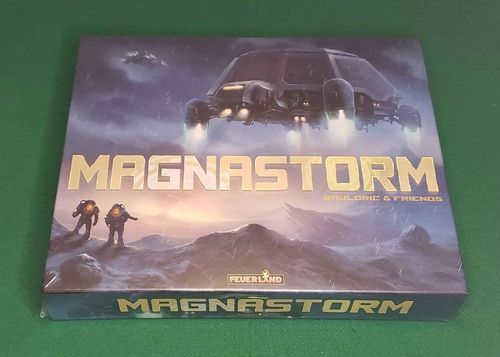
Magnastorm
Magnastorm Rulebook
Table of Contents
Table of Contents
The Story of Magnastorm
When the exploration ships of the Earth Alliance discover the new planet, they notice a gigantic, glowing magnetic storm raging under the clouds. However, the surface is overcast by an oppressive gloom.
In 2340 Earth is controlled by 4 peaceful federations: NEU (New Europe), SONA (States of North America), PACO (Pacific Confederation) and DASH (Democratic Alliance of the Southern Hemisphere). The Planetary Council of Earth instructs the exploration companies of the 4 federations to scan the planet for valuable resources.
After the first ground units reach the surface, they make an amazing discovery: relics of an alien civilization suggest the planet was not always desolate and empty. An apocalypse must have changed the planet drastically and the culture of that time has been erased.
Surprised by these unexpected discoveries, the Alliance establishes an administrative center and a research station in orbit - not only to explore the extraction of resources, but also the past of the lost culture.
As a representative of one of the four federations you and your team set out to gain reputation for yourself and your federation. From your lander you look down on Magnastorm.
Components
Shared Components
- 1 game board (double sided: for 2/3 or 4 players)
- 1 center tile showing 3 (green) quiet sectors and 3 (red) storm sectors
- 1 action board (double sided: for 2/3 or 4 players), with 2 action panels (double sided: for 2/3 or 4 players)
- 1 research board (with slots for 4 objective cards) (double sided: for 2/3 or 4 players)
- 16 commander tiles: 8 administrative commanders (front/back) and 8 research commanders (front/back)
- 1 first player token
- 8 objective cards (remove the 8 cards with German text): 4 research objective cards (front/back) and 4 sector objective cards (front/back)
- 16 commander cards: 8 administrative commanders (front/back) and 8 research commanders (front/back)
- 15 neutral yellow crew members
- 25 neutral CreditCubes each in 2 colors (yellow & black)
- 4 cover-up tiles for the 2-player game
- 120 artifact cards (30 bronze, 60 silver, 30 gold)
- 1 cloth bag
Components in Each of the 4 Player Colors
- 1 player board
- 3 transmitter stations
- 10 turtle labs
- 1 scout runner
- 14 markers
- 5 crew members
- 25 CreditCubes
Game Setup: General
The following pictures illustrate the setup for a 4-player game. The setup for the 2- or 3-player variant is described in the text below.
A. Place the game board between you and the other players. In a 4-player game use the side with the 4-player symbol. In a 2-player or 3-player game use the side with the corresponding 2-to-3 player symbol. Decide if you want to begin in starting area #1 or #2. For your 1st game, we recommend that you use starting area #1 in the lower left sector.
B. Place the center tile in the middle of the board with 1 or 2 (for starting area 1 or 2) facing up. Place the center tile so that the round indicator arrow on the board is pointing at the round number 1.
C. Place the research board next to the game board. In a 4-player game use the side with the 4-player symbol. In a 2-player or 3-player game use the side with the 2-to-3 player symbol. In a 2-player game also cover up each of the 4 reputation spaces showing the number "3" with a cover-up tile.
Shuffle the 8 research commander tiles and randomly place 4 of them on the empty spaces at the top of the research board. In a 2- or 3-player game only use the three spaces on the left (the dark right space remains empty). The remaining commander tiles are not needed for the rest of the game.
D. Place the action board next to the game board and place the 2 action panels on their designated spaces on the board. In a 4-player game use the sides with the 4-player symbol. In a 2-player or 3-player game use the sides with the 2-to-3 player symbol.
E. Place the first player token in the left-most commander space at the top of the action board.
F. Shuffle the 8 administrative commander tiles and randomly place 4 of them on the remaining empty spaces at the top of the action board. In a 2- or 3-player game only use the three spaces to the right of the first player token (the dark space on the right remains empty). The remaining commander tiles are not needed for the rest of the game.
G. Place 3 neutral (yellow) crew members under each commander tile on the top empty spaces of the upper action panel. Do the same for the left column below the first player token. (In a 2- or 3-player game the rightmost column stays empty.)
H. Find all commander cards corresponding to the selected commander tiles and place them face up on the table. The remaining commander cards are not needed.
I. Shuffle the research objective cards and randomly place 2 of them face up in the slots on the left side of the research board.
J. Shuffle the sector objective cards and randomly place 2 of them face up in the slots on the right side of the research board. The remaining objective cards are not needed for the rest of the game.
K. Players choose a federation color. Put 25 black CreditCubes into the black bag and add 3 yellow and 3 of each player's color. (The shown CreditCubes are placed into the bag in a 4-player game.) Put the yellow CreditCubes and the remaining player color CreditCubes next to the board, they form the general supply. Place all CreditCubes with colors not participating in the game back into the box.
L. Place the artifact cards aside, you only need them at the end of the game.
Game Setup: Player
M. Take the corresponding player board and the game material in the color of your federation. Place 10 turtle labs, 5 crew members, 8 markers, and 3 transmitter stations on your player board. Take 2 of the CreditCubes in your color. (The space transporter at the top of your player board is meant to be used as a repository for the CreditCubes in your possession.)
You can tell which player color a board belongs to by the color of the CreditCubes in the row at the bottom of the board.
N. Place your scout runner on the chosen starting area on the board.
O. Each player places 1 marker on level 0 of the reputation track on the game board.
P. Each player places 1 marker onto the hexagon at the bottom of each column of the research board.
Q. The last marker is used to show the turn order (on the action board). In a game with 2 or 3 players each of you needs 1 marker less. Return them to the box.
Goal of the Game
During the game, you travel across the planet with your scout runner to place the turtle labs. These turtle labs collect resources and let you also research the lost civilization, which allows you to advance in the research areas. The placed turtle labs and the knowledge from the research areas are important requirements for fulfilling objective cards.
The goal of the game is to be the first player with 27 reputation points (reputation). In a 3-player game you need 23 and in a 2-player game 25 reputation points. Reputation is represented by medals.
You acquire reputation through:
- Fulfilling objectives: Fulfill up to 4 objectives in the game. Whoever fulfills an objective first receives the most points.
- Taking control of a commander: Gain reputation every time you take control of a commander.
- The sector majority at the end of a round: If you have the majority of turtle labs in a sector at the end of a round, gain 1 reputation.
- Building transmitter stations: Gain 2 reputation for each transmitter station you build.
Starting Positions
1) Turn Order
Select a starting player. Beginning with the starting player and continuing clockwise, all players place their markers on the turn order track (position "1" for the first player, position "2" for the second player, and so on).
2) Putting Crew Members into the Command Center of the Action Panel
In turn order, all players place 1 of their crew members on an empty space on the upper action panel. When choosing starting positions, players cannot place their crew member in the same column as previously-placed crew. Only the first player has free choice. Place your crew members below a neutral (yellow) crew member.
3) Gain Knowledge Through Research
Starting with the last player and continuing in counter-clockwise order, each player advances 1 of their markers 1 level in one of the research areas. Each player must advance in a different area.
4) Turn Order Bonuses
The 3rd and 4th players both receive 1 additional CreditCube in their player color from the general supply. (Place them in your personal supply on your player board.)
Gameplay
Rounds
Each round consists of two phases. In the 1st phase, each player takes turns in order, performing a single action (starting with the player on position 1 of the turn order). This continues until the upper action panel is empty. When the last crew member has been moved from the upper action panel to the lower action panel, the 1st phase ends. The 2nd phase is the administration phase.
Phase 1: Turns
On your turn, you will choose between 1 of the 2 following options:
- Take over a commander, or
- Perform an action on the lower action panel
Afterwards you may fulfill 1 objective as a free action.
1) Take Over a Commander (or Buy the First Player Token)
To perform this action, pay 1 CreditCube of the corresponding color for every crew member standing on the upper action panel below the commander. The paid CreditCubes are returned to the general supply. Then take these crew members from the upper action panel and place them on any available spaces on the lower action panel. (Placing them on the lower panel has no effect other than to block these spaces for later actions.)
Place 1 of your markers in the space directly under the commander tile. Take the corresponding commander card, which you place in front of you. You immediately receive reputation as indicated by the green number on the card. From now on, the commander will be at your disposal. (If the commander has an instant effect, you may now use it once. See the List of Commanders below.)
A commander who has no crew members below cannot be taken over. So every commander can only be taken over once per round.
If a commander is already controlled by another player, you have to pay an additional CreditCube of this player's color to the general supply to take over the commander. Proceed as above: place 1 of your markers under the commander tile and gain reputation as indicated by the green number on the card. The other player takes back their marker and hands the commander's card over to you, and loses reputation as indicated by the red number on the card.
The commander in the left-most column has a special function. Whoever controls him will be the first player in the following round. Take the first player token and get the bonus shown on it. Do not place a marker under this commander. (Place the first player token next to you. In the following administration phase you will put it back on the game board.)
You cannot take over a commander who is already under your control.
2) Perform an Action on the Lower Action Panel
To perform an action on the lower action panel, take a neutral (yellow) or a crew member of your own color from the upper panel and place it on any free space on the lower action panel.
Only if there are no neutral (yellow) crew members and no crew members of your own color left on the entire upper panel may you take a crew member of an opponent player's color.
The lower action panel offers you 2 different options, but you may only choose 1 of them:
- A) Move your scout runner (and drop off a turtle lab), or
- B) Gain CreditCubes
For option A the row you placed your crew member in determines the cost you must pay for the movement. For option B it determines which CreditCubes you receive.
A) Move a Scout Runner (and Drop Off a Turtle Lab)
The costs for the scout runner movement are shown under the scout runner icon. Look at the section of the red display on the left, corresponding to the row in which you placed your crew member, and pay the cost (CreditCubes) in the displayed colors to the general supply. Black always stands for your own player color! After paying the cost you may move your scout runner.
Scout runner movement
The catastrophe that happened here left a desolate and rugged surface. Your scout runner struggles through dust and rubble to search for possible landing spots for your turtle labs.
A scout runner can move to another space (empty or occupied) within its current area or via a connecting line to a space in an adjacent area. Spaces are represented by round research icons on the game board. An area consists of 1-3 spaces. When you end a movement on a space without a turtle lab, you can place 1 of your own turtle labs there (you may have to pay extra costs).
Movement details
- You can end your movement on a space with your own turtle lab or a turtle lab belonging to another player. However, you are not allowed to place a turtle lab there.
- If there is at least 1 transmitter station on the board, you can start your movement at one of these stations. (If you own the station, you don't have to pay anything to use it; otherwise pay 1 CreditCube of your choice to the owner.) You cannot move through a transmitter space, even if there is no transmitter station there yet.
- You cannot move your scout runner onto a space within any of the 3 storm sectors.
- If your scout runner is already in one of the 3 storm sectors, you must move your scout runner into a quiet sector. If that is not possible, you must move clockwise towards the nearest quiet sector.
- You cannot drop off turtle labs in storm sectors.
Turtle labs
Wherever you land and dig, you find relics of the alien civilization. Before you share your new knowledge with the rest of mankind, you first have to study them.
If you finish your movement (or stay) on a space without a turtle lab, you may drop off 1 of your turtle labs there. You can choose freely which of your turtle labs to drop. The first 2 turtle labs on your player board (on the left) can be placed without any costs. For all others you must pay the shown CreditCubes.
After placing a turtle lab, you immediately advance 1 level in the research area as the same color as that space. If this is a white space, you advance in 1 research area of your choice.
If the research space you advance onto shows a bonus, you immediately gain that bonus (most of the time you will gain CreditCubes). You can get the following bonuses:
- 1 CreditCube in your own color
- 1 yellow CreditCube
- 1 CreditCube in any player color (no yellow one!)
- 2 or 3 CreditCubes drawn from the bag
- place 1 of your own crew members (see details below)
(You must pay the costs for the turtle lab first before you gain any bonuses.)
Transmitter stations
When moving between sectors, if there is an empty transmitter space connected to the path, you can build a transmitter station there. Take any station from your player board and pay the costs shown next to it. Put the station in the free space and immediately gain 2 reputation. (In the same turn you can also drop a turtle lab.)
B) Gain CreditCubes
Instead of moving your scout runner, you may take CreditCubes. Look at the section of the green display on the left, corresponding to the row in which you placed your crew member. You gain the CreditCubes shown there from the general supply. The black CreditCube always stands for your own player color!
Bonus spaces
Some spaces on the lower action panel show a bonus. You receive this bonus if you place a crew member on this space. For some bonuses you must use a specific action (A) Move Scout Runner or B) Gain CreditCubes). You must pay for the action first, before you receive the bonus.
These bonuses are available for both actions A) and B):
- Use your marker to immediately advance 1 level in the research area with the corresponding color. If the research space you advance onto shows a bonus, you immediately gain the bonus from the general supply.
- You can immediately take a crew member from your player board and place it on a free space on the upper or lower action panel. If you put it on the upper action panel, you must place it under another crew member. (You cannot place it in an empty column of the upper action panel!) If you place it on the lower action panel, no other action will be triggered. The new crew member will not gain you any extra action, but during the game it may be advantageous if there is another crew member of your color on the action panel.
- This bonus allows you to advance 1 position on the turn order track (only available in the 4-player game). Swap the position of your marker with the marker above. The new turn order takes effect on your next turn. So the remaining players each still take one more turn in the old turn order.
These bonuses are only available for action A):
- You can move up to 2 areas with your scout runner. The rules for movement and dropping off turtle labs are still the same. (This bonus does not allow you to drop off an extra turtle lab!)
- If you drop a turtle lab at the end of your movement action, you may drop off an additional turtle lab on the same space. (You must still pay the usual costs for the extra turtle lab.) Your marker on the research track still only moves up one space.
This bonus is only available for action B):
- In addition to the CreditCubes you receive through the action, you may randomly take 1 CreditCube from the bag. If you draw a black CreditCube, put it back into the bag and take a CreditCube of your player color from the general supply. Otherwise, keep the CreditCube. (The CreditCube you take from the bag will not be replaced.)
If on your turn you gain bonuses both from a commander card and from the chosen action space, you always receive the bonus from the commander card first.
Free exchange actions
At any time in the game, you may trade 3 CreditCubes for 1 different CreditCube. (You trade with the general supply. The 3 CreditCubes do not have to be of the same color.) The free exchange action is shown on the player board.
Action panel full
In rare cases there will be no more free spaces to place a crew member on the lower action panel. In this situation, you may place your crew member on an already used space in the bottom row.
Objectives
At the end of your turn, you may fulfill 1 objective. After completing an objective, place 1 of your markers from your player board onto the highest available reputation space next to the objective card and advance the shown spaces on the reputation track. There are 2 types of objectives:
Sector Objectives (Remove Turtle Labs)
The alliance is anxious for new resources! After your turtle labs have harvested enough, you send them back to supply the factories of the alliance.
Remove the turtle labs needed to complete the objective from the game board and return them to your player board. Always refill the free spaces on your player board from right to left.
Details
- You may also pick up turtle labs from the storm sectors to fulfill the objective.
- If a majority is required, it means the sole, simple majority.
- Place the regained turtle labs on the empty spaces farthest right on your player board.
Research Objectives (Move Down Research Markers)
Mankind thirsts for news! By sharing your knowledge with the public, you increase your reputation.
Move 1 or more of your marker(s) down on the research track(s). The track color as well as the required number of spaces are shown on the objective card. The conditions to fulfill the objective cards are often linked to the current round and become more difficult later in the game.
Details
- When you move your marker downward in a research area, you do not get any bonuses.
- When you advance in a research area again, you can also gain bonuses again.
- When the "most knowledge" is required, you alone must have the greatest knowledge in this research area.
When the last crew member has been moved from the upper action panel to the lower action panel, the first phase ends. Then the second phase starts: Administration.
Phase 2: Administration
The administration phase is divided into the following steps, which are carried out in order:
- Income from turtle labs
- Determine sector majority
- Assign research commander
- Adjust turn order
- Swap action panels
- Rotate center tile
1) Income from Turtle Labs
Compare the number of your turtle labs in each of the 3 green quiet sectors with the corresponding table on the center tile and take the shown number of CreditCubes. (The turtle labs stay on the game board.)
2) Determine Sector Majority
Compare your number of turtle labs in each of the 3 quiet (green) sectors. Gain 1 reputation for every sector in which you have more turtle labs than any other player.
3) Assign Research Commander
Compare your markers in each research area. Whoever's marker is highest in an area takes control of the commander above and gains the corresponding card. (You do not place any markers under the research commander.) Immediately receive reputation as indicated by the green number on the card. From now on, the commander will be at your disposal. (If the commander has an instant effect, use it once now.)
If the commander was previously controlled by another player, that player must hand over the card to you and lose reputation indicated by the red number on the card. If the commander is already under your control, you will not gain the reputation again. (If the commander has an instant effect, you also cannot use it again.)
If there is a tie in any area, nobody takes control of the corresponding commander. The commander card must be returned and the previous owner loses reputation as indicated by the red number on the card.
4) Adjust the Turn Order
If a player has the first player token, they place their marker on position 1 of the turn order track. The other players' markers move 1 position downward (as necessary). Then put the first player token back on the action board.
5) Swap Action Panels
Take the upper action panel from its place and push the lower action panel onto the upper space, leaving all crew members in their spaces. Place the empty action panel on the lower space. After exchanging the action panels, all crew members are once again on the upper panel.
6) Rotate the Center Tile
Rotate the center tile 1 position (60°) in clockwise direction so that each side on the center tile moves forward by 1 sector.
After the center tile has been rotated, the current round ends. The first player starts the new round with their first action.
Game End and Winner
Once a player gains a certain number of reputation, the game ends after the last player on the turn order track has taken their action. (Whoever is above their marker on the turn order track has no additional turn. If they are in the last position of the turn order track, the game ends immediately.) The table below shows the reputation required to trigger the game end.
- 4-player game: 27 reputation points
- 3-player game: 23 reputation points
- 2-player game: 25 reputation points
Alternatively, the game ends after 4 rounds if no player has reached the required reputation amount.
Details
- If the game ends during the administration phase, the administration phase will be completed.
- The game also ends even if the triggering player later loses reputation and their reputation falls below the game ending threshold.
The player with the most reputation wins. The other players' ranking depends on their reputation. If there is a tie, the players' position on the turn order track determines the ranking: whoever is first in turn order is also higher in the ranking. (The player who ends the game is not necessarily the winner! They can still be overtaken by subsequent players.)
Drawing and Keeping Artifact Cards
Each player receives an artifact card at the end of the game, depending on their ranking: the winner of the game draws a gold card, the last a bronze card. All other players draw a silver card. You keep these cards permanently in your personal supply! They are used to set the turn order and start bonuses in the advanced game.
For storage, you can use one of the small plastic bags by writing your name on it. If the owner of the game allows it, you can also take the cards home or borrow them for another match.
Advanced Starting Positions
If all players have at least 2 artifact cards, the steps 1) turn order and 4) take turn order bonus will be executed as follows:
1) Turn Order
Everyone randomly draws 2 of their previously acquired artifact cards. Add up the levels of the 2 cards. The player with the highest sum becomes the first player and places their marker on position 1 of the turn order track, the player with the 2nd highest sum gets position 2, and so on. In case of a tie, the player with the highest single card number comes first.
As usual, 2) place your crew members and 3) gain 1 knowledge in a research area.
4) Bonuses for the Turn Order
In turn order, take the bonuses shown on your artifact cards. A research icon allows you to advance 1 level in the corresponding research area, even if someone already advanced there. The available bonuses are:
- Gain 1 reputation.
- Gain 1 CreditCube in your player color.
- Gain 1 level in the green research area.
- Gain 1 level in the red research area.
- Gain 1 level in the blue research area.
List of Commanders
Administration Commanders
- Forrester Dain — After receiving this card, you may immediately spend up to 2 yellow CreditCubes to gain 1 reputation each.
- Justin B. Beeper — Whenever you move your scout runner, you can spend 1 CreditCube to increase your movement range by 1 (in addition to other bonuses). The CreditCube cannot be in your own color.
- Ellen B. Outridge — Whenever you complete an objective, you gain 1 additional reputation and advance 1 level in a research area of your choice.
- Adira Okzil — Whenever you move your scout runner, you may spend 2 CreditCubes of your own color to advance 1 level in any research area.
- Idris Yakuul — Whenever you use the "move scout runner" or the "take commander" action, you can replace 1 yellow CreditCube with 1 CreditCube of your color (or vice versa).
- Mira Mascovic — Whenever you move your scout runner, you can place your scout runner on a space in any area with any turtle lab instead of the normal movement action. Your movement immediately ends. If this space is empty, you may drop off 1 turtle lab there (according to the usual rules).
- Azrea Bonsmai — Whenever you perform a movement action with your scout runner, you can spend 1 CreditCube in your color to drop off 1 additional turtle lab in this space. (In addition to other bonuses, you have to pay the usual cost for dropping off the extra turtle lab.)
- Ozgül Yilmark — Gain 1 additional reputation for every own sector majority in the administrative phase.
Research Commanders
- Franzkarl Huber — Every time you gain a level in a research area, you may instead gain a level in any research area.
- Rain Davenpitt — Whenever you perform the receive CreditCubes action, you gain 1 level in the research area where you are furthest down. If there is a tie, you decide.
- Yuul Mbado — Whenever you perform the receive CreditCube action, you gain 1 additional CreditCube in any player color.
- Joy D. Obondov — Whenever you take CreditCubes from the bag, you may draw and keep 2 additional CreditCubes.
- Cedric J. Lebeaux — Immediately gain 1 reputation by receiving this card.
- Kim-Kin Park — Once per round you may place your crew member on an already used action space to perform the corresponding action (including the bonuses).
- Sayuri Modo — Whenever you use the move scout runner action, you may pay 1 CreditCube less in your own color.
- Kaysia Vasidis — Once per turn, if you move your scout runner, you may ignore the costs for dropping off a turtle lab or building a transmitter station. (For example: if you drop off 2 turtle labs in your turn, you will need to pay for just 1 of them.)
First Player Token
Immediately advance 1 level in any research area and receive 1 CreditCube of any color (except yellow). When the turn order is adjusted during the Administration phase you become first player.