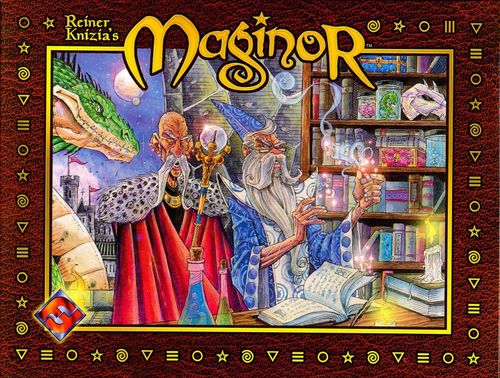
Maginor
Maginor Rulebook
Table of Contents
Table of Contents
Components
- Oracle images: These images represent 11 Oracles, whom you and your rivals try to influence. Each Oracle image has a number of symbols. Each symbol is 1 vote. The number at the top of an image shows how many votes that Oracle can give. The largest image is the Guild Hall.
- Oracle: Each Oracle image shows symbols. Each symbol represents 1 vote. The number at the top of the image shows how many votes that Oracle can give. Players compete for the votes of each Oracle. When a player receives one of an Oracle's votes, they place an influence marker in the slot beside that vote's symbol.
- Mage markers: Each of these markers represents one of the mages trying to become Supreme Mage. Before the game begins, each player chooses the mage marker they will use during play. Each mage has its own colour.
- Plastic stands: Carefully place the mage markers on the special stands so that you do not have to hold them in your hand.
- Maginor marker: This marker represents Maginor, who collects the votes of the Oracles.
- Influence markers: These markers represent each mage's influence over the Oracles. There are 4 colours, one for each mage. You begin the game with all 10 mage cards of your colour. Cards are used to help you gain votes (see below).
- Maginor die: Instead of numbers, this die shows mystical symbols. 5 of them correspond to the vote symbols on each Oracle image. The sixth symbol is for Maginor.
- Duel markers: When two mages come into conflict, they use the triangular duel marker to determine the winner (see below).
Setup
- Arrange the Oracle images in a circle. The Guild Hall must be at the top of the circle (see the illustration).
- Place the two small Oracles clockwise from the Guild Hall (see the illustration).
- Place the remaining Oracle images in any order clockwise from the small Oracles. There must, however, be enough space between them to place the Maginor marker (see "Movement of Maginor").
- Place the "Ritual of the Supreme Mage" spell face up, next to the Guild Hall.
- Place the "Ritual of the Golden Cauldron" spell face up next to the last Oracle image before the Guild Hall (see the illustration).
- Shuffle the remaining spells, place them in any arrangement next to the remaining Oracle images, and then turn them face up.
- Each player chooses a colour and takes the mage marker, the influence markers and the mage cards of that colour. Each player must have 10 cards and 15 influence markers.
- Place the Maginor marker and the players' mage markers on the image of the Guild Hall.
Playing the Game
Determine by lot the player who will take the first turn. After that player has taken their turn, the turn passes to the player on the left, and play continues clockwise.
During a turn, the player must carry out the following actions:
- Play any number of cards and spells, in any order.
- Move your mage, or roll the die.
Note that your turn ends immediately (even if you still have unused actions) if an Oracle is crossed out (see "Crossing Out" below).
1) Playing Cards and Spells
At the start of your turn you may play any of your mage cards and spells (if you have any), in any order. You may also play no cards at all.
When you play a card or a spell, its effect takes place immediately, after which it leaves the game.
Playing Mage Cards
There are 2 types of mage card: symbol cards and magic cards.
Symbol cards: Each of these cards bears one of the 5 mystical symbols (fire, water, earth, air and fate). When you play such a card, you receive one vote of that symbol from the Oracle where your mage is currently located. Place one of your influence markers on the corresponding symbol that is not yet occupied. While there are unoccupied symbols of that kind, you must choose one of them.
If all the corresponding symbols are occupied by influence markers, place your marker next to any of the markers already there and enter a duel with its owner. (Duels are explained below.) If all the corresponding symbols are occupied by your own markers, nothing happens.
If you play a fate card (marked with a star) on an Oracle that does not depict any fate symbols, you may use that card as any symbol of your choice and act accordingly.
Example: Joe's mage is on the Great Eagle. Joe plays a water card. The Great Eagle's Oracle has an unoccupied water symbol, so Joe places his influence marker there. If all the places had been occupied by other players' markers, Joe would have entered a duel with one of them.
Magic cards: A magic card shows a magic wand. When you play such a card, you may choose any Oracle and roll the die, even if your mage is not located there. This is in addition to your roll at the end of your turn (for how to roll the die, see below).
Playing Spells
If you can gain enough votes, the Oracles may teach your mage a spell. (This process is described in the section "Crossing Out".) Once you have a spell, you may play it during your turn to carry out the following actions:
Return: You may return to the game 2 symbol cards that you have played.
Restoration: You may return to the game 2 magic cards that you have discarded earlier.
Domination: You may place 1 or 2 influence markers on unoccupied symbols on your current Oracle.
Persuasion: You may replace 1 of your own influence markers on your current Oracle.
Telekinesis (moving objects at a distance): You may place 1 influence marker on one unoccupied symbol on any Oracle.
Teleportation: You may move your mage to any Oracle.
Challenge: Cross out the first Oracle clockwise after the Guild Hall, then move Maginor to the place located before the next Oracle.
Inversion (complete reversal): This is the only spell that may be played during another player's turn. Play this spell immediately after losing a duel, or instead of a duel, in order to achieve a quick victory.
Ritual of the Golden Cauldron: This carefully designed ritual has no magical effect, but it costs three votes.
Ritual of the Supreme Mage: This ritual likewise has no magical effect, but it costs five votes.
Spell card illustration labels (as printed on the spell diagram): Return, Restoration, Domination, Persuasion, Telekinesis, Teleportation, Challenge, Inversion, Golden Cauldron, Supreme Mage.
2) Moving Your Mage or Rolling the Die
At this stage of your turn you must either move your mage or roll the die. You must do one of these two actions, but you are not allowed to do both. (If your mage is not on an Oracle, you may not roll the die, and you must then move your mage.)
Moving Your Mage
To move your mage, simply take its marker off the Oracle where it currently is and place it on any other Oracle.
Rolling the Die
When you roll the die, you must act in accordance with the result:
Symbol: According to the symbol rolled (fire, water, earth, air or fate), you receive one vote of that same symbol from the Oracle where your mage is currently located. Place one of your influence markers on the corresponding unoccupied symbol. If there are several such places, you may choose any of them. If they are all occupied, you may place your influence marker next to any of the symbols and enter a duel with its owner. If your markers already occupy all the free places, nothing happens. If you roll a fate symbol and the Oracle has no fate symbols, you may use it as any other symbol.
Example: Dave's mage is in the Unicorn. Dave rolls the die and gets fire. Since this Oracle has unoccupied fire symbols, Dave places his influence marker there. If all the places had been occupied, he would have had to enter a duel with one of the other players.
Maginor: If you roll Maginor (marked by a mage's hat), first choose any symbol and act as described above. Then move Maginor as described below.
Movement of Maginor
When Maginor moves, he always travels clockwise: from an Oracle to the place before the next Oracle, and so on around the circle.
For example, if Maginor is in front of the Great Eagle's Oracle and moves, he moves onto that Oracle. The next time he moves, he moves from the Great Eagle to the place in front of the following Oracle.
When Maginor passes an Oracle, that Oracle is considered "crossed out."
Crossing Out
Each Oracle is "crossed out" only once during the game. You must do this immediately when:
- Maginor passes an Oracle, or
- All of an Oracle's symbols are occupied by influence markers.
When an Oracle is crossed out, determine which player has the most votes from it. If no one has any, the player who first filled the Oracle from top to bottom, clockwise, wins. In the same way, determine who takes second place.
Oracles and Spells
The Oracle and its spells are given to the two players with the most votes. The player with the most votes chooses what they want (the Oracle or a spell), and the second player takes what remains. If you have won an Oracle or a spell, place it face up beside you. Winning an Oracle means that your mage receives all of its votes.
If only one player has influence markers on the Oracle, that player chooses whether to take the Oracle or a spell. Items not chosen leave the game. If there are no influence markers on the Oracle, both the Oracle and its spell are discarded.
Influence Markers and Mages
After crossing out, influence markers return to their owners. Mage markers that were on the Oracle are placed in the centre and may no longer be on that Oracle. (They must be placed on another Oracle during the next turn.)
Crossing Out and Maginor
If an Oracle is crossed out because it has given all of its votes, the remaining images are moved closer together to fill the place of the crossed-out Oracle. Maginor moves as if the crossed-out Oracle had never been in that place. If he is on the Oracle being crossed out, he moves to the place after that Oracle.
If a place is crossed out, the player's turn ends immediately. (If this happens because of playing a card or a spell, the player may not play cards or spells, roll the die or move their mage.)
Exception: The Guild Hall may be crossed out only if Maginor is on it. In any case, the Guild Hall is crossed out last.
Duels
Each symbol of an Oracle may be occupied by only one influence marker. If all the symbols you wanted to occupy are already occupied by opponents, you must enter a duel with one of them.
To do this, place your influence marker next to your opponent's marker. You challenge them to a duel, and they defend. You both then take the triangular duel markers.
You both then choose (in secret from your opponent) an element of your magical attack (earth, water or fire) and point the corresponding corner of the triangle toward your opponent. Then you reveal your duel markers. The duel is judged by the following rules:
- Earth beats Water.
- Water beats Fire.
- Fire beats Earth.
If both players choose Fire or both choose Water, their influence markers are removed (they return to their owners) and the symbol becomes unoccupied.
If both players choose Earth (marked on the triangle by a star), the defender wins.
The winner's influence marker is placed on the contested symbol, and the loser's marker is removed.
End of the Game
The game ends when all the Oracles have been crossed out. The Guild Hall must be crossed out last. This happens when Maginor moves onto the Guild Hall (rather than passing it, as with the other Oracles). Until that moment, the Guild Hall is not considered crossed out, even if all of its symbols are occupied.
When the game ends, add up the votes gained by all players. The player with the most votes is the winner. If several players have the same number of votes, the winner is the one who holds the most valuable single Oracle.
Mystical Symbols
Fire, water, earth, air, fate.
Other symbols: magic, Maginor.
Movement of Maginor (Diagram Caption)
Maginor begins his movement from the Guild Hall (1), then moves to the place in front of another Oracle (2), then onto that Oracle (3). In the same way, he moves from an Oracle to a free space, then again onto an Oracle, following the pattern shown in the illustration, until he reaches the Guild Hall.