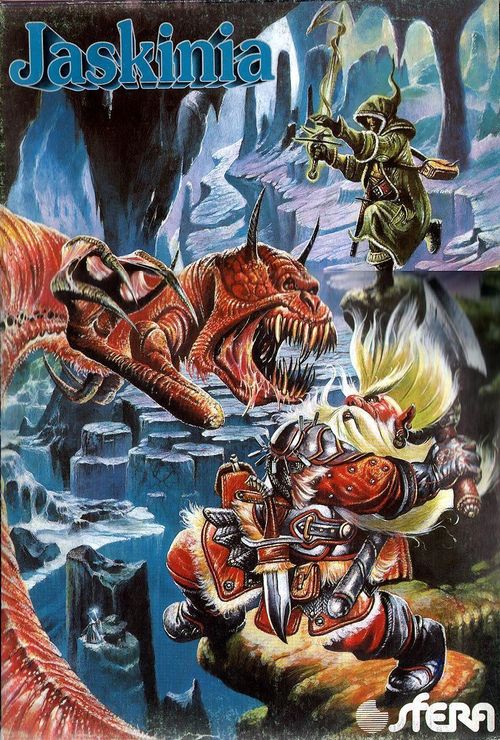
Magiczny Miecz: Jaskinia
Magiczny Miecz: Jaskinia Rulebook
Table of Contents
Table of Contents
- Components
- Setup
- Goal of the Game
- What You Need to Know About Characters
- 1. Character's Sword
- 2. Character's Magic
- 3. Gold
- 4. Life Points
- 5. Items
- 6. Allies
- 7. Nature
- 8. Characteristics of the Character
- 9. Spells
- 10. Turns
- 11. Movement
- 12. Encounters and Exploration of Areas in Jaskinia
- 13. Event and Jaskinia Cards
- 14. Ordinary Combat (Walka Zwykła)
- 15. Magic Combat (Walka Magiczna)
- 16. Turned to Stone (Zamieniony w Kamień)
- 17. Winning the Game
- Card Layout (Character Card)
Components
Jaskinia is an expansion to the game "Magiczny Miecz" (Magic Sword). The game set consists of a board depicting the corridors and the Chamber that a Character must cross in search of the Magic Crystal.
Besides the board, the box contains: 10 Spell Cards, 10 Equipment Cards, 40 Event Cards, 60 Jaskinia Cards, 8 Character Cards and their Pawns, 160 auxiliary tokens, a description of the Rooms and Instructions for the Areas, and 6 bases and a die.
Setup
At the start, lay out the Jaskinia board and divide the tokens by colour.
The Character Cards are shuffled, and then one is dealt face up in front of each player at random. If all players agree, the random deal can be skipped and each player may instead choose the Character that suits them best.
Each player, besides their large Character Card, receives the Character itself. Its figure, with the picture on its card, should be placed in its base and set on the board.
Players must also arrange the appropriate tokens around the Character Cards lying in front of them. At the start of the game each Character receives 1 Gold (unless its characteristics say otherwise) and a Life value of 4 points. The level of the Magic and Sword parameters is marked with blue and red tokens respectively, as indicated on the Character Card.
The remaining tokens should be set aside nearby, as they will be needed during play.
When playing "Jaskinia" alone, ignore the starting positions (MGR, "Miejsce Gracza") printed on the Character Cards.
When playing with the base Magic Sword board, the starting positions (MGR) match the information printed on the Character Cards.
All participants begin the game in the Cave Entrance Area.
From the Event Card set, set aside the following cards: Mineral, Penance (Pokuta), Meteor Shower (Deszcz Meteorów), Old Map (Stara Mapa), Pict (Pikt), and Recruitment (Werbunek). The remaining Event Cards are shuffled and placed face down. This forms the Event Card Deck.
Do the same with the Spell Cards, setting aside the cards Dissolute Life (Hulaszczy Żywot) and Providence (Opatrzność). The remaining Spell Cards are shuffled and placed face down as the Spell Deck.
From the Jaskinia Cards, take out the Magic Crystal Card and set it aside, as it will be needed during play. The remaining Jaskinia Cards form the Jaskinia Deck.
If a Character already has Spells at the start of the game, it takes the appropriate number from the Spell Deck and places them face down next to its Character Card, so that other players cannot see them.
Once all the cards have been placed, the players decide who will begin. Then the participants take their turns in clockwise order.
When playing with the base version of Magic Sword, players set aside only the Magic Crystal Card. The remaining cards (Events, Spells and Characters) are added to the same types of cards in the base version.
The Jaskinia board is placed next to the base board, and the Jaskinia Cards lie on it.
Goal of the Game
The goal of the game is to reach the Chamber in which the Magic Crystal is hidden. It can be obtained by successfully passing tests of Magic, Sword and Wealth. The Character that obtains the Magic Crystal wins the game "Jaskinia".
In a game with the base version of Magic Sword, the goal remains defeating the Beast. Obtaining the Magic Crystal in "Jaskinia" allows the Character to safely cross the Stone Bridge to the Beast's Castle.
Players drawing Characters use the Characters included in Magic Sword and those included in "Jaskinia".
What You Need to Know About Characters
1. Character's Sword
1.1. This trait represents the Character's physical strength, current condition and fighting ability. It is used in combat, and may also be used to overcome certain obstacles that appear during play. The level of the Sword parameter is shown by placing the corresponding number of appropriate (red) tokens next to the Character Card.
1.2. Only the Character's initial Sword and any increase of this parameter during play are represented by tokens. Points gained through Items, Magic Items and Allies are not marked in this way; they are added only when required or permitted.
1.3. Every loss of Sword points must be recorded by removing tokens of the corresponding value. The Character's Sword cannot, however, fall below the level with which it started the game.
1.4. Increasing the Sword parameter. A Character may raise its Sword by winning successful combats with the Monsters it meets while wandering. Monster Cards should be kept, because at any moment they may be exchanged for additional Sword points. The Character gains 1 Sword point for every 7 Sword points of defeated Monsters (these points are marked on the Monster Cards). Points above a multiple of 7 are lost. After this kind of exchange, the defeated Monster's card is placed on the discard pile of used Event Cards. The value of the Sword parameter may also be increased as a result of an encounter, or of exploring the Area on which the Character found itself.
1.5. TOTAL SWORD OF THE CHARACTER. At every moment of the game it consists of its own points (marked with tokens) plus the additional points obtained through possessing Items, Magic Items and Allies.
2. Character's Magic
2.1. Defines the Character's intellectual and spiritual abilities and magical skills. This trait is fundamental in conducting magical combat, and it also determines the number of Spells the Character may possess. Like the Sword, the level of the Magic parameter is shown by placing the corresponding number of blue tokens next to the Character Card.
2.2. Only the Character's initial Magic and any increase during play are represented by tokens. Magic points gained through Items, Magic Items and Allies are not marked in this way; they are added when required or permitted.
2.3. Every loss of Magic points must be recorded by removing tokens of the corresponding value. The Character's Magic cannot, however, fall below the level with which it started the game.
2.4. Increasing the Magic parameter. Magic may increase as a result of encounters or of exploring the Area on which the Character is. It may also increase (but only in the standalone game "Jaskinia") by drawing further Jaskinia Cards. For every 7 Jaskinia Cards the player draws while exploring Areas, the Character receives 1 additional Magic point, gained through the experience acquired during the dangerous journey.
2.5. TOTAL MAGIC OF THE CHARACTER. At every moment of the game it consists of its own Magic points (marked with tokens) plus the additional points obtained through possessing Allies and Items.
2.6. The number of Spells a Character may possess at any moment is determined by its Magic, as follows:
| Total Magic of the Character | 1 | 2 | 3 | 4 | 5 | 6 and more |
|---|---|---|---|---|---|---|
| Maximum number of Spells | 0 | 1 | 2 | 2 | 3 | 3 |
As can be seen, only a Character with a suitably high Magic can use Spells. If at any moment of the game a Character has more Spells than the limit set by its Magic, it must immediately eliminate the excess by discarding the appropriate number of Spell Cards.
3. Gold
3.1. Gold allows Characters to buy Items and pay for services. A Character's wealth is marked by placing the corresponding number of tokens representing Gold pieces (yellow) next to its Card. Usually Characters gain Gold during encounters or while exploring the Area they are in.
3.2. At the start of play each Character has 1 Gold piece (1 token), unless its Card states otherwise.
3.3. All prices in the game are given in Gold pieces (on some Event Cards Gold pieces are abbreviated "Sz.Z.").
3.4. Payments for all kinds of purchases or services are returned to the supply of unused Gold tokens (this rule does not, of course, apply to trade between Characters). Gold gained during encounters and Area exploration is taken from the same supply.
3.5. Gold pieces are not counted toward the limit of Items a Character may own.
4. Life Points
4.1. A Character's Life is exactly what the word suggests. Put more precisely: the number of Life points determines the number of combats the Character may lose before it leaves the scene of the Magic World. The Life parameter may decrease as a result of combat (of either kind), and also because of various dangers threatening the Character during its travels. The level of Life is marked by placing the corresponding number of (green) tokens next to the Character Card.
4.2. Each Character starts the game with 4 Life points.
4.3. Loss of Life points. Every loss of Life points must be recorded by removing tokens of the corresponding value.
4.4. Loss of all Life points. A Character that has lost all its Life points is considered dead. It is taken off the board and its Card is set aside among the cards not taking part in the game. All Items belonging to it, and its Allies, remain in the Area where it died. The tokens defining its Magic and Sword return to the supply of spare tokens; its Spell Cards are placed among those already used. The player whose Character has died may choose a new Character at random and begin the game with it from the Cave Entrance Area, but only while the Chamber with the Magic Crystal has not yet been found. If it has already been found, the player whose Character died is eliminated from the game.
When playing with the main board, these rules change: the deciding fact for remaining in the game is then the presence of any Character in the Beast's Castle.
4.5. Increasing Life. A Character may gain Life points as a result of encounters, Area exploration, and healing. Tokens used to mark such changes are taken from the supply of spare tokens.
4.6. Each Character may have a Life parameter of any height.
4.7. Healing can restore to a Character only those Life points it had at the start of the game (that is, up to 4 points). Specifically, in the standalone game "Jaskinia", healing is possible only by leaving this Land and deciding to go to the Cave Entrance Area in order to heal all its wounds (that is, to regain Life points up to the level of the start of the game). For each wound healed, the Character must pay 1 Gold piece, and in addition must remain on the Cave Entrance Area for 1 turn. For example, a Character that wants to heal 2 wounds must remain on the Cave Entrance Area for 2 turns and pay 2 Gold pieces. This kind of healing may be used any number of times during one game.
5. Items
5.1. In the further part of these Instructions, Items refers to both Items and Magic Items (unless the difference between them is specifically stated). During play Characters acquire Items, usually as a result of encounters or of exploring the Area on which they find themselves. The cards of Items a Character possesses are placed near its Character Card.
5.2. The cards of all Items belonging to a Character are laid face up (sleeves down), so that their content is visible to the other participants.
5.3. No Character may possess Items which, by the rules, it may not use. The card of such an Item is placed face up in the Area where the Item was found.
5.4. Limit on possessed Items. No Character may possess more than 4 Items at a time. Gold pieces are not counted toward this limit.
5.5. A Character may at any moment discard an Item it possesses, leaving its face-up card in the Area where it currently is.
5.6. A Character that has gained more than 4 Items must immediately discard the Items it cannot carry. Which Items the Character keeps and which are discarded depends solely on the player's decision.
6. Allies
6.1. Characters gain Allies, as a rule, as a result of encounters or of exploring the Area on which they find themselves. Ally Cards are placed near the Character Card.
6.2. Cards of the Allies accompanying a Character are laid face up (sleeves down), so that their content is visible to all players.
6.3. A Character may have any number of Allies.
6.4. Loss of Allies. The cards of all Allies who have been killed, or who must be discarded for other reasons, are placed on the discard pile of used Event Cards or Jaskinia Cards. A Character may at any time get rid of an Ally it possesses (one or several), leaving the card in the Area where the Character currently is.
7. Nature
7.1. Every Character has a defined Nature: Good, Evil or Chaotic. Possessing a Good or Evil Nature brings certain benefits, but also certain dangers. A Character of Chaotic Nature gains almost no benefit from its Nature, but nothing threatens it on account of a neutral view of the world.
8. Characteristics of the Character
8.1. Each Character has several special abilities, described on its Card and called its Characteristic. Besides abilities, a Characteristic often also includes limitations to which the Character is subject.
9. Spells
9.1. The effect of using a Spell is always described on its Card. The Card also contains information on the circumstances in which the Spell may be used.
9.2. Characters have the right to possess Spells only if their Magic value allows it.
9.3. Spell Cards held by a Character are kept face down (sleeves up), so that the other players cannot see their content.
9.4. A Character may not discard Spells unless it possesses more of them than its Magic parameter allows.
9.5. Acquiring Spells. Characters usually acquire Spells as a result of encounters or of exploring Areas. Some Characters already possess one or more Spells at the start of the game. Spell Cards are taken from the top of the deck. If the deck runs out, the used Spell Cards are shuffled and used again.
9.6. Declaring (casting) Spells. A Spell may be cast only in the manner indicated on its Card. After a Spell has been declared and its effects have expired, its card is placed on the pile of Spells already used. Spells acting on Characters, or directed against them, reach their victims regardless of where on the board they are.
Note: when playing with the base version of Magic Sword, the following Spells may not be used in Jaskinia: Flood (Potop), Seven Winds (Siedem Wichrów), Lord of Thunder (Władca Gromu) and Battle of the Elements (Walka Żywiołów).
10. Turns
The game time is divided into turns. During each turn Characters perform: a) movement, b) encounters and exploration of the Area on which they are located. Players perform these actions in clockwise order.
11. Movement
11.1. ENTERING THE CAVE. When playing with the Jaskinia board alone, all Characters starting the game from the Cave Entrance Area reach its interior already at the start of the game.
On the other hand, from the main Magic Sword board one may enter Jaskinia by standing on the Barrow (Kurhan) Area and not carrying out its instructions, i.e. not rolling the die (in that case, in the next turn, the Character is moved to the Cave Entrance Area), or by means of the Grotto Event Card (Karta Zdarzeń Grota), stopping on the Area where it is and also not rolling the die (similarly as in the previous case, this allows the Character to be moved to the Cave Entrance Area in the next turn).
11.2. Movement of Characters in Jaskinia takes place in any direction, provided that in one turn the same Area may not be crossed twice. The movement of a Character depends directly on its total Magic. A Character with a total Magic of 6 or more moves as many Areas as the number of pips rolled on the die, turning freely at corridor branches (unless its Characteristic, Spells, Event Cards or Jaskinia Cards modify this result). Characters with Magic less than 6 have a choice of two movement options:
a) Roll the die and move forward, turning at the branches as follows:
- at two-way branches: 1, 2, 3 pips - turn left; 4, 5, 6 pips - turn right;
- at three-way branches: 1, 2 pips - turn left; 3, 4 pips - go straight on; 5, 6 pips - turn right.
b) Move 1 Area per turn without rolling the die, turning freely at branches down any corridor.
11.3. If during movement a Character bumps into the Great Gate (Potężne Wrota), it must stop immediately. In the next turn (if it wishes to continue its journey in the same direction) it makes an attempt to open the Gate by any method.
11.4. If a Chamber lies on the route of the movement, the Character must roll an additional die. A result of 1-4 means that its movement is not disturbed, and the Character stops on the Area where it was to stop. After rolling 5 or 6 pips, the Character's movement ends on the Chamber Area, and the player should, still in the same turn, check the type of the Chamber and follow the instructions describing its interior.
12. Encounters and Exploration of Areas in Jaskinia
12.1. Characters may meet only on the Area where they ended their movement, or on the Area to which they were moved as a result of an encounter. Similarly, only these Areas may be explored. In no case may they meet anyone, or undertake any actions at all, on the Area from which they begin their movement.
12.2. A Character must choose between an encounter with another Character located on the same Area, and exploration of that Area.
12.3. An encounter with another Character may take one of two forms: the Character that has just entered the Area may attack the Character already there, or use its special abilities in relation to it.
12.4. Among explored Areas one can distinguish those that carry references (odsyłacze) to the Area Instructions, and those whose exploration consists of drawing an appropriate number of Event Cards or Jaskinia Cards. In the first case the player standing on the Area follows the instructions of that Area; in the second, the player draws the number of Jaskinia or Event Cards (from the appropriate decks) indicated. When more than 1 card is drawn it is possible that a Character draws, for example, 1 Event Card and 1 Jaskinia Card. (Remember that for the Jaskinia Cards drawn while exploring consecutive Areas of Jaskinia, the player is entitled to a reward of 1 Magic point for each 7 Jaskinia Cards drawn. Players should therefore keep track of how many Jaskinia Cards they have drawn and mark the increase in their Character's Magic at the appropriate moment.)
However, during play with the main Magic Sword board, on Jaskinia Areas only Jaskinia Cards are drawn. They are taken from the top of the corresponding deck. If there are already some Cards lying on the given Area, take only as many of them that their total equals the number of Cards which, according to the instructions, may be drawn on this Area. Drawing the Cards and becoming acquainted with them is precisely the exploration of the Area.
12.5. ROOMS (KOMNATY). After a Character stops on an Area marked with a Room symbol, it must determine the type of the Room by rolling the die, and then follow the instructions describing the Room's interior. These actions are carried out by every Character arriving at the Room's Area, even if it was previously entered by another Character, since the type of the Room may differ at each visit, and Characters may roll different results on the die. This rule does not apply, however, to the Room containing the Magic Crystal: once it has been found (in any way), it remains in the same place until the end of the game. The Magic Crystal Card should be placed there.
12.6. MAGIC CRYSTAL ROOM. This Room may be identified in two ways: a) it can be determined on the basis of a found Item, hints from an encountered Stranger (Nieznajomy), or by penetrating certain Areas; b) upon reaching any Room, instead of rolling one die, the player may roll two dice. The Room is identified as the Magic Crystal Room on that Area when:
- with a Character Magic of 6, the roll is 12 pips;
- with a Character Magic of 7, the roll is 11 or 12 pips;
- with a Character Magic of 8, the roll is 10, 11 or 12 pips;
- with a higher Magic (always referring to the Character's total Magic) the roll is more than 6 pips.
If the attempt to find the Magic Crystal Room with a two-dice roll fails, the Character attempting it loses one Magic point.
After the Magic Crystal Room has been found, the following tests must be passed successfully in order to obtain the Magic Crystal:
a) SWORD TEST (PRÓBA MIECZA) - fighting the Beast with a Sword of 10 (the combat continues until the Beast is defeated, or until the Character loses so many Sword points that its Sword indicator reaches the value from the start of the game; after each lost combat the Character loses one Sword point instead of one Life point).
b) MAGIC TEST (PRÓBA MAGII) - trying to defeat, in magical combat, the Vision (Zjawa) with a Magic of 8. In the case of a won combat, the Vision takes one Magic point from the Character and adds it to its own Magic. (The combat continues until the Vision is defeated, or until the Character loses Magic points down to the value from the start of the game.)
c) WEALTH TEST (PRÓBA ZASOBNOŚCI) - consisting of bribing the malicious Gnome who guards the Magic Crystal. The amount of the required payment, paid in total as the sum of Gold pieces, Items and Allies, is determined by rolling three dice. If the Character does not have that number of Items, Allies and Gold, the test is considered failed.
After an unsuccessful attempt, in the next turn the Character must leave the Room in which the Crystal is located, and may not return to it for the next three turns.
12.7. Exploring other Areas. The Character follows the instructions of the Area. If there are any Enemies there, they must first be defeated; only then may the Character visit the Strangers (Nieznajomi) and take Gold, Items and Allies. Some instructions the Character must follow; others it only may follow.
13. Event and Jaskinia Cards
13.1. Cards which, according to their instructions, should be placed on a specific Area, are considered first, regardless of where they were drawn. They have no influence on the Character that drew them (of course only during the current turn).
13.2. Next, the remaining Event Cards located on, or drawn to, the given Area are considered (their instructions are carried out). In doing so the order must be kept consistent with the numbering of the Cards (the number is found at the top of each Card): the Card with the lowest number is considered first.
13.3. Event Cards and Jaskinia Cards are considered in the following order:
- I - Encounters (Spotkania);
- II - Enemy-Beast, Enemy-Enemy (Wróg-Bestia, Wróg-Wróg);
- III - Enemy-Demon (Wróg-Demon);
- IV - Strangers (Nieznajomi);
- V - Items, Magic Items, Allies (Przedmioty, Przedmioty Magiczne, Przyjaciele);
- VI - Places (Miejsca).
Only after the Encounter Cards have been considered, and after all the Enemies located on the given Area have been defeated (in Jaskinia Enemies cannot be evaded), may the Character consider the remaining Event and Jaskinia Cards.
13.4. Encounter Cards. What is written in the Card's instructions must be carried out. If it causes the Character that drew the Card to lose its turn, that Character does nothing more, and this counts as a lost turn.
In Jaskinia the following Encounter Cards, which appear in the base version of Magic Sword, are ignored: Relocation (Przesiedlenie), Witches' Sabbath (Sabat Czarownic), Enchanted Path (Zaklęta Ścieżka) and Evil Spirit (Zły Duch) (the last of these leaves the Character once it has entered Jaskinia).
13.5. Enemy (Beast, or a creature with a specified Sword parameter). An encountered creature immediately attacks the Character that drew the card representing it. The cards of defeated Enemies of this kind may be kept for later exchange for Sword points.
13.6. Enemy (Demon). The Demon immediately attacks the Character that drew the card representing it. In this situation the combat takes the form of a magic combat. The cards of defeated Demons are not exchanged for Magic points.
13.7. Stranger Cards (Karty Nieznajomych). The instruction written on the card must be carried out. When playing with the base version of Magic Sword, the Unicorn (Jednorożca) card is ignored in Jaskinia.
13.8. Item, Magic Item and Ally Cards. A Character may take them with it, if it is allowed to. In Jaskinia, however, the following cards may not be taken along: Mount (Wierzchowca), Draught Team (Zaprzęgu), War Horse (Rumaka Bojowego), Mule (Muła), Horse (Konia) and Wild Steed (Dzikiego Rumaka).
13.9. Place Cards. The instruction written on the card must be carried out.
13.10. Event or Jaskinia Cards remaining on the board. Cards that remain on the given Area after the Character has completed all the activities connected with that Area must be turned face up and be visible to all players.
14. Ordinary Combat (Walka Zwykła)
14.1. Combat takes place in the following situations: a) the Character has been attacked by an Enemy that has a specified Sword value; b) a Character attacks another Character, unless it can use its Characteristic and carry out a magical attack.
14.2. If a Character intends to use Spells, it must use them before rolling the die, unless the instruction on the given Spell states otherwise.
14.3. The Character rolls one die and adds the result to its Total Sword parameter (it may use only one weapon in doing so). The sum obtained determines its strength in this combat. Next, one of the other players rolls for the opponent and calculates the opponent's Sword in the same way. If the Character's Sword proved greater, the opponent is considered killed. If the opponent's Sword proved greater, the Character loses 1 Life point (this may be prevented by using an Item or a Spell), and the combat ends there. If both sides obtained the same result, the combat is a draw.
14.4. More than one opponent. If a Character is attacked by more than one creature, the Swords of those creatures are summed, and the result of a die roll is added to the total. In this way one obtains the Sword with which these creatures attack the Character. If the Character is attacked simultaneously by the Beast and a Demon, both combats (Magic and Sword) must be fought separately.
14.5. Resolving combat between Characters. A Character that has been attacked may not attempt to escape from its opponent in Jaskinia.
14.6. Before the die is rolled, both Characters have the possibility of using Spells.
14.7. The attacker's Sword is calculated first, and then the attacked Character's. The Character whose Total Sword, including the die result, is higher wins. If the strengths are equal, the combat is a draw.
14.8. The victor may require the defeated Character to lose one Life point (this may be prevented by using appropriate Items or Spells), or take from it one Item (Magic Items included) or one Gold piece. This ends the combat and the whole turn.
14.9. Draw. In the event of a draw neither side suffers any losses. The end of the combat also brings the end of the turn.
15. Magic Combat (Walka Magiczna)
15.1. Magic combat takes place when: a) the Character has been attacked by a Demon-Enemy, which has a specified Magic parameter; b) a Character whose Characteristic allows it attacks another Character with the help of Magic.
15.2. Resolving magic combat. A magic combat is resolved in the same way as an ordinary combat, with the following differences: a) in place of the Sword parameter, the Magic parameter is used; b) no Item may prevent the loss of a Life point.
16. Turned to Stone (Zamieniony w Kamień)
Characters turned to stone may not in any way reach the Jaskinia board, and in this Land nobody can be turned to stone. Naturally these remarks concern the situation in which the game is played with the main Magic Sword board.
17. Winning the Game
The winner of the game is the Character that obtains the Magic Crystal. If all Characters drop out of the game before the Magic Crystal is found, the winner is the player who dropped out last.
In the case of a game with the base version of Magic Sword, the winner is the Character that reaches the Beast's Castle and defeats the Beast.
Card Layout (Character Card)
The sample Character Card printed in the booklet is labelled as follows (the example shown is the Wandering Knight, "BŁĘDNY RYCERZ", nature: good, starting place: Trackless Wilds):
- Character (Postać): the Character's name and picture.
- Nature of the Character (Natura Postaci): e.g. "good".
- Starting place (Miejsce rozpoczęcia gry), given as MGR.
- Place for Gold pieces (Miejsce na Sztuki Złota).
- Initial Sword of the Character (Początkowy Miecz Postaci).
- Initial Magic of the Character (Początkowa Magia Postaci).
- Characteristic of the Character (Charakterystyka Postaci): the special abilities printed on the card.
- Place for 4 Life tokens (Miejsce na 4 żetony Życia).
The Wandering Knight's characteristic reads, in translation: (1) You begin the game with a Sword and Armour. (2) If you lose a combat (but not a magical combat) you may disregard its result and fight on; during the second combat all Spells and Magic Items used in the first combat remain in effect, and you must accept the result of the second combat. (3) If you have Excalibur or the Holy Grail in your possession, you may take one more Spell Card than you should and discard the one that suits you less. (4) From every encountered Character you may take the Crusader (Krzyżowca) and the Squire (Giermka).
The sample Event Card printed in the booklet is labelled as follows: order in which Event Cards are to be resolved (Kolejność w jakiej należy rozpatrywać Karty Zdarzeń, marked with the symbol "V"), card type (Rodzaj Karty, here "Ally", Przyjaciel), card name (Nazwa Karty, here "RUSAŁKA"), and instructions and description of holding or using the card (Instrukcje i opis faktów posiadania lub użycia Karty). The Rusałka (water nymph) card reads, in translation: the friendship of the Rusałka allows you to make one die roll when moving from the Haunted Wilds (Uroczysko) to the Forest of Will-o'-the-Wisps (Las Błędnych Ogni). In the Marshes and in the Forest of Will-o'-the-Wisps you will be able to evade Enemies effectively, and you will not need to roll the die at the Barrow (Kurhan), where you will always be safe.