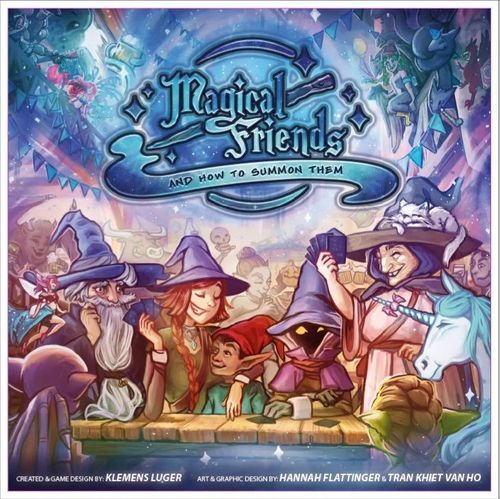
Magical Friends and How to Summon Them
Magical Friends and How to Summon Them Rulebook
Table of Contents
Table of Contents
Content
- 70 standees
- 70 standee holders
- 1 sheet of stickers
- 5 player aids (5 colors)
- 55 gingerbread hearts (5 colors)
- 55 artifact cards (5 colors)
- 5 doublesided exchangeable map tiles
- 50 summoning cards
- 1 summoning board
- 1 round counter
- 1 starting player token
- 10 cards pity power
- 10 cards fairy dust
- 2 dice
- 1 gameboard
- 1 rulebook
- 1 creature info sheet
- 5 infocards
Assembly
Assembly of the creature standees:
- Attach a plastic foot to each cardboard standee.
- Stick the number matching the creature on the bottom of the foot. This makes it easier to sort the creatures and helps the game flow.
Setup
Each player receives the player aid, gingerbread hearts and artifact cards of their color.
For 4 or 5 players, 5 doublesided map tiles are placed with any side up on the designated places on the game board, for 2 or 3 players use only 3 main and the small pathway.
For details on the game board elements, see pages 12-17.
For the first game, it is recommended to use the following game setup:
- 4, 5 Players: Map tiles: Dark Caves, Strange Portal, Stairway to Heaven, Fairy Trail and Whining Tent.
- 2, 3 Players: Map tiles: Lava Bridge, Strange Portal (switch without effect), Fairy Trail and Whining Tent.
The summoning cards are shuffled and placed according to the number of players on the designated positions of the summoning board, also fill the preview slots.
The round counter is placed on position 1. The player who was the last to have a party gets the starting player token.
Short Overview
Win the Midsommar contest! You don't want people to think you're a boring hermit. As a master wizard, you've already thought of a way to show off your extraordinary popularity.
The game runs for 7 rounds. In each round, each wizard (= player) summons at least 1 friend (= creature in his color), which makes its way to the tavern.
Doing so, the wizard can move friends through different paths. In each round, the turn order is determined first (A). After that, each wizard performs their turn (B).
How to Win the Game
You simply summon friends and send them to the tavern to participate at the Midsummer festival (after 7 rounds). You just have to have more friends at the tavern than your colleagues at the beginning of the festival to win the big prize.
Board Interaction
There can be any amount of creatures on each space of the game board. Creatures basically only move forward (towards the tavern) unless a card text says otherwise.
Creatures only trigger effects on spaces where they end their movement.
Example: When a creature moves 3 steps, it moves past the first 2 squares. It does not trigger effects on those squares unless otherwise described.
Round Procedure
Each Round is divided into two parts:
- A) determine the turn order
- B) playing the turns
A. Determine Turn Order
Each mage has 11 magical artifacts that are used to perform a summoning. The mage who gives up the more powerful artifact for his summoning acts first! Each artifact card shows a value and may show bonus effects.
Beginning with the starting player, each wizard plays an artifact face up in clockwise order. No value may be placed more than once. Used artifacts are discarded at the end of the round. The numerical values of the artifact cards determine the turn order. The wizard who played the highest value artifact begins, followed by the one with the second highest, and so on... Artifact cards are visible to all players at all times.
Example: Klemens (black) has the starting player token and must lay down an artifact first. He chooses his 5. In clockwise order Katharina (orange) is next, she is not allowed to place a 5, because it has already been played by Klemens. Michael (blue) has only the choice between 2, 3 and 6. He chooses 6. The turn order for this round is therefore Katharina (8), Michael (6) and finally Klemens (5).
B. Get Your Friends Moving
(Example move on page 18/19)
A wizard acts out his entire turn before the player with the next highest artifact card takes the turn.
-
First, the wizard selects one of the summoning cards shown in the "current turn" row from the summoning display and takes it. Summoning cards have 2 functions. The selected card indicates which friends you summon (bring into play) and how many basic moves you have available this turn.
Important: The basic movement of a Summoning card is valid ONLY for the turn in which it was chosen. (And does NOT imply that this creature can move that number of steps every turn.)
Example: If, as with the Gryphon, 3 basic moves of 2 steps are given, you may move up to 3 friends exactly 2 steps. This movement is valid only for the turn in which the card was taken. Any remaining movements at the end of the turn are lost.
-
All further actions can be performed afterwards in any order, some of them more than once:
-
Summoning: Equip the creature standee for the chosen card with your gingerbread heart and put it into play, i.e. place it on the wizards home. (for exceptions of alternate starting positions, see pages 8, 12 and 13). If you summon more than one creature, they may be summoned in any order.
-
Use basic movements (white feet): Using movement from the chosen summoning card. Basic movement can only be used forward, toward the tavern.
Important: Each friend may be moved only once with basic movement per turn!
-
Use bonus movements (green feet): Bonus moves are available on some artifact cards (only valid in the round they were played) or through bonus cards (pity power and fairy dust). Bonus movement can only be used forward, toward the tavern. For example, Pity Power lets you move a friend 2 spaces.
Important: Each friend may be moved only once with bonus movement per turn!
-
Attention for the 2 player variant: In 2 player mode a third wizard will join the party. This wizard will have special movement restrictions. See page 22 for details.
End of Round
A round ends after every wizard has completed his or her turn. The played artifact cards are placed on the discard pile and the starting player marker is passed to the next wizard in clockwise order.
The last summoning card on the summoning display is discarded. Cards are moved to fill the empty spaces and the preview is replenished from the draw pile. If a player has a summoning card from a creature that is no longer on the game board, discard it.
Move the turn marker one space. The next round begins.
Special Rounds
Starting from round 6: The wizards have conjured a tailwind for their friends. Each wizard may now let his friends start one space after the wizards home and therefore skip the first space.
In turn 7, the tailwind is so strong that each friend gets +1 on basic- and bonus movements. For example, any creature moved with Pity Power during turn 7 moves 3 steps instead of 2.
End of Game
After the 7th round, the game is over and the winner is determined. The friends who made it into the tavern are counted and the wizard with the most friends wins the game. The wizard who has the most to brag about (has the most trophies in his possession, see page 10) receives the favor of a tavern visitor and therefore an additional friend for scoring (= bonus friend). In addition for every 4 trophies a wizard has collected that player will also receive a bonus friend.
If more than one wizard has the same number of friends (including bonus friends) in the tavern, the winner by who has the highest remaining artifact card. If there is also a tie here, the second highest artifact decides and so on.
Creature Abilities
Each creature card shows: size, name, number (standee), spellpower, flight, basic movement (valid only during the round the card was selected), alignment, and creature ability (in this instance, a magic ability).
Each creature has a certain size (small/medium/large).
Creatures are neutral (gray), good (gold) or evil (red).
Some creatures have flight. A creature gets +1 to its basic movement per flight symbol.
And some creatures have spellpower.
Magical Abilities
Your friends can't use magical abilities as long as they are still at the wizards home. In addition you need to have enough spellpower in order to use magical abilities. This is the case if you have at least the number of wands available that is indicated on the creature's card. Wands can be on your own friends still on the game board and on the active artifact card. In addition, effects on the game board can also give spellpower to a wizard. This spellpower is not depleted and can be used for more than one abilities. For example, if a wizard has 2 spellpower and 2 friends who have an ability that requires 2 spellpower, he can use both abilities in the same turn. Friends in the tavern do not contribute their spellpower.
Some abilities might have very special interactions, for questions consult page 20 and 22.
Information on Standees
Standee symbols: inhibits movements, dangerous creature, good creature, evil creature, neutral creature, small creature, medium sized creature, large creature, flying creature.
Slaying Creatures
Some creatures allow you to slay other creatures. Another way of slaying creatures, is poisoning them twice. If a creature gets poisoned, flip the gingerbread heart to the poisoned side. If a creature gets poisoned a second time, it is slain and removed from the game. If a creature was the last of its kind, the summon card is placed on the discard pile. For slaying an opponent's creature or poisoning one the second time, the wizard receives the creature's gingerbread heart as a trophy to brag about in the tavern. The wizard who lost a friend because it was slain or killed by poisoning receives a Pity Power card.
If a wizard slays one of his own friends by an ability, he receives a Pity Power for the slain friend, but no trophy.
Attention: If a friend allows you to slay all creatures on a space, you have to slay all of them, even your own. It's either all or nothing.
Creatures that have arrived at the tavern: Celebrate! And because they are busy celebrating, they don't lift a finger outside the tavern - they are considered to be off the board. Therefore, the friends count only for the victory calculation.
Bonus Cards
Pity Power
If a friend is slain, its owner gets the sympathy of his colleagues in the form of a bonus card - Pity Power. This bonus card can be played at any time during your turn and is discarded afterwards. A friend can use it to move exactly 2 steps.
Pity Power counts as a bonus movement.
Remember: Only one bonus move can be used for each friend per turn.
Fairy Dust
On the pathway "Fairytrail" or via the summoning card Fairy you can obtain the bonus card Fairy Dust. This bonus card can be played at any time during your turn and is discarded afterwards. A friend will get poisoned but can use it to move exactly 3 steps. The fairy dust counts as a bonus move.
Remember: Only one bonus move can be used for each friend per turn.
Also Remember: During round 7, Pity Power and Fairy Dust also get +1 step to their movement.
Important! Scheming Dagger (Artifact Card 5) works differently than the Fairy Dust. When you move a friend with the Scheming Dagger's bonus movement, poison all creatures it moved to, while the Fairy Dust poisons the friend using the bonus move itself, even before the move is performed.
Paths and Special Spaces
The place on spaces is not limited, there can be any number of creatures on a single space. However, there are special places where special rules apply, especially on the interchangeable game tiles. Creatures also trigger these effects if they are moved on these spots through other means than basic- or bonus movement.
The board shows: the goal (tavern); the starting positions; the shortest path (Lavabridge / Dark Cavern); the longest path (Workshop / Portal); the 2nd longest path (Market Fair / Fairytrail); the 2nd shortest path (Stairway to Heaven / Highway to Hell); Whining Tent / Short Range Portals; and the possible starting position from round 6 onwards.
Special Pathways
Portal
Switch: When a creature ends its movement on this space, immediately flip the Stairway to Heaven/Highway to Hell path.
Portal: If there is a friend on this space, the mage can summon his friends here (instead of other starting positions).
Workshop
Workshop: If a friend moves onto this square, he gets a catapult at the end of the turn at the Mage Tower. If a friend moves to this space again, the catapult fires at a space 2 spots away and slays all creatures on that space (fires forward only).
Switch: When a creature ends its movement on this space, immediately flip the Stairway to Heaven/Highway to Hell path.
Catapult
The catapult can be moved like a friend and has the following ability: If a friend ends his movement on the space where the catapult is, fling the friend 2 steps forward. The catapult cannot be slain, but can be moved by abilities. It does not count as a friend in the tavern. The catapult also does not trigger any effects on the game board. If a friend moves to the Goblin Workshop again, the catapult fires at a space 2 spots away and slays all creatures on that space (fires forward only). If the catapult shoots through the Dark Cavern (page 14) or flings a friend through the Dark Cavern, you have to roll the die where it hits/lands.
Dark Cavern
As soon as a friend is moved beyond the first cave space, the die must be rolled. You have to announce how far you want to move before rolling the die. Depending on the result, a different path is taken:
- 1-2: On this way the friend will be poisoned. (Even if he moves across this space) But still comes quickly through the cave.
- 3-4: Congratulations! This is the fastest way to the party!
- 5-6: Your friend makes a small detour, otherwise nothing happens to him.
Lava Bridge
Lava rises on this bridge in rounds 3 and 6. At the beginning of these turns, all creatures on these spaces are surprised by the lava and slain. The associated mages receive Pity Power in return. If a creature moves over or onto these spaces during this round, it is also slain (distribute Pity Power). If you move opposing creatures onto the bridge during turn 3 or 6 using abilities, they are also slain. In that case, a trophy is awarded to the pushing player and a pity power is given to the owner of the slain creature.
Market Fair
- (A) Chili eating competition: When a friend finishes their movement on this space, that friend may make a second basic movement that turn (if there is still one available)
- (B) Fortune teller: As long as a friend is standing on this space, your artifacts get +1 to their value when played.
- (C) Gift shop: When a friend finishes their movement on this space, get a neutral trophy.
- (D) Flower tent: Creatures that are on this space cannot be slain or poisoned.
- (E) Magic tricks: As long as a friend is on that space, you get one extra spellpower.
Fairy Trail
At the beginning of each round, the fairy die is rolled and then placed according to the number rolled on the corresponding space on the fairy path. If a creature ends a move on this space, the associated mage receives a Fairy Dust card. This bonus card can also be picked up several times in one round.
(F): 5-6, (G): 3-4, (H): 1-2
Highway to Hell
Evil creatures that end their movement on one of these spaces can slay other creatures on that space (of any alignment), even if they don't normally have that ability to do so.
(A) Anger Management: If one of your friends already started the turn on this space, you may slay the next creatures it moves onto with the next movement. Even if that friend doesn't normally have the ability.
Stairway to Heaven
Good creatures that are on these spaces cannot be slain or poisoned.
(A) Wing Rental Service: If one of your friends already started the turn on this space, its next basic movement gains + [icon]. (The icon is not legible in the source text; by analogy with flight, likely +1.)
Whining Tent
As soon as a friend ends its movement on this space, that wizard ends its turn. This wizard gains a Pity Power card!
Short-Range-Portals
As soon as a friend ends its movement on this space, that wizard ends its turn. The wizard can move one creature on the game board one step forward or backward. As long as a friend is occupying this space, its wizard gains one spellpower.
Example
Katharina (orange) already has a troll and a vampire from the previous rounds on the board.
This round, Katharina chooses the Gryphon card.
Katharina uses one of the 3 basic moves to move the Troll 2 spaces and by its ability slays the Hero Soul. Klemens (black), gets Pity Power as a result, Katharina gets a Trophy.
Katharina uses the bonus move of her artifact card for the Troll to move to the portal. The Troll's ability can only be used once per turn and therefore cannot slay the Water Elemental.
Katharina summons her Gryphon on the portal (see page 13).
Katharina uses the second basic movement of this turn for the Vampire. The Vampire gets +1 step to the movement because of its flight ability.
Katharina still uses the last base move for the Gryphon. The Gryphon gets +1 step to the movement because of its flight ability.
Katharina could still use her Pity Power card for the Vampire or Gryphon, but not for the Troll, because it already has used a bonus movement this turn.
FAQ and Special Interactions
Path Interactions
- Dark Cavern: The path will also be determined by a roll if a creature is moved otherwise in the cave (Cyclops, Mermaid, Succubus, Water Elemental, Catapult) even backwards! The Harpy also requires a roll of the dice. The Minotaur and the Unicorn cannot use their abilities through the cave. The Dragon and Hydra's ability affects the entire cave from the cave entrance. If the Giant or Pegasus takes creatures with them, they may also be poisoned.
- Lava Bridge: The Gargoyle is not slain by lava while it is in its indestructable state during turn 3 or 6.
- Staiway to Heaven: Fairy Dust does not poison good creatures that are moved from a space on this path.
Creature Interactions
- 1 Arachne: Flying creatures that move past or to Arachne due to other effects, also go into her net. (Cyclops, Mermaid, Succubus, Water Elemental, Catapult) The player who moves the respective creature to Arachne and the player who is controlling Arachne get a trophy. (Unless it is one's own friend who is defeated by it.) If a flying creature has the ability to slay Arachne when it moves to Arachne, both creatures are slain. If the Gargoyle is moved to Arachne while it is indestructible, it is not slain.
- 4 Cyclops: When the Cyclops moves a creature, that move triggers effects from the space or creatures the thrown creature lands on.
- 6 Djinn: The artifact played this turn cannot yet be returned to the hand.
- 7 Dragon: From the cave entrance, his ability in the Dark Cavern affects the whole cave. On crossings, the Dragon's ability affects all directly following spaces.
- 8 Dryad: This ability counts during the turn order determination. A spellpower on the played artifact card counts towards the activation of its ability. The new value is subject to the usual rules for playing artifacts.
- 9 Earth Elemental: Creatures that are moved to the Earth Elemental by other effects are slain. (Cyclops, Mermaid, Succubus, Water Elemental, Catapult) The player who moves the respective creature to the Earth Elemental and the player who controlls the Earth Elemental receive a trophy. (Unless it is one's own friend who is slain by it.) If another creature has the ability to slay the earth elemental when it moves to the earth elemental, both creatures are slain.
- 12 Giant: Only creatures that are on the same space at the beginning of the movement can be picked up. When the Giant carries creatures, effects on that space are triggered for all creatures brought along. Creatures brought along do not trigger their own abilities as a result of this move.
- 13 Goblin: The movement speed is calculated in the path you want to move the Goblin and at the space from which the movement was started. Each single effect can be triggered at most once. (small creature in front of her, large creature behind her).
2-Player Variant
In the game with two players a third mage comes into play, this mage is influenced every turn by the player who has placed the highest artifact card. This third mage is subject to special movement rules and there are small changes in gameplay compared to the game with 3, 4 or 5 players.
Setup
Like in the game with 3 players you only use 3 paths to the tavern. They are determined before the game begins.
Changes During Turn
In the 2 player variant, cards will only be refreshed after the starting players turn. At the end of the round the last card will be discarded and the display will be refreshed as usual.
The Third Wizard's Turn
The third (influenced) wizard is always the last to act. The player with the higher initiative controlls the summoning and movements of this wizard. There are a few special rules for the influenced wizard.
- He gets the basic movement of the chosen summon card and an additional 2-step bonus movement.
- He must use these movements for his friends unless it would result in one of them being slain (for example, moving into lava or to an earth elemental...). His friends can be moved only once per turn with basic movement and once with bonus movement.
- Fairy Dust may be collected and used, unless the friend would be slain by poison.
- Magic abilities may not be used to slay your own friends.
- Pity Power is collected and saved for the last round, it has to be used during the last round if possible.
- Trophies are accumulated normally.
BE CAREFUL! The influenced wizard can win the game! In this case both players will lose the game and have to take the shame of losing to a mindless chess piece.