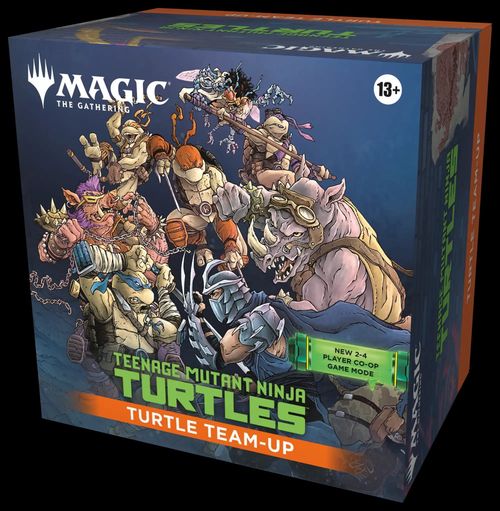
Magic: The Gathering – Teenage Mutant Ninja Turtles Turtle Team-Up
Magic: The Gathering – Teenage Mutant Ninja Turtles Turtle Team-Up Rulebook
Table of Contents
Table of Contents
Components
- 4 x 60-card Turtle decks and 5 double-sided tokens
- 4 x Play Boosters
- 11 x Boss cards
- 38 x Event cards
- 20 x Punchout counters (+1/+1)
- 4 x Life tracker pointers
- 1 x Boss life tracker
- 4 x Life trackers
Overview
In Turtle Team-Up, two to four players cooperate and battle side-by-side as a team of Heroes against an automated system of Boss and Event cards.
Players take turns together and attack three different stages of Bosses while defending against the Event cards that Bosses play. You'll face one Boss in the first stage, two in the second, and three in the third, with the difficulty ramping up as more Bosses enter the fray.
During the Boss turn, a designated player manages the Boss team's cards using a few simple rules. Once you've defeated all three Boss stages, you've won the game!
Different Ways to Play
This booklet features a number of alternative ways to play, so be sure to explore all the variants! To get started, the game will be explained using the rules for two players.
For three or four players, use the setup and rules on the pages that follow, then consult page 9 for modifications.
Setup
The play areas are laid out as follows. The Enemy play area contains the Boss deck, the Active Bosses area, the Event deck, the place where Bosses go when defeated, the place where Events go when used or destroyed, and the Boss's battlefield (Ninjas the Bosses play go here). The Hero team's play area contains, for each player, a battlefield, a Turtle deck/library, a graveyard and an exile area.
- Without looking at them, choose six Boss cards at random. Shuffle them together to make a Boss deck.
- Shuffle all of the Event cards together to make the Event deck.
- Set life total to 20 for both the Hero team and the Boss team.
Each player chooses a Turtle deck and removes the five double-sided tokens from it, then shuffles the deck and puts it into their play area.
Boss Rules
To begin the game, reveal the top card of the Boss deck to create the Boss team for stage one. The Hero team goes first, and each Hero player draws a card on their first turn.
The Boss Turn
Each turn, the Boss team take the following actions in order:
- Untap: Untap each permanent the Boss team controls.
- Action: Play two cards from the Event deck. The Boss team reveals the top card of the Event deck, then plays it. After resolving all the effects of that card, they reveal and play a second card the same way.
- Combat: Each creature the Boss team controls attacks the Hero team if able. (A creature can attack if it's untapped and it didn't enter the battlefield this turn.)
Whenever the Boss team's life total reaches 0 or less, immediately move to the next stage of Bosses.
When stage one is defeated, remove the previous Boss card. Then reveal the next two cards from the Boss deck to create the Boss team for stage two. When stage two is defeated, repeat this process, but reveal three Boss cards instead to create the Boss team for stage three. After the next Boss team is created, continue with the current turn.
Don't change anything else on the board, the Event deck, or the Boss graveyard as the stage changes!
Miscellaneous Rules
- When blocked by two or more creatures, a Boss team attacker assigns damage so that the greatest number of creatures die. If the Boss team would need to choose which creatures die, the players decide instead.
- The Boss team counts as a single player. (Abilities that affect "each opponent" will affect the Boss team once.)
- If a card the Boss team owns would ever be put into their hand, it is put into their graveyard instead.
Objective
To win, you must defeat all six Bosses across their three stages.
Radical! If you want to see how well you're doing, try tracking the number of turns it takes to complete a game and see what title you earn!
| Turns to win | Achievement |
|---|---|
| 11+ | Turtle Warriors |
| 9–10 | Turtle Champions |
| 7–8 | Turtle Legends |
| 6 or less | True Turtles |
Now you're ready to play!
Cowabunga! More Ways to Play!
Looking for a challenge? Interested in other ways to play the game? This section includes alternative game modes and difficulty modifiers to customize your Turtle Team-Up gameplay!
Co-Operative Challenge Mode
To up the difficulty on the co-op experience, try one or more of these rule adjustments!
- Not Defeated Yet! When a new stage begins, previous Bosses stay in play.
- Relentless Attack! Give haste to all Ninjas the Boss team controls.
- Bigger & Badder! Whenever you defeat a Boss team stage, increase the next Boss team's life total by 4, or reveal and play an Event card.
- Everyone's Here! During setup, add an additional four Bosses to the Boss deck.
Adding More Players
When adding more players to the co-op game, follow these rule changes:
Three Player Co-Op:
- The Boss team plays the top three cards of the Event deck each turn.
- The Hero team's starting life total is 30.
Four Player Co-Op:
- Each Boss stage starts with 30 life.
- During setup, add an additional four Bosses to the Boss deck.
- The Hero team's starting life total is 40.
These experiences will be more complicated and take longer to complete.
Free-For-All Play Rules
Tired of playing nice and itching to face your friends in a battle royale? You can play one-on-one with each other, or start a game with three or four players facing off all at once!
- Two, three, or four players each pick one of the Turtle decks and play against each other!
- Each player's starting life total is 20.
- Instead of taking turns together, determine a starting player. That player takes their turn first, and the turn order proceeds clockwise from their position.
- In a game with three or more players, a player may choose to attack any other player, regardless of their position on the table. They can also choose to attack multiple different players.
- Permanents, spells, and abilities that target players other than "you" can target any other player around the table.
(A QR code links to resource videos about the format and its differences from co-op.)
Expanding Your Decks with Play Boosters
Also included in this kit are four Play Boosters for Magic: The Gathering | Teenage Mutant Ninja Turtles. If you would like to expand your Turtle deck with cards from these boosters (or others), feel free! However, take the following tips into consideration when playing in co-op mode:
- Some cards will try to make the Boss team take actions that they can't do, such as moving cards to the Boss team's hand. In that case, nothing happens.
- Cards that ask the Boss team to make a choice will be determined by the players. It's best to avoid cards like this.
FAQ
Q: Can my creatures attack my opponent's creatures directly? A: No. Creatures can only attack players, not other creatures. Creatures deal combat damage to one another only when the defending player uses a creature to block an attacking creature. (In a co-op game, creatures attack Bosses in place of players.)
Q: Do I have to pay a creature's mana cost every turn that it is on the battlefield? A: No. You only have to pay to cast a creature once. It then stays on the battlefield until it is destroyed or otherwise removed by a spell or ability.
Q: Should my library or my hand be visible during the game? A: Normally the cards in your hand should be visible only to you. During a co-op game, however, players may freely share information about what is in their hands. You can't look at the cards in your library unless a spell or ability allows you to search your library for something specific.
Q: What happens to instant or sorcery spells after I cast them? A: They have an effect—whatever is written in the text box—and then you put them into your graveyard.
Q: Do I have to tap my creatures to block? A: No. Only an untapped creature may block, and blocking doesn't cause a creature to become tapped.
Rules Reference
How to Read a Magic Card
Magic cards are formatted so that the information you need to know is always in the same place. To learn more about Magic vocabulary, scan the QR code or go to Magic.Wizards.com/Keyword-Glossary.
The example card (Leonardo, Worldly Warrior) is labelled: card name, mana cost, type line, expansion symbol, text box, and power/toughness.
CARD NAME: Every Magic card has a unique name. Though a card may be reprinted in many Magic sets, every card that shares a name functions like every other card with that name. In most Magic formats, you may have up to four copies of a card with the same name in your deck. The exception is basic lands, which are unlimited.
MANA COST: Mana is used to cast spells in Magic. All spell cards have a mana cost in the upper right corner. Hamato Ninpō's mana cost, 1 and one white mana symbol, means that you must pay one mana of any kind plus one white mana to cast it.
TYPE LINE: Every card in Magic has a type, and some cards also have subtypes or supertypes. For example, Triceraton Regenta's type is creature, and its subtypes are Dinosaur and Noble. There are six card types included in this kit: land, creature, artifact, enchantment, sorcery, and instant.
- LAND: You'll use lands to generate mana, the game's primary resource, which is used to cast spells and activate abilities. Each basic land makes mana of a particular color. Plains make white mana, Islands make blue mana, Swamps make black mana, Mountains make red mana, and Forests make green mana. You can play one land during each of your turns. To play a land, put it from your hand onto the battlefield during either main phase of your turn. Once you play a land, you can use it to make mana on the turn you played it and every turn after that.
- CREATURE: Creatures fight for you. They can attack during the combat phase of your turn and block during the combat phase of an opponent's turn. You can cast a creature as a spell during your main phase, and it remains on the battlefield until it's destroyed, sacrificed, exiled, or otherwise removed. Creatures enter the battlefield with "summoning sickness," which means that a creature you control can't attack or use a tap-symbol ability until it starts your turn under your control. You can block with a creature no matter how long it's been on the battlefield.
- ARTIFACT: Artifacts represent machines or magical objects. As with creatures, you can cast an artifact as a spell during your main phase, and it remains on the battlefield unless it's destroyed, sacrificed, exiled, or otherwise removed. Some artifacts are colorless, which means you can cast them with any color of mana, and some require colored mana to cast.
- ENCHANTMENT: Enchantments have persistent magical effects that affect the game as long as they're on the battlefield. As with creatures, you can cast an enchantment as a spell during your main phase, and it remains on the battlefield unless it's destroyed, sacrificed, exiled, or otherwise removed.
- SORCERY: Sorceries are spells that you can cast only during a main phase of your turn. They have a one-time effect. You do what the spell says, and then put the card into your graveyard.
- INSTANT: Instants are spells that can be cast at any time, even during combat or your opponent's turn. Like sorceries, instants have a one-time effect. You do what the spell says, and then you put it into your graveyard.
TEXT BOX: The text box includes rules text and flavor text. Rules text explains special effects a card has during gameplay. Reminder text can sometimes appear (in parentheses, like this) to explain how abilities work. Flavor text does not affect gameplay, but provides the backstory of the card. Flavor text is always italicized and appears after the horizontal line in the text box.
- KEYWORD ABILITIES: Cards sometimes use keywords to describe certain abilities, such as flying, vigilance, and first strike.
POWER/TOUGHNESS: Every creature card has a box in the lower right corner that shows its power (the first number) and toughness (the second number). A creature's power is the amount of damage it deals in combat. Its toughness is the amount of damage that must be dealt to it in a single turn to destroy it.
Parts of the Turn
Each turn proceeds in the same sequence of five phases. Whenever you enter a new phase, the active player (the player whose turn it is) gets to cast spells and activate abilities first. Then each other player can do so in turn order. Once all players decline to do anything more, the game moves to the next phase. Any player may cast instant spells or activate abilities during any player's turn, even if they are not the active player.
Beginning Phase
- UNTAP STEP: Untap all your tapped permanents.
- UPKEEP STEP: Any "at the beginning of your upkeep" abilities trigger.
- DRAW STEP: You must draw a card from your library.
The player who goes first doesn't draw a card on their first turn. If you run out of cards in your library and need to draw one, you lose the game.
First Main Phase
- You can play a land during this phase, but remember that you can play only one land during your turn. (When playing co-op, each player may play one land.)
- You can play any number of cards and activate any abilities so long as you can pay their costs.
Combat Phase
- BEGINNING OF COMBAT STEP: Any "at the beginning of combat" abilities trigger.
- DECLARE ATTACKERS STEP: The active player decides which, if any, of their untapped creatures will attack. This taps the attacking creatures. (A creature that entered the battlefield this turn can't attack unless it has haste.)
- DECLARE BLOCKERS STEP: Your opponent decides which, if any, of their untapped creatures will block your attacking creatures.
- COMBAT DAMAGE STEP: All combat damage is dealt at the same time. (Any creature dealt more damage than its toughness dies.)
- END OF COMBAT STEP: Any "at end of combat" abilities trigger.
Second Main Phase
- Your second main phase is just like your first main phase. You can cast any type of spell and activate abilities.
- You can play a land during this phase if you didn't play one during your first main phase.
Ending Phase
- END STEP: Any "at the beginning of your end step" abilities trigger.
- CLEANUP STEP: If you have more than seven cards in your hand, discard cards until you have only seven. All damage on creatures is healed, and all "until end of turn" effects end.