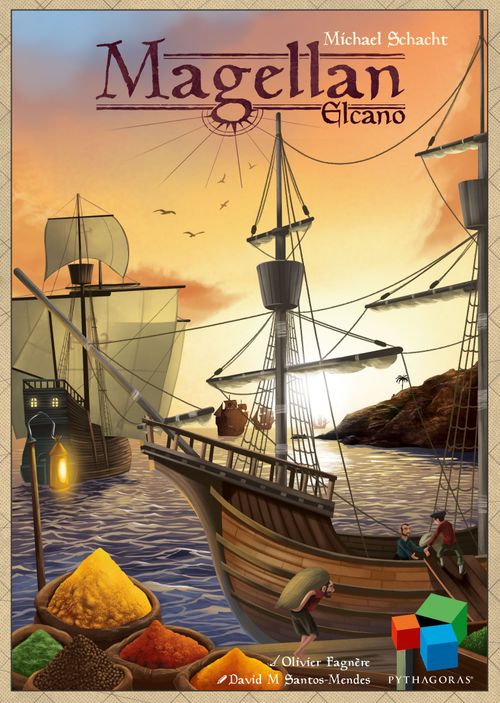
Magellan: Elcano
Magellan: Elcano Rulebook
Table of Contents
Table of Contents
Introduction
In this game, each player assumes the role of captain on one of the ships circumnavigating the world.
To win the game, the captain must have the skills to manage the crew and to figure out which feuds require the use of more, or less, resources.
During the game, several ocean cards (in 3 different colour sets) will be up for grabbing. Captains play their crew cards on the table, in an attempt to collect each of those ocean cards and their victory points. During their turn, they have the option to stop placing cards or to carry on, increasing their crew value.
When the time to anchor has come, the captain with the strongest crew will take the ocean card of the matching colour.
Pushing a bit further the fight for an ocean card may lead other captains to spend crew cards, that would have proven of better use in upcoming fights!
Components
75 Crew Cards
- 15 crew cards per player.
- The sets of crew cards are distinguished on the back by a slightly different color and the ship name.
- Most cards have values in two colors. When playing a card with two colors, players must decide which color the card will take for the round.
- The color and value of the card: the smaller number on the compass shows the color and value on the opposite corner of the card.
- Three different anchors are associated with each of the colors and serve to help players with difficulty in picking out colors.
18 Ocean Cards
- 6 ocean cards per color/anchor.
- The sets of ocean cards are distinguished by the color and shape of the anchor. Each card shows victory points.
6 Storm Cards
- These cards are used in the 5-player game (and in a 4-player game variant).
- The back of each storm card is distinguished by the simple astrolabe on a grid background.
- Cards are bid by playing crew cards face down.
1 Pigafetta Card
- This card is given to the first player.
2 Rulebooks
- A rule book in Portuguese and Spanish.
- A rule book in English and German.
Preparation for a 2-4 Player Game
(See 5-Player Game for 5-player rules.)
- A starting player is determined and takes the Pigafetta card.
- Each player takes a set of 15 crew cards. The players shuffle their cards and place them face down on the table as their draw deck.
- Then all players draw the top 5 cards from their deck to form their starting hand.
- The 3 decks of 6 ocean cards are shuffled separately to form 3 face down decks in the center of the table.
Game Play
The game is divided into 6 rounds. Each round consists of the following 5 phases, which are played out in sequence.
A. Chart the Course
Draw one ocean card from each deck and place it face up on the table, below each deck.
Important: if any ocean cards remain from the previous round the new card is placed on top of them so that the values of all cards are visible.
B. Cross the Seas
- Starting with the first player and following clockwise, on their turn the players place one of the crew cards from their hand face up on the table.
- The crew card played takes the larger number on the compass facing the center of the table. The card may be played upside down.
- The players can place up to three columns of cards, each one in a different color/anchor (red, blue, green). All cards in a column must be of the same color/anchor; the cards shall be overlapped so that the appropriate color/anchor number is always visible.
- The placement and orientation of a card may not be changed once it has been played.
- The players may play a card from their hands, on their turn, until all players pass.
- A player who passes cannot play any more cards in the current round.
Note: the start player must play at least one card, but may pass thereafter.
C. Anchoring
After all players have passed the played crew cards are evaluated and the ocean cards will reward the best captains.
- The 3 colors/anchors are evaluated one after another.
- The player who has the largest sum in a color (i.e. is the strongest in that color) wins all the ocean cards face up of that color - including cards from previous rounds if any.
- For each color, the winning players place the ocean cards in front of them face up.
- The winning sets of crew cards are discarded by each winning player. That is, when a player wins an ocean card of a certain color/anchor they have to discard the crew cards played of that color (i.e. the entire column of cards of the winning color).
- All the other crew cards played by all players are taken back into their hands. That is, when a player does not win an ocean card in a certain color, the played crew cards of that color (column) are taken back to the player's hand.
- Ties: in the event of a tie, the ocean card in the tied color is not awarded and remains face up in the center of the table. The tied players take their crew cards back into their hands. It is possible that several ocean cards of the same color remain face up from round to round.
- After the 3 colors/oceans are evaluated move on to phase D.
Example: Rita won the green anchoring this round with a value of 3 + 2 = 5 crew. Rita takes the green ocean card = 2 victory points. Rita places her 2 crew cards used to win into her discard pile. Tommy played a single green card and lost the competition for the green anchoring (4 < 5). Because of this he takes the card back into his hand for the next round.
D. Sailors Shift
Each player draws the top two cards from their draw deck and adds the cards to their hand, no matter how many cards they have in the hand already.
E. Pigafetta on Board
The Pigafetta card is given to the player to the left of the current first player. The next round continues starting at phase A.
End of the Game
The game ends immediately if, after phase C (Anchoring), the players have no more crew cards to draw from their deck and add to the hand (it's not possible to perform phase D).
The players add up the total number of victory points on their conquered ocean cards. The player with the most victory points wins.
Example: Marianne won the game with 16 victory points, coming from 5 ocean cards conquered!
If there is a tie the player with the highest sum of crew cards still in their hand wins.
Example: Rita also ended the game with 16 victory points. Two crew cards remained in her hand (she did not place them on the table during the last round). Marianne ended the game with a single crew card in hand. Marianne won because she adds a maximum value of 7 while Rita adds in her two cards the maximum value of 6!
If the tie persists, the players share the victory.
2-Player Game
In a 2-player game a small variation is introduced. When, in phase A (Chart The Course), a 4/1 ocean card is drawn, that card must be immediately rotated to show the value 1 as marked with a 2-player icon. At the end of the game these 4/1 ocean cards are only worth 1 victory point when totalling up the ocean cards.
5-Player Game
In a 5-player game the 6 storm cards are used and a fourth deck is introduced for contention alongside the three ocean card decks.
Storm cards have lower values: 1 x 1 victory point; 3 x 2 vp; 2 x 3 vp. The competition to win these cards each round is by bids of value 1 per card played face down in a 4th row on the table.
The phases B (Cross The Seas) and C (Anchoring) described above will have the following modifications:
- In addition to the three columns where players can place green, blue and red crew cards, the players, on their turn, can play any card face down in a fourth column.
- The backs of the cards show an astrolabe which is also the symbol shown on the fourth deck available, the storm cards.
- In each round phase C (Anchoring) the face up storm card is won by the player with the most astrolabes in sight (i.e. with the most cards played face down in the column).
- All the other rules of phases B and C are applied.
Example: Joe won the storm competition this round with a value of 2, 1 per crew card. Joe wins the 2 storm cards available this round, earning 1+2 victory points.
Note: the storm cards can also be used as a variant in 4-player games. The rules set out for 5-player games are maintained.
Historical Notes
The rulebook (pages 10 to 12) contains historical background on Fernão de Magalhães (Magellan), Juan Sebastián del Cano (Elcano) and the 1519-1522 voyage; it contains no game rules and is omitted here.