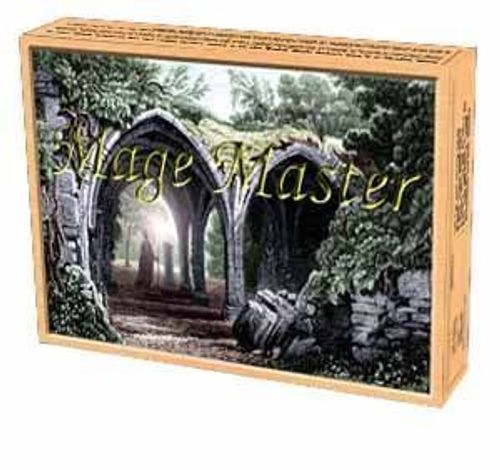
Mage Master
Mage Master Rulebook
Table of Contents
Table of Contents
The Aim of the Game
The aim of this game is to become the Arch Mage, the most powerful magic caster in the land. To win, a player can either defeat all the other players in the game or open the Arch Mage's tomb.
The Game
Players start in one of the four towns in the land as lowly wizards. By travelling around the land, they search for means to increase their powers. As each player begins the game with 400 gold, a good place to start is to head for the shops, situated at special locations and buy some equipment. Roads are fairly safe but a weapon may come in handy. A player can collect ingredients for casting spells, defeat creatures for rewards, locate better equipment and meet strange people in their travels around the land.
Players need to become sorcerers and eventually mages to cast higher level, more powerful spells. Visit all 5 volcanoes to acquire the shards required to assemble a full shard belt. Shard belts can be bought from the Magician, a special location in the land.
Definitions
Players
- Gold - The coin of the land. A player starts with 400 Gold.
- Health - Measured in HP. The amount of Health Points a player has got at any time. Health Points are lost when a player takes damage. A player starts with 12HP. A player is unconscious and Resting when HP=0, and dead if HP is less than 0.
- Resting - A player may miss their turn to Rest. This heals 2HP.
- Vitality - Measured in HPmax - the maximum Health Points a player can heal to. A player starts with 12HPmax.
- Attack Points - Measured in A - the amount of damage that can be inflicted. A numbered Skull Token is used to keep track of this amount.
- Defence Points - Measured in D - the amount of damage that can be defended against. A numbered Shield Token is used to keep track of this amount.
- Strength - The amount of physical Attack Points a player can inflict. A player starts with +1A. Use a skull token for this.
- Toughness - The amount of Attack Points a player can physically defend against. A player starts with +1D. Use a shield token for this.
- Movement Points - Measured in - defines how far a player can travel during their turn. It is linked to a person's Health ( 2HP = 1M ). A player starts with 6M.
Magic
- Magic Class - The classification of the magic casters in the game: Wizard, Sorcerer and Mage. Arch Mage is the classification given to the winner. A player starts as a L0 Wizard.
- Wizard - Can only cast L1 to L3 spells if they have the required Magic Tools. Can only cast Line-of-sight spells. Cannot use Magic Items. A wizard can become a Sorcerer by sacrificing the Magic Tools to the Sacrificial Stone, a Special Location.
- Sorcerer - Can cast L1 to L3 spells without Magic Tools. Can cast Line-of-sight and Same-landmass spells. Can use Magic Items. Can cast L4 to L6 spells if trained at the Magic School, a Special Location. A sorcerer can become a Mage by sacrificing the Magic Tools and a full Shard Belt to the Power Orb.
- Mage - Can cast all spells without Magic Tools anywhere on the game board. All spells are twice as powerful. No player can Respawn after a Mage is in play. A Mage becomes the Arch Mage by defeating all other players or by opening the Arch Mage's Tomb.
- Arch Mage - The title given to the winner of the game. The Master of all Mages. The Mage Master.
Board
- Land Hex - Individual hexagonal spaces on the game board of a particular terrain type. Road, Forest, Swamp, Desert, Water, and Mountain. Mountain terrain can also be a Mountain Pass or a Volcano. A player needs to spend Movement Points to move on to a hex. Road 1M, Forest 2M, Swamp 4M, and all other terrain 6M. (This data can be found at the top of the game board). Only one player can occupy a hex at any time. Players can pass through an occupied hex. Some terrains have a Land Hex Penalty.
- Land Hex Penalty - When a player ends their move on a land hex with a penalty, they take the damage associated with that terrain. Swamp -2HP, Desert -4HP, Water -6HP and Volcano -6HP. (This data can be found at the top of the game board). The player takes this damage for each turn that they remain on the land hex. A player must still pay the penalty while resting. There are ways in the game to nullify land hex penalties.
- Road (1M) - well travelled terrain. Low risk. Low rewards. Reasonably safe for all players.
- Forest (2M) - the start of the wilderness. Higher risk with better rewards. Reasonably safe for high level wizards who are reasonably equipped.
- Swamp (4M, -2HP) - Come prepared with boots. Dangerous, but with good rewards. Reasonably safe for well equipped sorcerers.
- Desert (6M, -4HP) - You better have a water bottle! High danger with great rewards. Risky for low level sorcerers.
- Water (6M, -6HP) - Throwing yourself into deep water when you can't swim is not a good idea! High danger level, but it may just be worth it - if you survive. Not recommended unless you are a well equipped, high level sorcerer.
The printed rulebook shows the special location tiles as artwork only (a row of twelve hex icons, including the Oasis and the Magician's and Magic School's tiles); the icons are not labelled in the text.
- Oasis (1M) - If a player ends their move on an oasis they will be fully healed. A player can also be cured of any affliction at the cost of 1 turn per affliction. There are 2 oases, one in the middle of a desert the other being a special location.
- Line-of-sight - A line on the board, from one player to another that only crosses Road, Swamp, Water and Desert terrain (centre of one land hex to centre of another).
- Same-landmass - Land completely surrounded by water. Does not include bridges or surrounding water.
- Bridge - A Road hex that spans 2 landmasses.
- Starting Points - a player starts the game in a town hex situated at the corners of the board. No land card is drawn in a town hex. (If there are more than 4 players in the game a town hex can have 2 players start on it).
Cards
- Land Card - Playing cards associated with each terrain, Road, Forest, Swamp, Desert, Water and Mountain. A player draws the relevant card when they finish their move. A Mountain card is drawn on a Mountain Pass hex and no card is drawn on a Volcano or a special location. If a card moves a player onto another hex a new card is then drawn.
- Card Types - a land card can be an Item, a Magic Item, a Creature, an Event, an Affliction, an Ingredient or a Familiar. This information is found at the top of the land card.
- Item - objects that can be carried or equipped. A player can carry 6 items. A player can only equip 1 item of each type (i.e. a player cannot wear 2 helms - one is equipped, the other is carried). Any number of rings or amulets can be equipped. Only one weapon can be used (i.e. a staff and a dagger can not be equipped at the same time). A player only gets the benefit of an item if it is equipped. Some items are considered to be consumable. Players cannot discard an item unless their carrying capacity has been exceeded.
- Consumable Items - are items like potions, salves and scrolls that do not need to be equipped to be used and once used are discarded. (i.e. a +3A strength potion is used in an encounter with a creature. Once used the potion is discarded and the effect of +3A is lost). Some consumable items might have multiple uses before they are discarded (i.e. a fireball wand can be used 3 times before it is discarded). Any item with words such as ONE USE ONLY is also a consumable item.
- - Items that have been enchanted with magic to enhance them. may carry or equip Magic Items but cannot benefit or use them.
Spells
-
Scrolls - An item which is used (and discarded) to cast a spell anywhere on the board, irrespective of the level of the magic caster.
-
Spells - A player can only cast spells during their turn. An Ingredient is used (and discarded) to cast a spell. Spells are either resolved immediately or "hang around" to be resolved. These types of spells are known as Active Spells. Not all spells can be made active. Once resolved a spell is discarded.
-
Active Spells - Some examples of active spells waiting to be resolved are:
- A L3 Slow spell is cast on another player. This spell remains active until that player moves next, which may not be for several turns. When the player does move, the spell resolves by giving that player -6M.
- A L2 Missile spell is cast without a target. This spell remains active until a target presents itself (next combat) at which time it deals +2A (multiple missiles can be active simultaneously, in which case only enough of the missile spells resolve to destroy the target, the rest remain active until the next target presents itself.) The Armour spell, for defence, works in the same way.
Note: Non-targeted Active spells will always resolve with the first target that presents itself. A player cannot choose to have the spell not resolve (i.e. A L4 Missile (+4A) will resolve when a player is attacked by a 1D creature).
- A L1 Regeneration spell is cast and remains active until the player is fully healed. It is then discarded.
Player Starting Statistics
The starting statistics of a player are:
- Vitality: 12 HPmax
- Health: 12 HP
- Strength: +1A (use a skull token)
- Toughness: +1D (use a shield token)
- 400 Gold
- Wizard Level 0
- 6 Items Carrying Capacity
- 4 Ingredients Carrying Capacity
(Any number of Items can be equipped.)
The printed rulebook shows a sample player record sheet (HPmax, HP, Attack Points, Defence Points, Gold, Magic Level, Item and Ingredient capacity boxes).
Movement
2HP = 1M. Movement is dependant on how healthy a player is and the type of Terrain they travel on. A player may choose not to use all their movement points to move.
Creature Statistics
- 12A - The creature's strength. It will inflict 12 points of damage on the player.
- 7D - The creature's toughness. A player must inflict 7 points of damage to kill the creature.
- Sand Snake - The creature's description.
- Reward - On defeating the creature, the player will receive this reward (200 Gold + the Fangs ingredient that can be used to cast a L5 Power Up spell).
The printed rulebook shows this as a sample creature card: Sand Snake, 12A, 7D, reward 200 Gold + Ingredient FANGS, "L5 - POWER UP: TARGET MISSILE SPELL DOES DOUBLE DAMAGE".
Combat Between a Player and a Creature
When a player encounters a creature, combat occurs. The player and the creature inflict damage to each other simultaneously. The player must inflict enough damage to meet or overcome the creature's toughness to defeat it. Damage on the player is resolved by subtracting the player's defence from the creature's attack points.
For example (see diagrams on opposite page):
- At the start of the encounter, the player's attack is 4A and defence is 3D.
- [ 4A = +2A (strength), +1A (dagger), +1A (spiked boots),
- 3D = +1D (toughness), +1D (helm), +1D (spiked boots) ].
- The player also has a +2A L2 missile active spell.
- The player draws a Sand Snake, a 12A, 7D creature.
- The active missile immediately strikes the creature for 2 points of damage, which is insufficient to kill the Snake. (If the active spells defeat the creature at this point, the creature will not get a chance to inflict any damage on the player). The creature then closes with the player in combat.
- During combat the creature inflicts 12 points of damage on the player, of which 3 points is defended against. The player therefore takes 9 damage points and so loses 9 HP. At the same time the player inflicts 4 more damage points on the sand snake, bringing the total damage inflicted to 6, which is still insufficient to kill the snake.
- The player now casts a +1A L1 missile, bringing the total damage inflicted on the snake to 7 and thus defeating the sand snake as it meets the creature's toughness. The player can now claim the reward of 200 Gold and the Fangs ingredient. (The creature card is used as the ingredient card ), as well as a carcass.
If the creature is not defeated in the initial encounter, it will remains on the hex, and the player will have to engage in combat again on their next turn, unless they leave the hex, at which time the creature is removed from the board.
A player is unconscious and resting when HP=0, and dead if HP is less than 0.
If the player becomes unconscious any creature will leave, having assumed that it has killed the player.
As long as there is no Mage in play, a player may respawn if they are killed.
The printed rulebook shows two annotated player-sheet diagrams for the example above, "Before Combat" and "After Combat".
Combat Between Players
One player can attack another if they are on an adjacent hex. Combat is resolved simultaneously. The attacking player has an advantage in being able to cast spells as well.
(Note: Players can only cast spells in their own turn, although items can be used at any time.)
A Player's Turn
A player's turn consists of:
- Pay any affliction penalty (i.e. from disease, poison etc.).
- Move.
- Pay any land penalty.
- Draw a card.
- Combat or interact with other players or special locations.
Spells can be cast at any time during a player's turn. Any number of spells can be cast.
A player can miss their turn to rest and heal 2HP. Even though the player doesn't move or draw a card while resting, any affliction or land penalties must still be paid. Spells cannot be cast while resting.
Odds and Ends
- If vitality is increased or decreased, the players health is also affected by the same amount.
- If a player is on a special location during a spatial vortex, they will also move to the new hex.
- A healing potion cannot be consumed after a player is killed.
- Players cannot trade with each other.
- An encounter is any interaction between a player and another player or card, including spells.
- If a player leaves the game, they are considered to have been killed.
- If a player steals an item from another player, they do not pay any cost associated with that item.
- If a player misses a turn, they still have to pay any affliction or land penalties.
- A short version of the game can be played where the starting statistics are:
- 24 HPmax
- 24 HP
- +1A
- +1D
- 800 Gold
- Sorcerer Level 3 (untrained)
- 6 Items Carrying Capacity
- 4 Ingredients Carrying Capacity
Score Sheet and Cards Layout
The printed rulebook shows a diagram titled "Score Sheet & Cards Layout" that places each card type on the player's score sheet. The labelled areas are: Active Armour Spell, Active Spells, Active Missile Spells, Equipped Weapon, Equipped Items, Carried Items, Ingredients, Familiar, Afflictions, Strength, Toughness, and Gold, with the score sheet itself recording HPmax, HP, Attack Points, Defence Points, Magic Level, the 6 Item Capacity and the 4 Ingredient Capacity.