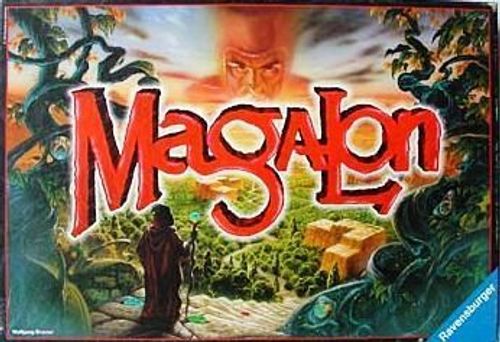
Magalon
Magalon Rulebook
Table of Contents
Table of Contents
Game Idea and Goal
Your goal is to be the first to return with your magician to the entrance of the valley (the start and finish space) after you have collected the three artifacts.
Contents
- 1 game board
- 6 ruins
- 1 giant
- 2 gnomes
- 4 magicians
- 4 energy stones
- 4 shields
- 44 magic cards
- 12 magical artifacts
- 4 action chips
- 2 dice
Setup
- Place the ruins on the grey marked, angled spaces of the game board.
- Punch the artifacts and the action chips out of the die-cut sheet and place the artifacts on the three artifact spaces at the edge of the game board. The four action chips are laid out next to the game board.
- Place the giant and the gnomes in their starting positions on the three spaces of the game board outlined in red (see illustration).
- Each of you receives:
- 1 magician, which you place on the start and finish space.
- 11 magic cards in the colour of your magician, in your hand.
- 1 energy stone in the colour of your magician, which you place on space 10 of the energy scale as its starting position.
- 1 shield of the same colour, which you initially set down in front of you.
- Lay out the two dice, and you are ready to go!
(Illustration labels: artifact spaces, ruin, magician, start/finish, magic cards, action chip, giant, energy spaces, gnome, energy stones, shield.)
Course of Play
Going clockwise, each player lays one of his magic cards face up, with the youngest player beginning in the first round of a game. It is important that each player must lay down a card of a different value. If all players have played different cards, the player with the highest card value is first to take his turn, then the one with the second highest, and so on.
When it is your turn, you carry out the following actions:
- move your own magician,
- carry out the card you played,
- set your own shield on any free space,
- and move your own energy stone.
The player with the lowest card of a round also moves the giant.
To keep track: these actions are shown on the four action chips. They are laid in front of whichever player's turn it is. As soon as he has finished one of the actions, he turns the corresponding chip over. At the beginning of a round, the player who may move the giant in this round receives the two dice.
You decide for yourself in which order you carry out the individual actions. You have complete freedom in this, i.e. you may for example first carry out part of an action, then follow with another action, and only afterwards finish the first action.
Example: With a 7 card you can move a ruin by two spaces, then first move your magician and afterwards push the ruin back the remaining two spaces.
When you have finished your turn, turn the card you played face down and leave it face down in front of you. You may not use it again for the time being. When all players have finished their turns, the next round begins, again with the playing of a magic card. The following applies: whoever was last in turn in the previous round (i.e. had played the card with the lowest value) now begins the playing. He lays his card face up in front of him. Then all the other players, going clockwise, lay their cards face up. The procedure within the individual rounds remains unchanged.
Moving Your Own Magician
The card value (upper left and right corner) tells you by how many spaces you must move your magician. From the start space you may enter the valley at any point.
(Illustration: arrows from the start/finish row going horizontally and vertically into the valley.)
The following rules apply when moving:
- You can only move horizontally or vertically, but never diagonally.
- When moving you may change direction as often as you like (turn at right angles).
- You may not enter the same space twice in the same turn.
- If you cannot or do not want to move all movement points, your magician must stay where he is. You may therefore not let part of the movement points lapse.
- Other players' magicians, ruins, shields, gnomes and the giant are obstacles. The spaces on which these stand may not be entered or jumped over.
Carrying Out the Played Magic Card
The following magic cards are available to choose from:
Moving Gnomes (3, 6, 9 and 10 cards)
- You may move one or both gnomes by a total of as many spaces as is stated on the respective card.
- The same movement rules apply as for magicians, with one exception: you may attack other players' magicians! If you move a gnome onto or over a space with an opponent's magician, you may displace this magician by 5 spaces in any direction. The known movement rules must also be observed when displacing.
- In one turn you may displace several magicians. A magician can, however, be displaced only once per turn.
- Gnomes may not enter the start space or the three artifact spaces.
Moving Ruins (2, 7 and 8 cards)
- You may move one or more ruins by a total of as many spaces as is stated on the respective card.
- Ruins may only be moved horizontally and vertically within the spaces of the game board.
- You may not push along any magicians, gnomes, shields, other ruins, or the giant.
- Ruins may not be moved onto or over the start space and the artifact spaces.
Moving One Ruin (5 card)
- You may lift a ruin, turn it, and set it down on any free place within the game board spaces.
- Ruins may not be placed on the start space or on an artifact space.
Gaining Energy Points (1 and 2 cards)
- You may move your energy stone up the energy scale by as many spaces as are stated on the cards (next to the energy symbol), but not beyond the top space.
Protection from Attacks (4 card)
- Leave this card lying face up in front of you until the end of the round. In this round you can be displaced neither by the giant nor by the gnomes!
Regaining Played Cards (0 card)
- You take all magic cards already played by you, which lie face down in front of you, back into your hand (including the 0 card), and may use them again from the next round on.
Setting Your Own Shield
You set your shield, for your own protection and/or to obstruct other players' magicians, on any free space (not on the start space or the artifact spaces) in each turn, or leave it standing. You may not enclose a magician at the edge of the board with other players' shields in such a way that he can no longer move.
Showing the Current Energy Reserve
The magicians constantly lose energy on their roving through the valley of Magalon, therefore on every turn you must set your energy stone down by 1 space. This does not apply, however, if you receive new energy, by:
- moving directly onto a red energy space and remaining standing there. In this case you may move your energy stone up by 3 spaces.
- playing the 1 or 2 magic card, with which you may set your energy stone up by 4 or 8 spaces respectively.
If you want to move into the finish with your magician, you must have at least 16 energy points! If you do not have that many, you must first collect energy again on one of the energy spaces or with a 1 or 2 magic card.
Should your energy stone fall below "0", you must return with your magician to the start and finish space, give up all artifacts you have obtained, and from there set out on the journey again with your magician (with 10 energy points as starting capital).
Moving the Giant
The player who has played the lowest card in this round may move the giant with the help of the two dice. When it is his turn, he rolls and moves the giant by the number of pips rolled. The same movement rules apply as for magicians, with one exception: the giant may attack other players' magicians!
If you move the giant onto or over a space with another player's magician, you may displace this magician by 10 spaces in any direction. The known movement rules must also be observed when displacing.
In one turn you may displace several magicians, but a magician can be displaced only once per turn. Likewise a player may not, in one round, attack a magician one after the other with a gnome and with the giant: either - or!
The giant may enter neither the start space nor the artifact spaces.
Special Board Spaces
Start and Finish Space
From here the magicians start forward or sideways over any space in a horizontal or vertical direction. Here the game also ends, as soon as a magician with the three artifacts and at least 16 energy points has returned to this space.
The Red Energy Spaces
If your magician is, at the end of your turn, directly on a red energy space, you have the choice between two alternatives:
- You remain standing there and may set your energy stone up by three spaces (see above).
- You immediately move on three spaces and must, as otherwise, pay one energy point (exception: if you have played a 1 or 2 magic card).
The energy spaces have no significance if you merely move across them.
The Three Artifact Spaces
You receive the corresponding artifact when you move with your magician onto or over an artifact space for the first time, and lay it face up in front of you on the table. It can no longer be taken from you now. As soon as you have collected all three artifacts, you set out on the way back to the finish space.
The artifact spaces each count as 1 space and may at any time be entered and left at any point in a horizontal or vertical direction, even if the player already possesses the artifact in question. The gnomes and the giant may not enter the artifact spaces. These spaces therefore also offer protection for the magicians.
The Light Grey, Angled Spaces
These spaces merely mark where the ruins are set up at the start of the game and have no significance during the course of the game.
End of the Game
When you possess all 3 artifacts, try to reach the finish space at any point as quickly as possible. Whoever is first to
- reach the finish space,
- have collected all three artifacts, and
- have at least 16 energy points available when moving into the finish (the entire turn need not yet be completed in doing so),
is admitted into the "Council of 11" and is the winner.
Special Cases / Notes
What if ...
- a player cannot play a magic card because he only has cards left that have already been played in this round? In this case the player must sit out, but may in the next round be the first to play a magic card!
- a player cannot move his magician by the full number of movement points because he is surrounded by obstacles? In this case the player cannot move his magician in this round. He can, however, carry out all the other actions.
- a player cannot move the gnomes or the giant by the prescribed distance? In this case the action is not carried out.