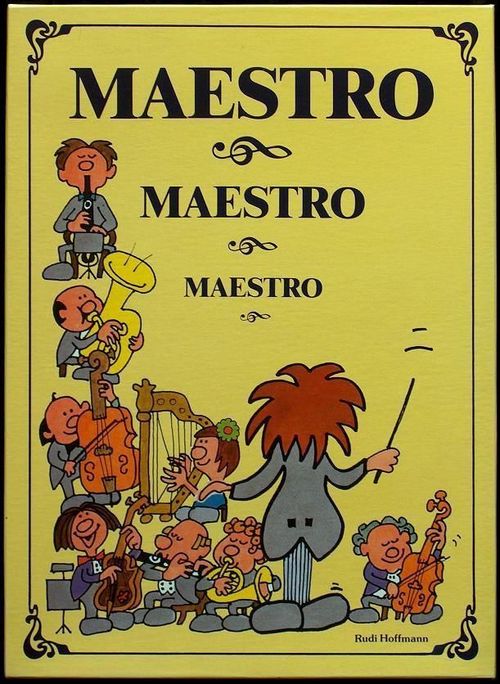
Maestro (1989)
Maestro (1989) Rulebook
Table of Contents
Table of Contents
Contents
- 1 game board
- 14 Applause
- 4 Agencies
- 1 Critic with stand
- 1 Bag of Chips
- 56 Musicians (46 Musicians and 10 Maestros)
Number of players: 2-4. Ages: 8 and up.
Before the first game please carefully remove the tiles from the sheet.
Preparation
All cards must be placed face up.
Each player receives an agency and a Maestro, who is placed in the 10 space. All remaining musicians and applause cards are mixed together and piled up face-down next to the gameboard. The chips are placed next to the game board, as is the critic.
The Game
The game is played in turns. The player who can best sing high "C" starts.
First place, then draw (1-3 musicians, as you wish)
Whoever's turn it is, can first place musicians onto the gameboard and then must draw 1-3 musicians and place them onto the agency card empty spaces of his choice. You must decide before you draw, whether you will take 1, 2, or 3 tiles.
Important: In the beginning of the game, usually the conductor is not placed down alone without first drawing musicians.
First the Maestro
How are musicians placed on the board?
In an Empty Row: The first musician in any empty row must be a Maestro. The Maestro replaces the musician of your choice and is placed at your discretion on any instrument. After that, in the same turn, as many musicians as desired can be placed next to the Maestro so long as there are no gaps in the line. In this way a row may be started or a row can be finished all in one turn.
1 Maestro per row and only 1 complete row
In a row in which musicians have been previously placed: Further musicians are likewise placed so that there is no gap in the line. In any case, a player may only place musicians in one row per turn.
From your agency and from the top row of others'
Where do you get musicians to place on the gameboard?
You may take any number of musicians from anywhere in your own agency, but from others' only from the top row of opponents' agencies. But only from the top rows and only as many as there are in the row of the gameboard in which you are placing them.
One can place musicians, but is not required to
Even if you cannot or do not want to place musicians, you must still draw. Newly drawn musicians are placed onto empty spaces in your agency.
You must draw at least 1 musician however
Once played, these musicians may not be moved to different positions in your agency. You may not draw more tiles than you have space for in your agency. If an applause is drawn, it is placed on the bottom row of the gameboard, without a new tile being drawn to replace it.
The Agencies
Numbers count only if musicians remain
You have ten spaces in two rows. Every space is numbered. The number symbolizes the value of the contract that you gave that musician and only has meaning at the end of the game. If musicians remain in your agency at the end of the game, the owner of the agency pays as much money as the total of the contracts for these musicians.
Bottom rows exclusive. Top rows for all musicians from opponents immediately playable on the board
As already mentioned, musicians can be taken from the top row of the other player's agencies, and not from the bottom row. These musicians have so-called exclusive contracts!
There is one exception: if an agency is completely full, then musicians can also be taken from the bottom row of this player's agency. But only so long as the agency is truly full. Musicians, which are taken from opponents immediately go onto the gameboard and never into your agency!
The Critic
Critics placed at completion of a row
When a row is finished, (either completed in one turn, or completing one already begun), it receives the critic. For the effect of this, please read the next section.
Scoring
50-, 10-, 5-, 1-point chips
Chips come in the following denominations: 50, 10, 5 and 1 points. The 1-chips are only needed in the final scoring.
5 per musician
Scored are:
- For a row begun, continued, or completing an already started row. For each newly placed musician you receive a 5 chip. (The Maestro is a musician.)
10 per musician
- A row is completed all in one turn. You receive a 10 chip per musician.
10 for the critic
- You have the critic. At the beginning of your turn you receive an extra 10 chip.
Game End and Victory
Last applause placed / No musician drawn
The game ends immediately as soon as the last applause marker is placed. The game also ends when a player can not draw a new musician. That second condition may also occur if someone has a full agency and will not or can not place a musician. When the game is over, everyone counts their points, and subtracts the negative points.
Whoever has the most points wins the individual game. Usually several games are played, and the points earned for each game are totalled. Whoever first reaches 200, 300 or another pre-agreed figure wins.
General
Each musician corresponds to an instrument space on the gameboard. Additionally, there are ten Maestros.
The small stars on the musician tiles indicate the frequency of that type of musician, that is, their instruments. The numbers next to each row gives a simple point value. If you fill the row in one turn, you receive double this printed value. All rows are music pieces in authentic arrangements.