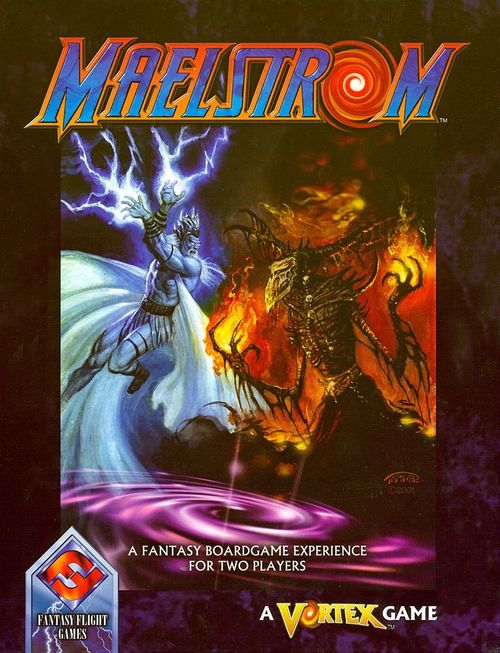
Maelstrom
Maelstrom Rulebook
Table of Contents
Table of Contents
Object of the Game
Vortex is a two-player game in which you and your opponent play Masters of the Void. Using your minions and strongholds, you are trying to dominate the central Vortex, forcing your opponent to "burn" off points of Essence. Both players begin play with three points of Essence. When your opponent has no more Essence, you win the game.
You can also win the game by surrounding the Vortex. If, at any time, you have tiles adjacent to every side of the Vortex, you immediately win the game.
Contents
This starter set includes four fixed flats of hexagonal tiles from the specified faction, four flats of random tiles, and this rulebook. The four fixed flats also include a Vortex tile and several counters, which are explained below.
Getting Started
To start playing Vortex, you need a collection of tiles (called your force), three Essence counters, a handful of energy and wound counters, a Vortex tile, and an opponent to play against. You have enough tiles and counters in this starter set for you to play, but your opponent should have his or her own starter set.
Below is a description of what you need to play Vortex.
Components
The most important components in Vortex are hexagonal tiles. Aside from the Vortex tile itself, there are four types of tiles: minions, strongholds, events, and relics.
The Vortex Tile
Each starter set includes one Vortex tile. You need a Vortex tile to play, since it forms the center of the playing area.
Minions
Minions are the soldiers, monsters, and magical creatures that you summon to fight on your behalf around the Vortex.
Here is a sample minion:
Name: This is the minion's name.
Movement: This is how many spaces the minion can move. (Spaces and movement are detailed below.)
Combat: This is how effective the minion is at attacking other tiles and defending itself against attackers.
Range: The number of stripes here indicates the minion's Range. A minion's Range is how many spaces away it can attack a target. Most minions have a Range of 1, meaning they can only attack tiles adjacent to themselves.
Armor: This is a measurement of how well the minion resists damage. When a minion receives an amount of damage equal to its Armor, it receives a wound.
Life: When a minion receives a number of wounds equal to its Life, it is destroyed.
Cost: The number of jewels here tells you how much Output you need in order to summon this minion. There are eight different colors of Output. The color of the cost jewels tells you what color of Output the minion requires.
Text: This lists the minion's traits, keywords, and special abilities. Words in bold are traits, which have specific game effects, described later in these rules. Words in bold italics are keywords, which have no inherent effects, but serve as identifying features. Text in plain italics is flavor text; it has no game effect, but tells you about the story behind Vortex.
Type Icon: This icon tells you what type of tile you're looking at: a minion, stronghold, event, or relic. It also indicates the tile's alignment: If it has a black background, the tile is evil. If the background is white, the tile is good. (Alignment is important when assembling your force, described below.)
Faction Icon: There are eight different factions in Vortex, each with its own icon. This icon tells you the faction to which the tile belongs.
Strongholds
Strongholds allow you to summon other tiles into play. Each stronghold has a certain amount of Output, which you may spend to summon minions.
Like minions, each stronghold has a name, armor, life, cost, text, type icon (showing that it's a stronghold), and faction icon. Strongholds also have an Output value.
Output: Strongholds produce Output in one of eight colors. The number and color of jewels tells you the number and color of the stronghold's Output.
Events
Events allow you to affect the game in many different ways, such as making your minions faster or your strongholds stronger. Events are usually discarded after producing their effects.
Like minions and strongholds, each event has a name, text, and icons. Events may also have a cost, but their cost is in energy, and not Output.
Cost: Some events cost energy (explained below) to bring into play. The number of energy icons tells you how many energy you must spend to bring the event into play.
Relics
Relics are items of power that, like events, affect the game in many different ways. Like events, each relic has a name, text, and icons, and may cost energy to bring into play. Unlike events, however, relics are usually not discarded after producing their effects, but are placed in front of their owners and some may be used again.
Counters
Vortex uses three types of counters: Essence counters, energy counters, and wound counters.
Essence Counters: Each player begins the game with three Essence counters. If a player ever runs out of Essence counters, that player immediately loses the game.
Energy Counters: At the beginning of the game, all energy counters are placed in a communal pile called the Void. When one of your tiles consumes an energy tile (consuming energy is detailed below), you receive an energy counter from the Void and put it in your personal collection of energy, known as your Hoard. You may spend energy from your Hoard to supplement your strongholds' Output, or to bring event and relic tiles into play. (Consuming and spending energy are detailed below.)
Wound Counters: If a tile receives a wound, but is not destroyed, place a wound counter on it to show that it has received a wound.
Assembling Your Force
Before playing, you must assemble your force. Choose, from your collection, which tiles you wish to include in your force. There are two things to keep in mind when assembling your force: alignment and faction.
Alignment
When two players play a game of Vortex, one player must play a force composed of good tiles and the other must play a force composed of evil tiles. Good and evil tiles may never be in the same force.
Factions
There are eight different factions in Vortex. Four of them are good (Arcanae, Host, Gaians, and Loftis), and four of them are evil (Draconis, Necris, Brood, and Deep).
Each of the eight factions is associated with one specific color of Output. The Host, for example, rely on (and produce) white Output, while the Necris need red Output. You can identify what faction a tile belongs to by its icon, as well as the color and texture of its border.
You may include multiple factions in your force. Including tiles from multiple factions allows you greater diversity, but makes it more challenging to summon the tiles you want into play. (See the "Summon Phase" for details.)
Other Force-Assembling Rules:
- You may include as many tiles or as few tiles as you want, as long as your opponent's force has the same number of tiles.
- All the tiles in your force must be either good or evil. If you have good tiles in your force, you may not have any evil tiles, and vice versa.
- You may not include more than four copies of any one tile in your force, with one exception: You may include as many Primary tiles as you wish. (Primary tiles are described below.)
Setting Up
Once you and your opponent have assembled your forces, you are ready to set up. Setting up is quick, and done in four steps:
1) Place the Vortex and primary strongholds
Place a Vortex tile in the middle of the playing area. Choose a Primary stronghold from your force and place it adjacent to the Vortex. At the same time, your opponent chooses a Primary stronghold from his or her force, and places it adjacent to the Vortex, on the opposite side of the Vortex tile from your stronghold. (See the "Example of Play #1" diagram.)
2) Select your opening hand
Both you and your opponent choose, from your respective forces, five tiles each. These tiles are your hand. When you bring a tile into play, you bring it into play from your hand. Your opening hand may include only strongholds and minions of Cost 3 or less.
3) Shuffle
Randomly shuffle your remaining forces and place them face-down in front of you. This stack of tiles is your draw stack. (When you discard a tile, it goes face-up into your discard stack.)
4) Determine first player
Flip a coin to see which player goes first. The player who goes first must randomly discard one tile from his or her hand, then draw another tile from his or her draw stack.
Playing the Game
Vortex is played in a series of turns. Each turn is divided into four phases:
- Movement Phase
- Action Phase
- Summon Phase
- Burn Phase
After one player has played through the four phases above, it is the second player's turn. After the second player has played through the four phases, it is the first player's turn again. In this fashion, both players continue taking turns back and forth until one player wins.
Exception: During your first turn of the game, there is only the Summon Phase. You must skip your Movement, Action, and Burn Phases on your first turn.
During your opponent's first turn of the game, he or she must likewise skip his or her Movement, Action, and Burn Phases. Your opponent may also only play the Summon Phase.
After both players have taken their first turns, they play through all four phases of all subsequent turns.
1) Movement Phase
Each tile-sized section of the playing area is considered one "space." During your Movement Phase, you may move each of your minions a number of spaces up to their total Movement value. Minions are moved along the edges of other tiles.
The Vortex Mass
The Vortex ties the universe together. Minions and strongholds caught up in the battle for the Vortex cannot break free of its pull, nor can they help others break free.
The Vortex mass consists of the Vortex tile, and all strongholds, minions, and energy tiles in play. You must be able to trace a path from the Vortex tile to each tile in the Vortex mass. This path cannot be traced through empty spaces.
The Golden Rule
You may not move a tile in such a way that it separates from the Vortex mass, or separates another tile from the Vortex mass. Nor may you take any other action that will cause one or more tiles to separate from the Vortex mass.
This is the Golden Rule of Vortex, and nothing may violate it. If you wish to do something (move a tile, consume an energy, use a tile's special ability, play an event tile, etc.) that would violate the Golden Rule, you may not do it.
Other Movement Rules:
- You may move your minions in any order, but may only move each minion once. (You may wish to place a token on each tile as you move it, as a temporary reminder of which tiles you have moved.)
- You may not move a tile one part of its movement, move another tile, then move the first tile the second part of its movement.
- Flying minions may move over other tiles, but may not end their movement on other tiles. Like all minions, Flying minions may not separate from the Vortex mass, even while moving.
Movement and Flying: Minions with the Flying trait may move over other tiles, but must end their movement in a legal location. For example, a Flying minion might move three spaces, moving over one or more tiles, and ending its movement in a legal location that is part of the Vortex mass.
Movement: A minion moves a number of spaces up to its total Movement value along the edges of other tiles, ending its movement in a legal location.
Movement and the Vortex Mass: A tile may not move to a location if doing so would separate another tile from the Vortex mass. A tile may move to a location that keeps every other tile connected to the Vortex mass, even if that means moving along the outside edge of the Vortex mass to reach it.
2) Action Phase
During your Action Phase, you may perform three actions. Each action may be one of the following:
- draw a tile from your draw stack,
- attack one of your opponent's tiles,
- use a tile to consume an energy tile, or
- use a tile's special ability.
You may take the same action multiple times during your Action Phase if you wish. (For example, you may draw three times.) You may take less than three actions, but if you do so, the unused actions are wasted.
Action: Draw a Tile
Take the top tile from your draw stack and put it into your hand. You may have any number of tiles in your hand.
Action: Attack
You may attack your opponent's minions and strongholds in order to destroy them. Attacking is done in four steps:
1) Choose a target: Choose one of your opponent's tiles in play to be the target of your attack. You may attack the same tile multiple times during your turn, but you must use different minions for each attack (see below).
2) Choose your minions: Choose which of your minions will participate in the attack. A minion may only participate in one attack per turn. In order to participate, a minion must be in range of the target. Most minions have a Range of 1. Therefore, they must be adjacent to the target to participate in the attack.
3) Apply the attack: Combine the Combat values of all your minions that are participating in the attack. Compare this total to the target's Armor value. If the total is equal to or greater than the target's Armor value, the target receives a wound. Place a wound counter on the target.
4) Apply the defense: The defending player now compares the target's Combat value to the Armor value of a single minion that is participating in the attack (and is within the target's Range). If the target's Combat value is equal to or greater than the participating minion's Armor value, the participating minion receives a wound. Place a wound counter on the participating minion.
5) Resolve the wounds: If any tiles have received a number of wounds equal to or greater than their Life, those tiles are destroyed. Remove the wound counters from these tiles and flip them upside down. Destroyed tiles are no longer considered minions or strongholds. Instead, they are now energy tiles, controlled by neither player.
Note that once you have played a couple games, you may find it faster and easier to compress steps 3-5 by applying the attack and defense simultaneously, and immediately resolving the wounds.
Other Attack Rules:
- Each of your tiles may only participate in one attack per turn.
- Damage is not cumulative. That is, if it does not cause a wound, it disappears at the end of the attack.
- Damage may inflict multiple wounds. For instance, if the damage a tile receives is double its Armor value, it receives two wounds; if the damage is triple, the tile receives three wounds, and so on.
Action: Use a Tile to Consume Energy
If any of your minions or strongholds are adjacent to an energy tile, you may use your tile to consume that energy. When this happens, discard the energy tile into its owner's discard stack, then receive one energy counter from the Void and put it into your Hoard. Each of your tiles may only consume energy once per turn.
Note that you may not use a tile to consume an energy if doing so will separate one or more tiles from the Vortex mass. (See the "Golden Rule" for details.)
Action: Use a Tile's Special Ability
Many tiles have some sort of special ability listed in their text. Some of these special abilities are passive; that is, they are constantly in effect as long as the tile is in play.
Other special abilities are active, which means you must spend an action during you Action Phase in order to use them. Active special abilities are denoted by the "action" icon, followed by their effect.
For example, a tile has the special ability, "Action: Remove a wound counter from one adjacent tile." This means that during your Action Phase, you may spend an action to to use this tile's special ability, and therefore remove a wound counter from an adjacent tile.
You may only use each tile's special ability once per turn.
3) Summon Phase
During your Summon Phase, you may bring minions and strongholds into play from your hand. (Relics are also brought into play from your hand during the Summon Phase, but they are not summoned. Relics are detailed below.)
Most minions and strongholds have a Cost: a number and color of Output needed to summon it. When you summon a tile, you must bring it into play adjacent to at least one of your strongholds (already in play at the beginning of the Summon Phase) with Output that matches or exceeds the Cost of the summoned tile. For example, if you want to summon a minion with a Cost of two red Output, you must bring it into play adjacent to a stronghold with red Output of at least two.
You may summon a tile adjacent to two or more strongholds, combining their Output to pay the cost of the summoned tile. For example, you could summon a tile with a Cost of four blue Output adjacent to two strongholds with two blue Output apiece. (Note that the summoned tile must be adjacent to every stronghold that is providing it Output.)
When summoning a tile with no Cost (such as many Limited tiles), you do not have to bring it into play adjacent to a stronghold. You must, however, bring it into play adjacent to one of your tiles already in play prior to the Summon Phase.
Spending Energy
During the Summon Phase, you may spend any number of energy counters from your Hoard. For each energy counter you spend, you may add one point of Output to the Output of any one of your strongholds in play during this Summon Phase. Note that you may not spend energy to simply create Output; it must add onto the Output of a stronghold already in play.
Other Summoning Rules:
- You may summon only one tile per stronghold. If a stronghold's Output exceeds the cost of the tile you summon, the excess Output is wasted.
- A stronghold has no Output the turn that it is summoned.
- If you spend energy to increase a stronghold's Output, the added Output is the same color as the stronghold's Output.
Text Icons: Some tiles use icons in their text to refer to specific game elements. These icons and their meanings are listed here:
- Combat Value
- Movement Value
- Armor Value
- Energy
- Action
4) Burn Phase
During your Burn Phase, if you have fewer minions or strongholds adjacent to the Vortex than your opponent, you must discard one Essence counter. If discard your last Essence counter, you immediately lose the game. (Note that you can only lose Essence counters during your Burn Phase, and that you only lose one Essence counter at a time.)
After your Burn Phase, your turn is over and it is your opponent's turn.
Example of Play
In this example, Greg is playing a good force, composed mostly of the Arcanae faction. Brian is playing an evil force, specializing in the Brood faction. Both players have 24 tiles in their forces, which they have already assembled. From this 24, they have each pulled out one Primary stronghold.
Setting Up
The players place the Vortex tile in the center of the playing area. Greg places his primary stronghold, "The Academy of the Arcane" adjacent to the Vortex. Brian places his primary stronghold, "Lake of Fire" across the Vortex from Greg's tile.
Now the players choose their opening hands of five tiles each. When both players have chosen their opening hands, they shuffle their draw stacks and place them face-down in front of them.
Greg and Brian flip a coin to see who goes first. Brian wins the coin toss, so he gets to go first, but has to discard a random tile from his hand. He presents his opening hand to Greg, who picks one at random and puts it into Brian's discard stack. Brian then draws a random tile from the top of his draw stack.
First Turn: Brian
Because it is his first turn, Brian must skip his Movement and Action Phases, and goes straight into his Summon Phase. He summons a minion that costs one Output ("Daemon Horde") and places it adjacent to both his "Lake of Fire" (which has one Output needed to summon the minion) and the Vortex. Brian also summons a second "Lake of Fire," which is a free stronghold, and places it adjacent to the first stronghold, opposite the "Daemon Horde" and adjacent to the Vortex.
Brian now has three tiles in play, covering three sides of the Vortex. He has three tiles left in his hand.
Because it is his first turn, Brian skips his Burn Phase. It is now Greg's turn.
First Turn: Greg
Greg must skip his Movement and Action Phases because it is his first turn. During his Summon Phase, he summons a minion with a cost of one Output ("Iron Enforcers") adjacent to his primary stronghold, which has an Output of one. The minion is also adjacent to the Vortex, as well as Brian's "Lake of Fire."
Greg also summons a second primary stronghold, a second "Academy," which he places adjacent to the first stronghold, the Vortex, and Brian's "Daemon Horde."
Greg now has three tiles in play, covering three sides of the Vortex. He has three tiles left in his hand.
Because it is his first turn, Greg skips his Burn Phase. It is now Brian's turn again.
Second Turn: Brian
Brian begins his turn with his Movement Phase. He moves his "Daemon Horde" two spaces, so that it is adjacent to both of Greg's strongholds. (Because it is Flying, the Horde moves over one stronghold.)
For his Action Phase, Brian spends his first action to attack. He targets Greg's first stronghold. He chooses the Horde to participate in the attack (since it's the only minion he has in play). The Horde has a Combat value of 1, which is equal to the stronghold's Armor of 1, so Brian places a wound counter on the stronghold. (The stronghold has a Life of 2, so it is not destroyed by the single wound.) The stronghold has no Combat value, so it cannot defend itself against the Horde.
Brian spends his second two actions to draw two tiles from his draw stack.
During his Summon Phase, Brian summons a second "Daemon Horde" adjacent to his first stronghold, thus filling the space left empty when his other minion moved at the beginning of the turn.
During his Burn Phase, Brian has the same number of tiles adjacent to the Vortex as Greg does (they both have three). Therefore, he does not lose an Essence counter. If Brian had not summoned the second minion during his Summon Phase, that space would have been empty. He would have had only two tiles adjacent to the Vortex, which is less than Greg's three, and he would have lost an Essence.
Second Turn: Greg
Greg uses his Movement Phase to move his "Iron Enforcers" adjacent to the "Daemon Horde."
During his Action Phase, Greg spends his first and second actions to draw tiles. With his second draw, he draws an event tile that will help his minions during an attack.
Greg spends his third action to attack Brian's Horde. He chooses his "Iron Enforcers" to participate in the attack. The Enforcers tile has a Combat value of 1, and the Horde has an Armor of 1, so the Horde receives a wound.
The Horde has a Combat value of 1, and the Enforcers tile has an Armor of 1, (which would mean a wound for the Enforcers) but Greg plays the event tile from his hand that he just drew. This event increases his Enforcer's Armor to 2, so the Enforcer does not receive a wound. Greg then discards the event tile.
Because the Horde has received a wound, and has a Life of 1, the Horde is destroyed. Brian turns his Horde tile face-down. It is now an energy tile.
During his Summon Phase, Greg summons a second "Iron Enforcers" adjacent to his wounded Academy, thus filling the space vacated by the first Enforcers.
Now it is Greg's Burn Phase. Because he summoned the second "Iron Enforcers," he has three tiles adjacent to the Vortex. This is the same number that Brian has, so he does not lose an Essence.
The game continues in this manner, with Greg and Brian taking turns, until one of them loses three Essence.
Other Rules
Events
Unless the text of an event tile tells you otherwise, you must play the tile during your Action Phase. Some event tiles are played at other times. For instance, an event tile may have the text "Play during your Summon Phase," or "Play when your opponent draws a tile."
Many event tiles are free, but others have a Cost. You must pay this Cost in order to play the event tile. Most events cost energy, but a few require you to spend actions during your Action Phase.
It is important to note that each event tile belongs to a faction. You may not play an event tile unless you already have a stronghold or minion of that faction in play.
When your event is no longer in effect, discard the event into your discard stack.
Relics
Relic tiles are similar to event tiles, but you may only bring relics into play during your Summon Phase. Bringing a relic into play is not the same as summoning a minion or stronghold.
Relics come into play in front of their owner, not adjacent to a stronghold, and not as part of the Vortex mass.
It is important to note that each relic has a faction. You may not play a relic unless you already have a stronghold or minion of that faction in play.
Like minions and strongholds, relics have special abilities. Some of these are passive, and remain in effect as long as the relic remains in play. Others are active, and require you to spend actions (and sometimes energy) during your Action Phase in order to use them.
Exchanging Energy and Actions
During your Action Phase, you may spend two energy to receive one additional action. Likewise, you may spend two actions to add one energy from the Void to your Hoard. You may perform this exchange as many times as you can afford to do so.
Rules Conflicts
If there is a conflict between these rules and text printed on a tile, the tile text always takes precedent over these rules, with one exception: Tile text may not violate the Golden Rule. (See the "Golden Rule," above, for details.)
Timing
Sometimes, one effect may cancel out or otherwise modify an earlier effect. Other times, there may be some confusion over which effect takes place first.
In either case, the most recent effect always takes place first, followed by the previous effect.
If an effect is canceled by a subsequent effect, the cost for the first effect is still paid. For example, if you pay two energy to play an event tile, and your opponent plays another event to cancel yours, your two energy remain spent.
Note that passive special abilities are considered to be in effect before event tiles or active special abilities. For example, a minion with 1 Armor has the passive special ability, "Receives +2 Armor if adjacent to a friendly stronghold." If the minion is adjacent to a friendly stronghold (and thus has 3 Armor) when an opponent plays an event that gives it -1 Armor, the minion's Armor is 2 for the duration of the event.
Range
To determine if your tile is in range of its target, trace a path through the Vortex mass from the tile to its target. You may not trace this path through empty spaces or the Vortex tile. Count the number of tiles on the path, including the target tile but not your starting tile. If this number is equal to or less than your tile's Range, then the target is in range.
Traits
Below is a list of traits that a tile may have. Each trait gives a tile a specific bonus or disadvantage.
Overpower: If a minion with this trait participates in an attack, that minion's Combat value is applied, and its inflicted wound(s) resolved, before the target's defense is applied. In this manner, a minion may destroy a target before the target can defend itself. If the target survives the attack, its defense is applied normally.
A minion's Overpower trait is negated if the minion participates in an attack with other minions that do not have the trait. To make use of a minion's Overpower trait, that minion must participate in the attack alone, or with other minions with the Overpower trait.
Counterstrike: If a minion with Counterstrike is the target of an attack, its Combat value is applied, and its inflicted wound(s) resolved, before the attack is applied. In this manner, the target of an attack may destroy its attacker before the attacker can apply its damage. If the attacker survives, it may apply its Combat value normally.
Note that unless a minion also has the Defense Mastery trait, it can only apply its Combat value to one attacking minion in this manner.
If one or more minions with the Overpower trait participate in an attack on a target with the Counterstrike trait, the two traits cancel each other out. The attack is resolved normally.
Attack Mastery: Tiles with this trait may participate in more than one attack per turn. Note that each attack still costs you an action.
Defense Mastery: When a tile with this trait is the target of an attack, its full Combat value is applied to every minion in range participating in the attack (instead of just one).
Flying: Tiles with this trait may move over other tiles, but must end their movement in a legal location. A Flying tile may not move over the Vortex.
Limited: You may only summon one Limited tile per turn.
Primary: You may include as many Primary tiles as you wish in your force. Also, at the beginning of the game, you place a Primary stronghold adjacent to the Vortex.
Unique: You may only have one copy of a Unique tile in play at one time. You may have more than one copy of a Unique tile in your force, however.
Legendary (X): If you cause an opponent's Legendary tile to be destroyed (either by attacking it, defending against it, or through some other effect), you receive a reward of X energy counters from the Void.
Terms
Below is a reference guide to the terminology used in Vortex. Some of these terms are used in the rules, while others appear on the tiles themselves.
Damage: Tiles can give and receive damage. If a tile receives damage equal to or greater than its Armor, the tile receives a wound. Tiles usually give and receive damage while the target of, or while participating in, an attack, though there are other ways to give and receive damage. If a tile receives damage that is insufficient to give it a wound, the damage disappears at the end of the attack. (If a tile receives damage other than during an attack, the insufficient damage disappears at the end of the damage-inflicting effect.)
In Play: All minions, strongholds, and energy tiles that are part of the Vortex mass are in play, as are any of your events or relics in front of you that have not yet been discarded. Tiles in your hand, draw stack, or discard stack are not in play.
Void: At the beginning of the game, all energy counters are put into a communal pool called the Void. When you receive an energy counter, it comes from the Void. When you spend an energy, it goes back into the Void. Note that you cannot deplete the Void; it has an infinite supply of energy counters.
Hoard: Your Hoard is your personal pool of energy counters. When you receive energy from the Void, it goes into your Hoard. At the beginning of the game, all players have zero energy in their Hoards.
Owner: A tile's owner is the player who started the game with that tile. When a tile's text refers to "you" it means the tile's owner.
Wounded: A wounded tile is one with at least one wound counter on it.
Target: If a tile's text refers to a target, it means something that you choose. For instance, if a tile refers to a "target stronghold," you get to choose a stronghold.
Participate in an Attack: When you attack one of your opponent's minions or strongholds, you choose which of your minions will participate in the attack. Note that the target of the attack is not participating in the attack. A minion may only participate in one attack per turn.
Enemy: Any tile that is not part of your force is an enemy tile.
Friendly: Any tile that is part of your force is a friendly tile.
Force: The collection of tiles you bring to the game is your force.
Effect: Most tiles have effects you may use to affect the game. Special abilities are effects. Event tiles produce effects. Most effects are instantaneous; they happen, and then they are done.
Customization and Rarity
Once you have played a few games of Vortex, you will probably want to customize your own force. The tiles in this starter set are a good beginning, but you will probably want to have more tiles from which to choose. You can obtain more tiles by trading with your friends, or by purchasing Vortex booster packs at your local game store.
There are 92 flats in Vortex: flats 1-16 are fixed (you'll find them in each starter set), flats 17-54 are standard, and flats 55-92 are rare. Each starter and booster contains three standard flats and one rare flat.