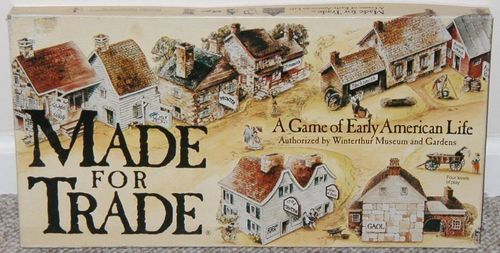
Made for Trade
Made for Trade Rulebook
Table of Contents
Table of Contents
Shillings
A fast-paced card game played like "Spoons"
Object
Be the first player to collect five objects from the same early American shop.
Players
3 to 6, ages 8 and up
Game Materials
48 Object Cards
Shillings equal to the number of players, minus one (5 shillings for 6 players, for example)
Setting Up the Game
- Put the shillings in the center, where everyone can reach them.
- Choose a dealer, who deals each player five cards, one at a time and face-down. The dealer stacks the deck face-down to form a DRAW pile.
- Organize your cards by the shop name at the top.
Rules for Playing
- To start: The Dealer draws a card, checks to see if the shop matches cards in his or her hand, and quickly passes any card to the left. It's okay to pass the card just drawn.
- To take a turn: The player to the dealer's left picks up the passed card, checks the shop, and passes a card to the left, and so on.
- Start a new round: The last player to pick up a card (the player to the dealer's right), discards a card face-down to start a second DRAW pile. The dealer draws a card from the first DRAW pile to begin a new round. When the first DRAW pile runs out, the dealer draws from the second one.
- Making a set: As soon as you have five cards from the same shop, quickly and secretly pick up a shilling. Don't tell the others that you have a set. Hold the coin and keep passing cards as usual.
- The end: If you see someone take a shilling, grab one for yourself, even if you don't have a set. The game ends when all the shillings are gone. The player without a shilling loses. Start a new game with a new dealer.
Made for Trade
A Game of Early American Life
Levels of Play
Choose a level for your group:
- Game 1 Tourist: Get a glimpse of daily town life by making your way around a colonial village.
- Game 2 Trader: Rise from indentured servitude to freedom by collecting Objects, responding to Events, and negotiating more complex trades.
- Game 3 Shopper: Make up your own Inventory List of 5 Objects to collect.
GAME I:TOURIST
Object
Be the first player to collect any 4 Object Cards and 4 shillings.
Players
2 to 4, ages 8 and up
Game Materials
- Game board
- 48 Object Cards
- 60 Shillings
- 2 Dice
- 1 Character per player
Setting Up
- Choose a Governor, who takes care of the Treasury and the Object Cards. To start, the Governor passes out 6 shillings per player.
- Sort the Object Cards by shop (6 cards per shop). Place each set of Object Cards face-up next to its matching shop on the board.
- Each player chooses a Character and puts it on Immigration (Start).
- Roll to see who goes first. Highest roller begins; play goes clockwise.
Rules for Playing
-
To take a turn: Roll the dice and move your Character clockwise around the town. Here's what to do when you land on each space.
-
Enter spaces: Decide if you want to enter the adjoining shop to buy or trade an Object. If not, stay put until your next turn.
To purchase an Object: Roll 1 die. If the Object Card that matches your roll is in the shop's inventory (on the board), you can buy it with shillings. For example, if you roll a 3, and the Object that sells for 3 shillings is in stock, buy it for 3 shillings. You don't have to buy it.
If the Object is out of stock, you get a second roll to try for another Object.
If the second Object is out of stock, your turn is over. On your next turn, exit the shop from the Exit space.
To trade an Object: Place one of your Object Cards face-up on the Market area and take any Object Card in the store's inventory. Make up any difference in value by giving shillings to the Treasury or taking shillings from the Treasury.
-
Event spaces: Take another turn (the Event Cards are used in other games).
-
Blue market spaces: Exchange any Object or shillings for one or more Objects or shillings at the Market.
-
Pay day and harvest spaces: Each time you pass or land on either of these spaces, collect the number of shillings indicated from the Treasury.
-
Customs spaces: Each time you pass or land on these spaces, you serve as the Customs Official. Tax any opponent by placing one of his or her Objects face-up on the Market.
The printed Game 1 rules number 1 through 5, then 7 through 10; no item 6 appears in the source.
GAME 2: TRADER
Object
Collect 3 of the 6 Objects on your Inventory List and the most total assets.
Players
2 to 4, ages 10 and up
Game Materials
Same as for Game 1, plus the Event I Cards (easy) or Event II Cards (more difficult) and the matching Inventory List for each Character used in the game.
Setting Up
Same as for Game 1, but don't pass out the shillings yet. Plus:
- Put the Event I or the Event II Cards face-down on the board.
- Give each Character his or her Inventory List. Don't show your list to the others.
Rules for Playing
-
To take a turn: All players start out as Indentured Servants. Roll the dice and move clockwise around the board. If you land on EVENT, draw a card and collect or pay shillings, if you can. If you land on any other space, ignore all directions to exchange Objects or shillings. Only Free Citizens, not Indentured Servants, can exchange Objects and shillings on spaces other than Event spaces.
-
To become a free citizen: You must either roll a 7, 11, or doubles; draw an Event Card that frees you; or go past IMMIGRATION. When you become a Free Citizen, collect 6 shillings from the Treasury and exchange Objects and Shillings as usual for the rest of the game.
-
Enter spaces: If you are a Free Citizen, decide if you want to enter the shop and make a purchase or trade an object. If you need cash, sell Objects to Market and collect the value in shillings from the Treasury.
To purchase an Object: Roll 1 die. If the Object Card that matches your roll is in the shop's inventory buy it with shillings, if you like. If it's out of stock, roll again to try for another Object. If the second Object is out, your turn is over. On your next turn, exit the shop from the Exit spaces for that shop. (Printed as "Exist spaces" in the source.)
To make a trade: You can make up to three types of trades:
a. As in Game 1, place one of your objects on the Market area and take any Object Card in the store's inventory. Settle any difference in value with the treasury.
b. If you own an Object from the shop, trade it for an available Object of equal value in one of the other shops.
c. Trade 1 Object Card or any shillings to another player in exchange for 1 or more cards or shillings.
-
Event spaces: Whether you are a Free Citizen or an Indentured Servant, draw the top Event Card, read it aloud, and follow the directions. Place the card at the bottom of the pile. If you can't pay, go to Gaol, pay 1 shilling (if you can), and lose a turn.
The player who ends the game collects 3 shillings. All players who have at least 3 Objects on their list should total their shillings and the value of all the Objects they own. The player with the most total assets wins.
GAME 3: SHOPPER
Object
Make your own Inventory List of five items and be the first player to collect all the Objects on it.
Players
2 to 4, ages 12 and up
Game Materials
Same as for Game 2: TRADER, plus a pen or pencil and scrap paper (for writing Inventory Lists). We suggest you use the advanced Event Cards for this game.
Setting Up
Set up as you would for Game 2: TRADER.
In addition, each player secretly prepares an Inventory List with the names of any 5 Objects from 5 different shops and with 5 different values. Note that in this game, players will probably be competing for many of the same Objects.
Do not show your Inventory List to other players.
Rules for Playing
Follow all the rules for Game 2: TRADER with this difference:
To win: Be the first player to collect all 5 Objects on your list. For a description of the Objects, prepared by the Winterthur Museum staff, see the next page.
Blacksmith
- Wrought-iron toaster made in America, 1750-1800. Cooks held it in the kitchen fireplace and then flipped it over to toast the other side.
- Iron spider made in Europe or America, 1700-1750. It's a frying pan for cooking over the coals. The three legs help it rest safely on uneven surfaces. The long handle allows the cook to move the pan without getting scorched.
- Fire back made in 1781 and sold by Joseph Webb of Boston. Made of cast-iron plates, it rested against the backs of fireplaces to radiate heat and protect the bricks and stones.
- Sheet-iron weathervane made in the United States, 1850-1900. This rooster-shaped weathervane, sometimes called a weathercock, revolves when wind pushes its large, flat tail. The head turns into the wind to indicate direction. Weathervanes were also made of copper and brass.
- Iron and brass candlestand made in America, 1710-50. As sources of light, candlestands were portable and adjustable. The candle arm moves up, down, or around.
- Iron gooseneck andirons, possibly made in Rhode Island, 1725-75. Houses were heated by fires, and each room had a fireplace. The legs of the andirons held firewood. Spithooks on the back held a spit for cooking.
Music Shop
- Wooden pitch pipe, probably made in America, 1725-1850. It sets the pitch for singing or for tuning musical instruments. This pitch pipe has a slide with a pierced heart. Pulling or pushing the slide produces different tones when the pipe is blown.
- Wooden flageolet made by Edward C. Riley of New York City, 1819-29. It's a small, sweet-sounding pipe often used in dance music and occasionally to train caged birds to sing.
- Mahogany and tulipwood dulcimer, probably made in Pennsylvania, 1790-1825. The name means "sweet song." The musician strikes the wires with two small hand-held hammers.
- Harp made by J.A. Stumpff in London, England, 1800-1830. Few American homes could afford this expensive and hard-to-play instrument.
- Mahogany barrel organ made in New York, 1790-1810. It has 27 brass pipes of different sizes, one of each note. The musician turns the crank on the front, which pumps the bellows. The organ plays Yankee Doodle and nine other tunes automatically.
- Mahogany piano with works made by John Geib and Son of New York City, 1804-14. As on today's pianos, the musician presses a key that makes a hammer strike a wire inside. This piano has 68 keys and two pedals. Many modern ones have 88 keys and three pedals.
Cabinetmaker
- Walnut corner chair made in Philadelphia, 1740-50. Designed in the 18th century, it has two backrests that form a corner. People used it at a desk or card table.
- Mahogany fire screen made in Philadelphia, 1765-80. As the family sat near the hearth, the fire screen shielded their faces from the heat. It often displayed the finest needlework of the mistress of the house.
- Mahogany bedstead made in Philadelphia, 1785-1800. In the 18th century, "bedstead" meant only the wooden frame and "bed" meant the featherbed mattress. The bedstead had a headboard, footboard, pillars, feet, and "tester" (the frame supporting the canopy). Hangings–the curtains, skirt (dust ruffle), valance (canopy), and counterpane (bedspread) – were the most expensive part of the bed. The hangings helped keep out night drafts.
- Mahogany tall clock case made by Nathaniel Dominy V of East Hampton, Long Island, around 1799. At first, clockworks hung on the wall. Then cabinetmakers designed cases to protect the works from dust. The makers sold the cases to clock manufacturers. The members of the Dominy family included both cabinetmakers and clockmakers.
- Walnut schrank, or wardrobe, made in Pennsylvania, 1768. Schrank is the German word for closet. Few houses had rooms with built-in closets, so homes needed these large storage pieces. Pennsylvania German furniture was often decorated with folk motifs such as birds and hearts.
- Walnut high chest made in Philadelphia, 1765-80. The high chest, or high boy, is a tall piece with two sections of drawers. This one is a good example of the Chippendale style (1760-90) which often featured elaborate carving as decoration, ball-and-claw feet, and a scalloped shell.
Potter's Shop
- Earthenware tiles with transfer-printed decoration, made in England, 1760-70. Tiles decorated parlor or chamber fireplaces. A favorite bedtime diversion for children was to "read the tiles" by making up stories based on the designs.
- Earthenware tea caddy made in England, 1750-80. It covered containers of precious tea leaves, which were imported from China and very expensive. People often gathered for mid-afternoon tea, an important means for friends and neighbors to exchange news.
- Mochaware pitcher made in England, 1800-25. Taverns often used mochaware. Its decoration was formed by applying colored slips, or liquid clay, to geometric engine-turned designs.
- Tin-glazed earthware posset pot and cover, made in Lambeth, England, 1660-80. It held posset, a hot, spiced drink of milk curdled with wine, which people sucked through the strainer spout on the side of the pot.
- Earthernware plate, made in Pennsylvania, 1800. Many Germans settled around Philadelphia during the 17th and 18th centuries, bringing their traditions, craft, and language to America. The German inscription reads, "Out of clay such skill he brings, the potter makes all kinds of things, luck, glass, and earth, are all their money's worth."
- Creamware tureen and stand, probably made by Josiah Wedgewood in Staffordshire, England, 1770-80. Soups and stews were served in it. The stand protected the dining room table from spills and from the heat of the contents.
Silversmith
- Silver button engraved with initials TG made by Lewis Heck of Lancaster, Pennsylvania, around 1760. Silversmiths designed this luxury item to fill special orders. Silver buttons, pins, and buckles were a symbol of wealth. Some coats had as many as two dozen buttons.
- Silver snuffbox made in New England, 1740-60. People inhaled snuff, or powdered tobacco, through the nose in an elaborate ritual. Snuffboxes were fashionable accessories for men and women in the 18th century. This one was small enough to carry in a pocket.
- Silver tablespoon made by William Simkins of Boston, 1725-40. The back of the spoon handle had the owner's initials engraved on it, a decorative but useful feature that provided good identification if the object was stolen.
- Silver porringer made by Jonathan Clarke of Newport, Rhode Island, 1730-70. Made of metal, wood, or horn, this traditional wedding gift served individual dishes. The maker engraved the initials of the married couple and wishes for happiness and prosperity. Porringers engraved with single initials were sometimes given to children.
- Silver tankard made by Paul Revere of Boston, 1768. The most popular drinking vessel of the 1700s, tankards were also used as communion vessels in American Protestant churches. Though known for his role in the American Revolution, Paul Revere was a silversmith of beautiful pieces by profession.
- Silver coffeepot made by Myer Myers of New York City, 1750-70. It had a pineapple-shaped finial, or knob, on its lid, a symbol of hospitality. Because wood is a poor conductor of heat, the handle stayed cool even when the pot is full of hot coffee.
Tinsmith
- Heart-shaped tin nutmeg grater made in the United States, 1775-1850. It originally had a hinged lid to cover the sharp grating surface. The nutmeg was stored inside. People carried the grater in the pocket or purse to use at tea time. Besides spicing up tea, nutmeg was an important condiment for flavoring food.
- Tin coffeepot made by Willoughby Shade in Pennsylvania, around 1865. More decorative than functional, already-brewed coffee was poured inside just before serving.
- Tin sconce made in the United States, 1800-50. A popular decorative wall light, the metal back plate was tinned and kept highly polished to reflect light from the candle.
- Tin candle mold made in the United States, 1800-50. The craftsman stretched a wick of plaited string from end to end in the mold and then poured hot wax into the hollow tubes around the wick. Both homes and shops used these molds.
- Wood and tin foot warmer made in the United States, 1800-25. It made horse-and-carriage journeys in cold weather more comfortable. Hot coals or stones were placed in a pan inside the box. Heat radiated from the holes.
- Tin lantern made in the United States, 1790-1820. It was carried or hung from a hook or beam. The light passed through small, pierced designs in the cone top and through larger diamond-shaped openings in the side.
General Store
- Tulipwood butter mold or stamp made in Pennsylvania, 1750-1850. The hand-carved wood design, used to identify the butter maker, was stamped in pounds of butter. The eagle was a popular patriotic design. This owner added his initials: JLM.
- Hourglass made in England or America, 1725-1800. Surprisingly accurate, the sand-filled hourglass measured time, usually the passing of one hour.
- Steel and brass balances, or scales, made in the United States, 1800-1900. Like the modern versions used today, balance scales weighed many things from gold to medicine. One pan held the object to be weighed, the other held just enough weights to make the pan balance.
- Leather shoes made in Europe, 1750-1810. In the 18th century, shoes were not made with a left foot and a right foot, as they are today. Instead, they took the shape of the owner's feet as they were worn. In place of shoelaces, the fasteners were decorative brass or silver buckles.
- Three-cornered hat made of wool felt, probably in England, 1740-70. Also called the tricorn, it was the most popular men's hat in the 18th century, often worn by wealthy men. The brim was turned up, or cocked, in three places to form the three corners, which helped avoid disturbing the wearer's wig.
- Cotton curtains, or window hangings. The woven blue-and-white check fabric was probably made in England, 1760-1820. A colonist would have bought the imported material by the yard or bolt and sewn it into curtains at home. Very few people bought ready-made curtains.
Glass Shop
- Glass marbles made in the United States, 1850-1900. An ever-popular toy in America, they were made of clay, stone, glass, and actual marble imported from Europe and England until the late 19th century. Around 1890, U.S. manufacturers began making glass marbles either colorless or with colored twists inside (called "Cat-Eyes").
- Glass salt cellar made in England, 1750-75. In the 17th and 18th centuries, it took the place of today's salt shakers. The salt was served with a small spoon.
- Glass hurricane shade made in England or Ireland, 1760-80. It covered a candle to keep the flame from blowing out near open windows. Cut-glass designs made it sparkle in the candlelight.
- Wine glass made in England, 1760-75. This trumpet-shaped wine glass has an air-twist stem decorated with enamel designs. The glass maker made the stem by twisting long threads of white glass with the molten glass before it hardened.
- Blown-glass decanter probably made in Germany, 1780-1810. Decorative decanters stored spirits and were also used to fill glasses at the table.
- Glass condiment bottles in cruet stand made in London, England, 1774-75. Cruets held oil, two kinds of pepper, and other condiments. The bottles with pierced covers were used for pepper, sugar, and dry mustard. The stand made it easy for diners to pass the bottles around the table.
About our Town
The Made For Trade board depicts an early American town that might have been. Though not patterned after a particular city, it includes buildings commonly found in early urban America. Our town is on the seacoast. While there were also trading centers inland, they were generally established on rivers because communication was chiefly by water.
Around the edge of the town are livestock and farms. Most townspeople keep gardens, cows, and poultry. Few middlemen stand between the farm and the goods available at the General Store, which retails just about anything and extends credit to farmers in hopes of collecting come harvest time.
When travelers come through town, they can stay at the Red Lion Inn, where meals are family-style and rooms are not always private. The spire of the Meeting House makes it the tallest structure in town, a reminder that this is a society that fears and worships God.
The Tavern is a clearing house for news and a place to relax. Gaol (or jail) is near the tavern, not inappropriately. The stocks are a punishment designed to shame offenders into proper conduct. Between the tavern and the gaol is the Mews, a narrow back alley usually found in less fashionable parts of town.
Every town has a Blacksmith, who makes horseshoes, nails, farm tools, and other items. Our blacksmith has his forge attached to his home. Trade shops blend business and residential neighborhoods into one, for proprietors often live upstairs or "at the back." That's why the stores all look more like houses.
You might find some of life's details in our town very foreign. The water carrier behind the Glass Shop reminds us that water is drawn by hand. Of course, the well was dug by hand, too. A deep well provided cold water and served as a cool place to store eggs and butter in summer. Behind the Hatter Shop is a woman cooking outside over an open fire, possibly making apple butter or ketchup. Flour, sugar, salt, and other staples are in the barrels seen on the wharf. Families buy them in large quantities for home use. The threshers behind the Blacksmith's Shop show farm work being done laboriously by hand. Amusements are simple, such as the stilts youngsters are trying out across the river from the outdoor Market.
A word about indentured servants: Indentured servants came from all over Great Britain. Men, women, and sometimes children signed a contract with a "master" (landowner) to serve a term, which could last up to 7 years. In exchange for their service, indentured servants received their passage paid from England, as well as food, clothing, and shelter once they arrived in the colonies. When the contract had expired, the servant was paid freedom dues of corn, tools, and clothing, and was allowed to leave the master's plantation. During the time of his indenture, however, the servant was considered his master's personal property and his contract could be inherited or sold to someone else. Some of the male indentured servants were highly skilled laborers, with such jobs as bricklayer, cook, clerk, gardener, butcher, plasterer, blacksmith, and musician. Female indentured servants performed domestic chores including sewing, laundry, and housekeeping.