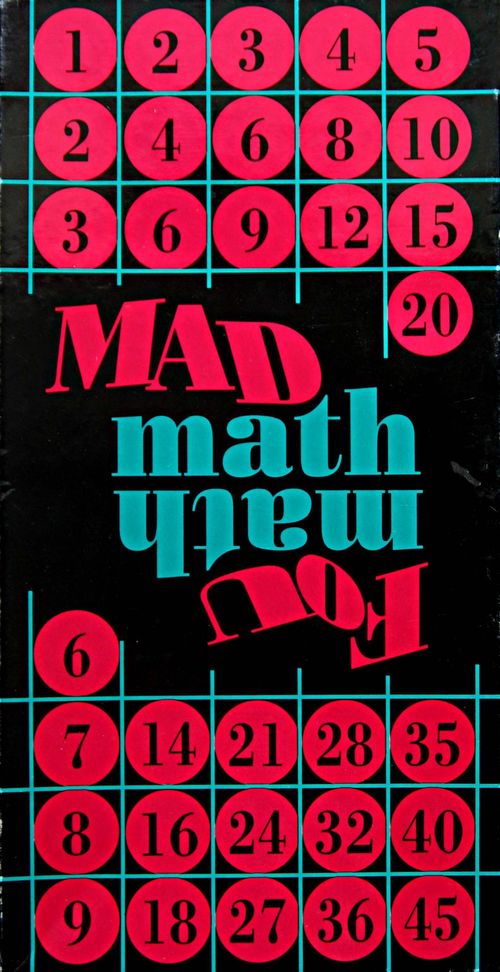
Mad Math
Mad Math Rulebook
Table of Contents
Table of Contents
Goal
By rolling the dice, you must line up three of your pawns horizontally, vertically or diagonally, on three numbered squares that touch each other.
The game is played in one or more rounds.
Setup and Play
Begin playing by following these 5 steps:
- Each player chooses 4 pawns of the same colour, and the players determine who begins.
The sheet illustrates both faces of the board: the multiplication side and the addition side (for younger players).
-
Roll the two dice to place your first pawn on the board. Each die corresponds to one vertical row and one horizontal row, indicated by the numbered triangles around the board. At the intersection of these two rows, place your pawn on the numbered circle that matches the result of multiplying the dice, or the sum of the dice if you are playing on the addition board.
- If you roll a 0, you lose your turn.
- If you roll two identical dice, you double your turn. You may either roll both dice again, or keep one and re-roll the other.
- Once you have placed your pawn on the intersection, your turn is over.
- If the intersection is occupied, the turn is lost and it is the next player's turn to roll the dice.
-
To place his pawn, the next player (on the left) may decide to roll both dice, or to roll only one die while keeping one of the numbers rolled by the previous player.
Remember this advice: watch carefully the dice rolled by the previous player, so that on your turn you keep the one that benefits you.
-
Once your 4 pawns have been placed on the board, you must, on your turn, move one of these pawns to the position indicated by the dice (unless those intersections are occupied).
-
When a player lines up three of his pawns on three touching squares (see the example on the sheet), the game ends for junior players.
For advanced players: at the end of each round, the winning player scores the total of the points shown under his three pawns. The game ends when a player totals more than 200 points.
For expert players: at the end of each round, the winning player scores the total of the points shown under his three pawns. The other player or players subtract from their score the largest number shown under one of their own pawns. A score can never fall below 0. The game ends when a player totals more than 200 points. (If the winner lines up 4 pawns, he chooses the three largest numbers.)