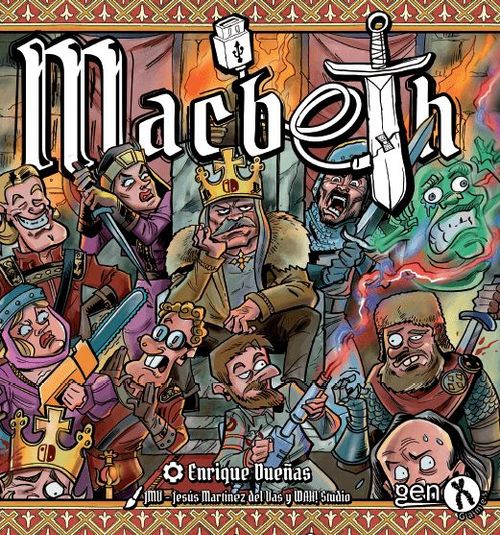
Macbeth
Macbeth Rulebook
Table of Contents
Table of Contents
Components
- 5 custom dice
- 1 pyramidal die (4 sides)
- 40 gold tokens
- 40 dagger tokens
- 20 monologue tokens
- 5 prophecy tokens
- 1 theatre pawn
- 1 board
- 15 character portraits
- 15 character cards
- 1 first conspirator token
Game Setup
- First of all, shuffle all the character portraits face down and place them on the pyramid that is drawn on the board, randomly and face up.
- Place the theatre pawn on the first space of the play (Start).
- Depending on the number of players, each conspirator secretly takes a number of character cards, 4 gold tokens and 1 prophecy token:
- 2 players: 5 character cards each.
- 3 players: 4 character cards each.
- 4 players: 3 character cards each.
- 5 players: 2 character cards each.
The most important thing for an actor is to be heard well. Therefore, the player with the strongest voice stream will receive the first conspirator token.
Game Turns and the Play
As a conspirator, your turn is divided into two phases:
- Lucky phase.
- Bugging phase.
Once you have completed both phases, the turn goes to the player on your left.
After all the conspirators have played, the first conspirator token goes to the player on the left, who rolls the pyramidal die and moves the theatre pawn forward. The number of spaces he moves is the result of the die roll.
If the theatre pawn lands on any event, apply its effects. If it doesn't, ignore it, for heaven's sake!
The player with the first conspirator's token starts a new round.
Lucky Phase
In the lucky phase, roll the 5 custom dice.
You may roll them as many times as you like, gaining more and more tokens, until you decide that the risk of obtaining 3 misfortune results is too high and you prefer to keep what you have obtained by now. You could also run out of gold to keep on rolling dice. Note: you must immediately set the dice with misfortune results aside!
The first roll is free, but you will have to pay for your next rolls. The second roll will cost you one gold, the second one will cost you two gold, a.s.o. We recommend to put the payed gold in front until the end of your turn so you know how many times you have rerolled already.
- Misfortune. Set this die aside, you can't roll it again. If you obtain 3 "misfortunes", your turn ends and you lose all your dagger, gold and monologue tokens.
- Dagger. For each die with this result, obtain 1 dagger token.
- Gold. For each die with this result, obtain 1 gold token.
- Monologue. For each die with this result, obtain 1 monologue token.
Bugging Phase
Once you decide to stop rolling, the bugging phase starts. During this phase you can spend the obtained tokens (in the order you prefer).
Spending Daggers
You may kill a character by spending 8 daggers. Remove their portrait from the pyramid. A killed character cannot return to the game in any way.
If any conspirator has that character, they must say it out loud and show the corresponding card to everyone. A conspirator that has no characters left (because all of them have been killed) is eliminated from the game. Optionally, the players may cry and make a fuss or sing praises for the deceased.
If a character portrait has daggers on top of it (because of a monologue), the cost of killing this character is reduced by 1 for each dagger assigned.
Spending Gold
You may spend gold to move character portraits up in the pyramid. If you do that, the character that is being replaced will go down to the position the "usurper" was occupying. (The characters swap their positions.)
- To move a character from the pyramid base up to the fourth level, you need to spend 1 gold.
- From the fourth to the third level - 2 gold.
- From the third to the second level - 3 gold.
- To move a character from the second level up to the top (the Scottish throne), you need to spend 4 gold.
You can only move a character up in the pyramid into a space that is adjacent to them.
If the space is empty (because the character occupying that space has been killed), then the moving costs 1 gold token less. It's easier to become a duke when there is nobody else occupying the position!
Spending Monologues
You may spend 4 monologues to do one (and only one) of the following actions:
- Swapping two character portraits, no matter their position in the pyramid. Except for the top spot! There is no easy way to the throne.
- Stealing all the gold from another conspirator.
- Placing a dagger on 3 different character portraits. Take the 3 dagger tokens from the main supply.
Prophecies
You may spend your prophecy token at any time during your turn. When you do it, you may repeat a dice rolling that has had misfortune results... even if you already got 3! This is the only exception to the rule that forbids repeating misfortune results.
Prophecies are very useful, but be careful! Once spent, you can't get them back! Did you really think Hecate was giving away spells as if they were candy?
Victory
To win the game you must get one of your characters to be the King of Scotland when the play ends. That is, to get to the top of the pyramid. Quite simple, right? You will also win if you are the only conspirator with characters that are still alive.
Now, if no conspirator achieves these objectives... too bad! All of you have lost! Clean the blood and, if you still have some time on your hands, play another game.
Atrezzo
If the main supply runs out of any kind of tokens and a player would gain one or more of them because of a die roll, that player takes the tokens from the player with the most tokens of that kind instead.
Out of Play
If a player loses all of her characters, that player stops playing and gives all her tokens back to the main supply. Now she can enjoy the rest of the play from her seat!
Events
- All conspirators gain a monologue.
- All conspirators gain a dagger.
- The character that's currently on top of the pyramid dies.
- All conspirators lose all their daggers.
- All conspirators gain 2 gold tokens.
- All conspirators lose their prophecy token (if they still have it).
- All conspirators lose all their gold.
- Roll the pyramid die again and the theatre pawn moves forward as many spaces as the result obtained.
- The game ends immediately. It is not necessary for the theatre pawn to land on the exact number on this space, it is enough if it passes through it.