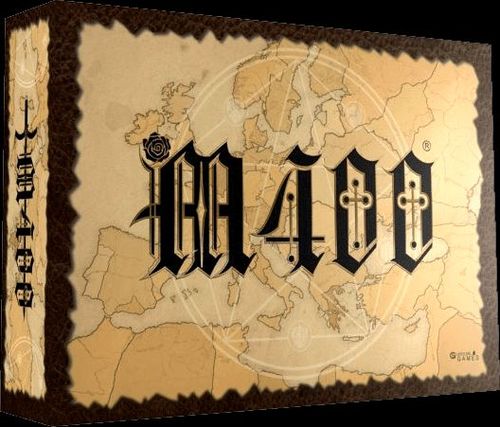
M400
M400 Rulebook
Table of Contents
Table of Contents
- Contents of the Box
- Game Board
- Score Table
- Player Equipment
- Cards
- Deck Composition
- Number of Players
- Setup
- Turn Structure
- Phase 1: Drawing Cards
- Phase 2: Trading Cards
- Phase 3: Moving Armies
- Phase 4: Conquering a State
- End of Turn
- Scoring
- End of Game and Victory
- Variant: "Alliance" - 2 Players
- Special Cards
Contents of the Box
- 109 Playing Cards
- 1 Game Board
- 1 Score Table
- 1 Fabric Bag
- 10 Man Pawns in 5 different colours (2 per colour)
- Various round tokens in 6 different colours
Game Board
The game board depicts 15th-century Europe, divided into 36 territories. Each territory has a "numeric value", which is the number of points a player gains by conquering it.
The 5 most powerful nations of the era are marked with a coat of arms and represent "the Capitals", that is, the starting territories of the players.
Venetia, Luxeborg and Byzantium are considered "special states" because they are made up of parts that do not border one another. Armies that move through these territories are simultaneously present in all the various parts of the same state, spread over several points of the map, thereby extending their range of action.
- Venetia is a capital/state made up of several territories.
- Luxeborg is a state made up of two territories.
- Byzantium is a state made up of two territories.
The seas on the board are divided into sectors. The dashed lines do not indicate boat routes, but the boundaries of the sea sectors.
The Mediterranean Sea is divided into 3 sectors. Each sector can be freely navigated "coast to coast" by any state bordering that particular sea sector. (See the "Caravella" card, page 7.)
Score Table
The score table is divided into 2 parts. On the left, all players' points are recorded (points from conquered territories + "victory points"). The right side serves as a reminder of the "victory points" the player has earned by winning battles and/or attacking Capitals.
On the left side, below the score, is shown the number of cards to draw at the start of the player's own turn.
Player Equipment
Each player takes a set of round tokens of a chosen colour, which they use to mark the states they conquer and the points they gain during the game.
Each player also takes 2 man-shaped pawns of the same colour, representing the "armies" they will move on the map to conquer territories.
Cards
The playing cards are divided into 3 categories.
Combat Cards (People - Weapons - Territory)
Used to conquer free territories, to fight a battle and to attack a capital. They come in 3 different colours (red, green, blue). In the bottom right corner, the card's value is shown in Roman numerals (from lowest to highest: I, II, III, IV). The number is also shown in the 4 corners of the card in traditional Arabic numerals.
Bonus/Malus Cards (People - Weapons - Territory)
Used during battles to modify the value of the played Combat Card. They come in 3 different colours (red, green, blue) and are played in combination with Combat Cards of the same colour.
- The bonus "+1" increases your card by one point.
- The malus "-1" removes one point from the opponent's card.
(See "Combat" on page 8.)
Special Cards
There are 8 types of special cards. They have no coloured border. Each card has its own specific function in the game. (See the "Special Cards" page for the details of the effects.)
Deck Composition
The deck consists of 109 cards in total, distributed as follows:
- 6 Level I cards per colour
- 5 Level II cards per colour
- 6 Level III cards per colour
- 4 Level IV cards per colour
- 3 Bonus +1 cards per colour
- 2 Malus -1 cards per colour
- 4 "Alchimista" special cards
- 5 "Rapina" special cards
- 3 "Capitaneus Venturae" special cards
- 5 "Caballus" special cards
- 8 "Caravella" special cards
- 2 "Pestem" special cards
- 2 "Incendium" special cards
- 2 "Revolutionem" special cards
Number of Players
5 players: The deck is ready as it is. All capitals are in play.
4 players:
- Remove 1 Level IV Combat Card of each colour from the deck.
- Venetia is not a capital but a 4-point state.
3 players:
- Remove 2 Level IV Combat Cards of each colour from the deck.
- Remove 1 "Capitaneus Venturae" special card from the deck.
- Venetia and Anglia are not capitals but states worth 4 and 2 points respectively.
2 players, "Alliance" (see the Alliance section):
- Remove 1 Level IV Combat Card of each colour from the deck.
- Venetia is not a capital but a 4-point state.
Setup
The first thing to do to play M400 is to establish the initial Turn Sequence. The turn sequence is the order in which the players take their Game Turns in a round. Each player plays exactly one turn within the sequence.
Who goes first: each player draws one card from the deck. The player with the highest-value card begins the sequence, and play proceeds clockwise. Only at this moment are the Bonus/Malus cards valued at "0" (zero), while Special cards are valued at "5". In case of a tie in value between the top players, a new card is drawn. The cards are then returned to the deck, which is shuffled again.
Following this sequence, each player:
- Chooses their colour, taking all the state tokens and the two army pawns.
- Chooses their capital, placing one army pawn on it.
- Takes 10 cards from the deck.
- Places 1 state token on position "0" of the score table.
(The rulebook shows examples of choosing the colour Green, choosing the capital Anglia, and placing a token on position "0".)
The first player begins the first turn of the game.
Turn Structure
Each turn is divided into 4 actions. The player is not obliged to perform them if they do not consider it necessary for their strategy, but in any case they must take place in this exact order:
- Drawing Cards.
- Trading Cards.
- Moving Armies.
- Conquering a State.
Turn order after the first sequence: from the second sequence onward, the turn order is dictated by the standings: the player with the fewest points begins, and the order proceeds in ascending order up to the player with the most points.
- In case of a tie in points, the player with fewer cards in hand plays first.
- In case of a further tie, the player with fewer territories plays first.
- In case of a complete tie, the order of the first sequence is followed.
Phase 1: Drawing Cards
At the start of their turn, the player draws cards. The number of cards to draw is shown below their score on the score table.
After drawing, the Special cards Alchimista and Rapina may be played. (See the "Special Cards" section for the details of their effects.)
- Alchimista: draw two more cards from the deck.
- Rapina: the player draws a face-down card from an opponent's hand.
Phase 2: Trading Cards
Any type of card may be traded in the following ways:
- With opponents: if a player needs one or more cards, they may ask whether any of the opponents is willing to make a card exchange. There are no limits on trades, leaving players free to negotiate as they wish. (For example, a player stuck on an island may ask for a "Caravella" special card in exchange for a "Caballus" special card.)
- With the deck: the player discards 2 cards from among those in their hand and draws one new card from the deck.
Phase 3: Moving Armies
The aim of the game is to conquer states by collecting the greatest number of points, and to do so armies must move across the map to conquer territories.
Special cards (for game strategy): before moving an army, the player may play two particular special cards that are important for their strategy, namely the Special cards Capitaneus Venturae and Revolutionem. (See the "Special Cards" section for the details of their effects.)
- Capitaneus Venturae: add a new army.
- Revolutionem: free one state.
One Army
Starting from its capital, the player moves their army to a state adjacent to its position. Each turn the player moves their army only once, to bordering territories.
A single army can never be destroyed. (Note: all players remain in the game until the end of the game.)
Two Armies
During the course of the game the player will have the opportunity to add a second army. The second army starts from the player's starting capital, and the same movement rules apply as for the first army.
In the same turn, the player first moves the first army and then proceeds with moving the second army.
During the course of the game, only one of the two armies could be destroyed.
Basic Movement and Extended Movement
We have seen that army movement proceeds one state at a time in a turn, so the army has the basic movement property, which allows it to move to a state adjacent to its position.
The army's movement can be extended using the two special movement cards Caballus and Caravella. These special cards can be played several times during the movement phase, and also in combination with one another.
The effects of these cards take precedence over the army's basic movement, so they must be played before moving the army.
Special Card "Caballus" (Land Movement)
The Caballus special card extends the army's movement over land.
Using this card, the army moves to a state bordering its position, then finishes on another adjacent state through the basic movement of the pawn.
Using several Caballus cards, the army can cross several bordering states in order to finish with the basic movement.
- Example: by playing one Caballus card, from Novgorod the army can move to Lithuania, and with basic movement into Poland.
- Example: by playing a combination of 3 Caballus cards, from Novgorod the army can move to Lithuania, into Poland and into Hungary. Then, with basic movement, it ends in the Western Roman Empire.
Special Card "Caravella" (Sea Movement)
The Caravella special card extends the army's movement by sea.
Using this card, the army crosses a sea sector from a starting state to any state bordering the same sea sector, then finishes on another bordering state through the basic movement of the pawn. (The basic movement of the army is optional.)
Using several Caravella cards, the army can cross several adjacent sea sectors, docking at the chosen destination state, to finish with the basic movement.
- Example: by playing one Caravella card, the army can set sail from Anglia, dock at Gallia, and then with basic movement end in Germania.
- Example: by playing three Caravella cards, the army can set sail from Anglia, sail across three seas and dock at Regnum Ecclesiae.
The Toll
When an army passes through, stops on or is blocked on an enemy territory, it must pay a toll.
The owner of the territory draws a face-down card from the hand of the passing player.
Phase 4: Conquering a State
When the player moves the army onto a territory, they may choose either to remain on the new state without doing anything, or to conquer it.
Conquering a Free State
To conquer a free territory, the player must first move their army onto it and discard from their own hand 2 combat cards of different colours. (Bonus/Malus cards are not valid for this.)
The player thus takes possession of the territory and its value.
They place one of their round state tokens on the conquered territory to indicate the new ownership of the territory.
(Example: conquering the free state of Tartaria by discarding a red card and a green card.)
(No victory points are earned for conquering free territories.)
Conquering a State Occupied by an Opponent
It is possible to attack any enemy territory, whether or not the opposing army is present on the battle territory.
To conquer an occupied territory, the attacking player (the Attacker) must first move their army onto it and declare war on the player who owns the territory (the Defender).
The Defender must respond by choosing either to accept the combat or to surrender without fighting.
Surrender
If the Defender surrenders without fighting, they effectively lose possession of the territory and, consequently, its points.
- The Attacker gains one victory point.
- The Defender draws 2 face-down cards from the Attacker's hand.
Combat
If the Defender accepts the combat, the two players will challenge each other with Combat Cards and Bonus/Malus Cards, giving rise to a maximum of 3 battles on the 3 different colours of cards.
-
The Attacker has the advantage of deciding the colour with which to make the first move.
-
The Defender has the advantage of always winning in case of a tie.
-
The combat takes place over a maximum of 3 battles.
-
Each battle is fought on one colour.
-
With a series of victories on two colours, there is no need to play the battle on the third colour.
1. The Attacker chooses the colour with which to begin the challenge and plays a single face-up Combat Card of level I to IV.
(In our example, the Attacker Anglia chooses blue and plays a level 4 card.)
2. The Defender is obliged to respond with a Combat Card of the same colour, trying to exceed the value of the Attacker's card. If the Defender does not have a card that equals the value of the attack card, they may play a combination of a Combat Card (as the base) and add one or more Bonus/Malus cards of the same colour to equal or exceed the value of the Attacker's points.
(In the example, the Defender Novgorod responds by playing a 3-point Combat Card as the base and a +1 bonus card to match the Attacker's level.)
(Attacker: 4 points. Defender: 3+1 = 4 points. Tied: the Defender is winning.)
3. In case of a tie, the clash continues if the Attacker is able to respond with one or more Bonus/Malus cards of the same colour to exceed the Defender's total points.
(In the example, the Attacker responds using a -1 Malus card, to lower the Defender's total by one point.)
(Attacker: 4 points. Defender: 3+1-1 = 3 points. The Attacker is winning.)
The challenge continues indefinitely on this colour, playing exclusively Bonus/Malus cards.
The winner of the colour battle will be:
- the Attacker, if they manage to exceed the Defender's total points;
- the Defender, if they manage to equal or exceed the Attacker's total points.
Winning the clash: the player who wins 2 of the 3 colours wins the clash.
Attacker Wins
If the Attacker wins the clash, they gain possession of the territory, its points and 1 Victory Point. (See the section on assigning points.)
They place one of their round state tokens on the conquered territory (removing the opponent's token) to indicate the new ownership of the territory.
Defender Wins
If the Defender wins the clash, the territory remains theirs. As a reward for defending the state, the Defender draws 2 face-down cards from the main deck.
The Attacker's army remains on the territory. On the next turn, the Attacker must decide whether to attack again, move to another territory, or remain in the state and pay the toll.
Destruction of an Army
If the player has only one army, it never dies.
- If the player has two armies and one of them launches an attack, in case of defeat that army will be destroyed by the Defender.
- If the player has two armies and one of them is on one of their own states under attack, in case of defeat that army will be destroyed by the Attacker.
Attacking a Capital
On M400 a player may launch an attack on an opponent's capital.
An opponent's capital may be attacked, but it will never be conquered.
The player who is attacked in their own capital may not respond in any way, so there is no combat with cards as there is for any other state.
(Example 1 — the capital is conquered by playing just two cards: Green, a 4-point card; Blue, a 4-point card.)
(Example 2 — the capital is conquered by playing just four cards: Blue, a 4-point card; Red, a 2-point card plus two +1 bonus cards, 2+1+1 = 4.)
How to attack an opponent's capital: the player must move one of their armies onto the capital and declare the attack. They must then play either Level 4 Combat Cards or combinations of Combat Cards + Bonus cards in order to obtain a total of 4 points on two different colour types.
Rewards: as a reward for attacking the capital, the player gains 2 Victory Points and may choose between:
- Adding a second army to their own starting capital, which they may immediately move, thereby continuing their turn.
- Destroying an army of any other opponent who has two of them.
Important: a capital cannot be attacked twice in the same turn sequence.
End of Turn
Before concluding the turn and passing the turn over, the player may play two particular special cards that are important for future strategy, namely the special cards Incendium and Pestem. (See the "Special Cards" section for the details of their effects.)
- Incendium: block an opponent's army.
- Pestem: put a state in quarantine.
Conclusion of the turn: at the end of their turn, each player may not have more than 15 cards in hand. If a player has more than 15 cards, they must discard the excess cards, choosing freely which to discard.
Scoring
To determine the score it is necessary to distinguish between the assignment of Victory Points and the counting of the Points Totalled by each player.
Assigning Victory Points
During the game, when a state is conquered by winning a combat, or by making an attack on a capital, Victory Points are gained.
These points must be immediately indicated during the player's turn on the right side of the score table, using a state token of the player's colour.
The player chooses any free column and places the state token above the number corresponding to the Victory Points obtained. Each time the player gains new Victory Points, these increase the Victory Points total, and the player moves the state token along the column to indicate the new total.
Counting Points and Determining Standing
The counting of the points totalled is carried out exclusively at the end of each turn sequence.
On the left side of the score table is the game's standings. Each player uses one of their own round state tokens to indicate their position in the standings.
The player's total score is determined by the sum of all the state points relating to the territories conquered, plus any Victory Points.
It is important to remember that during the game a player may conquer or lose states, so the sum of the state points held by the player may vary after each sequence, while Victory Points, once acquired, remain with the player until the end of the game.
(Example: Red has conquered a capital, gaining 2 Victory Points, but having lost all its states, it finds itself on 2 points in the standings (0+2 = 2).)
(Example: Blue has conquered Gallia by winning the combat, so it receives the 3 points of the state plus the Victory Point (3+1 = 4).)
End of Game and Victory
The player who reaches the predetermined score at the end of a turn sequence wins the game. It is not permitted to win by using the Revolutionem card on the last turn, or by launching an attack on a Capital.
If two players reach or exceed the predetermined score, only one of them can be declared the winner. In this case the winner is the one who:
- has obtained the highest score;
- in case of a tie in score, has conquered more territories;
- in case of a further tie, has obtained more Victory Points.
(Examples are given for a victory at 32 points. In the examples, "pt" denotes points, "ter" denotes territories and "pv" denotes Victory Points.)
- Example 1 (victory at 32 points): Red 32 pt | Yellow 33 pt. Winner: YELLOW.
- Example 2 (victory at 32 points): Red 32 pt | Yellow 32 pt; Red 10 ter | Yellow 9 ter. Winner: RED.
- Example 2 (victory at 32 points): Red 32 pt | Yellow 32 pt; Red 10 ter | Yellow 10 ter; Red 3 pv | Yellow 2 pv. Winner: RED.
(The printed rulebook labels both of the last two examples "Esempio 2". They are kept here as printed.)
Variant: "Alliance" - 2 Players
"Alliance" is a special way to play M400 with 2 players as well. This version involves a more complex and careful strategy and deck management, for experienced players of the game.
In this version, each of the two players controls and manages 2 allied capitals (therefore 2 colours), using a single deck of 20 cards valid for both colours. The two colours of each player act as if they were independent of each other, but "allied". Allied colours can never fight each other, destroy the allied army, attack the allied capital, or use the special cards Rapina, Revolutionem and Incendium on an allied colour.
In this mode, the game is won by the capital (therefore the colour) that reaches 32 points at the end of the turn sequence. The allied capital will also automatically be declared a winner.
The Alliance version follows the same rules as M400 with 4 players, with some variants given below:
- According to the starting order (set up as in the classic 4-player mode), each player chooses their capital and places an army on it. (In Alliance mode, "Venetia" is not a capital but a state that can be conquered, worth 4 points.)
- The players place a state token for each capital (colour) above the number "0" on the score table.
- The two players draw cards twice each. In fact, each player manages two colours that follow the same turn rules independently. (They are two different nations, but managed by the same player.)
- Trading of cards between players is abolished.
- Armies may stop or pass through allied territories without paying the toll.
- At the end of each turn, the players may not have more than 25 cards in hand.
Special Cards
Reference summary of the special cards, as printed on the rulebook's Special Cards page:
- ALCHIMISTA: the player draws two more cards from the deck.
- RAPINA: the player draws a face-down card from an opponent's hand.
- CAPITANEUS VENTURAE: the player adds the second army to their starting capital.
- REVOLUTIONEM: immediately frees any territory occupied by an opponent.
- CABALLUS: increases land movement.
- CARAVELLA: the army sails across a sea sector, landing in the territories that border that sector.
- INCENDIUM: blocks a single opponent's army of the player's choice for the whole of the following game turn. (The army piece is laid down horizontally, and the player may still draw and play special cards until the end of their own turn.)
- PESTEM: prevents the passage and conquest of any territory. The state is marked with 1 black token for each player. Each player, starting from the following turn, removes one black token at the end of their own turn. (Only the Revolutionem card has an effect on a plague-stricken territory. All pieces in the territory must leave it on their own turn or as soon as possible if they are set on fire.)