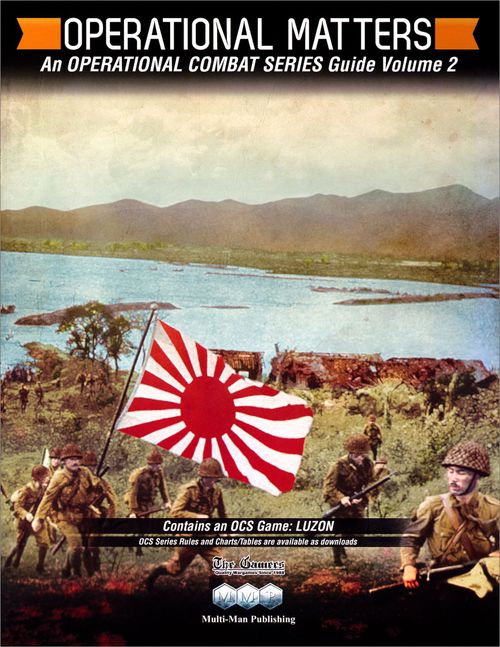
Luzon: Race for Bataan
Luzon: Race for Bataan Rulebook
Table of Contents
Table of Contents
Introduction
This mini-game is a great introduction to the Operational Combat Series (OCS). If you are new to OCS, these rules are not used, so you can skip over them:
- 12.6c Eating off the Map
- 12.7 Extenders
- 12.8e Breakout
- 13.5 Replacement Units
- 13.9 Unit Consolidation
- 14.7d Hip Shoots
- 14.9 Air Transport
- 14.10 Air Drop
- 16.0 Hedgehogs
- 18.0 Naval Power
- 19.0 Ports & Shipping
- 20.0 Breakdowns
Also, Step Loss Markers, Hedgehog Markers, Replacement Units, and Railhead Markers will not be used.
1.0 General Special Rules
1.1 Map & Terrain
There is one map. Hexes are identified by a number, e.g. hex 17.16 is the Major City terrain hex of Manila. The scale of Luzon is the OCS standard of 5 miles per hex, and 1/2 week per turn.
1.1a Terrain Effects Chart. The movement/combat effects are explained in the Terrain Effects Chart (TEC), which is printed on the map.
1.1b Hedgehogs. Hedgehogs are not used in Luzon.
1.1c Ports. Ports are printed on the map purely for historical interest. They have no gameplay function.
1.1d Points of Interest. A Point of Interest represents a place that is smaller than a Village in OCS terms. In Luzon, the Terrain Category Line of a Point of Interest is Close (for Combat and Barrage), but the Terrain Modifier is that of the other terrain in the hex, so Armor and Mech units are doubled when attacking if the hex is Open Terrain.
A Point of Interest also functions as a Detrainable Hex on Secondary Roads for the Japanese (see 2.1b).
1.2 Weather
Weather only affects air operations in Luzon. Weather is determined each turn by rolling for Flight Conditions (one die). A roll of 3-6 is Normal Flight (no restrictions). A roll of 1-2 is Limited Flight. During Limited Flight, air missions are allowed only in the Player's Movement Phase. Air Refits are unaffected by weather conditions.
1.3 Air Operations
1.3a Hip Shoots. Neither player may conduct Hip Shoots (OCS 14.7d).
1.3b Off-Map Box. The Japanese player has an off-map air box representing airfields in northern Luzon. It may be used to base any number of air units at any given time. Air units refit for no supply cost in the off-map box. No combat or barrage is allowed in this box.
The Northern Luzon Air Box is 25 hexes from any hex along the north map edge.
1.3c Air Strips. There are several Air Bases printed on the map. While these Air Bases had been heavily damaged by the Japanese air campaign prior to game start, each side was able to make use of them for small numbers of aircraft. In OCS terms, they function as Air Strips (OCS 15.2).
At game start, place all six of the provided Air Strip Markers on hexes marked with an Air Base with the U.S. color side facing up. They are flipped to their Japanese color side if the hex is captured (OCS 9.14f). Air Strips can neither be improved nor destroyed.
1.4 Manila – Open City
MacArthur declared the city of Manila an Open City to spare it wartime destruction. The U.S.-Philippine Army units defending in any of Manila's hexes have their defenses halved and are not subject to the Terrain Effects of Major or Minor City terrain (consider them to be in Open terrain for purposes of combat or barrage). These restrictions do not apply to Japanese units.
1.5 HQ Units
All six HQ units in this game have a parenthesized (defense-only) strength of 2 when in combat mode, and 1 in Move Mode. They are considered 1/2 RE. HQ units do not provide the usual +1 Flak DRM in this game.
1.6 Engineer Functions
HQ and Engineer units can perform engineer functions. Only Bridging and Detrainable Creation are available. Neither army can build or improve Air Bases or Hedgehogs.
Japanese HQ units do not have the ability to create Detrainable Hexes on Secondary Roads (see 2.1b).
1.7 Transport
Neither Army can transport units or SP by rail, air or sea.
Japanese Wagons cannot be captured. If rolled for on the Capture Table (OCS 9.14c), captured Wagons are destroyed with their cargo.
1.8 Breakout
Breakout (OCS 12.8e) is not available to either side in this game.
1.9 No Eating off the Map
Eating off the Map (OCS 12.6c) is not available to either side in this game. Combat units that cannot "make their trace" to a Supply Source are marked Out of Supply and roll for Attrition (OCS 12.8).
1.10 Multi-Unit Formations
The trace supply limitation for Multi-Unit Formations (OCS 12.6f) does not apply to the Japanese (historically, the 16th Division was committed to both Lingayen Gulf and Lamon Bay).
1.11 Restricted Hex Entry
The U.S.-Philippine Army units cannot enter Japanese Supply Sources at 7.39 (Agoo), 31.08 (Atimonan), and 21.42 (Bayombong), and the Japanese landing hexes (the hexsides are highlighted black for clarity).
The Japanese player can enter the U.S.-Philippine Supply Sources at any time.
1.12 Armies & Nationalities
The terms Japanese and Axis are used interchangeably. Japanese Army units are pale yellow. The 16th Division's unit stripe is green for its code name "Hedge" and the 48th Division's stripe is blue for its code name "Sea."
The terms U.S.-Philippine and Allied are used interchangeably. The U.S.-Philippine Army consists of the U.S. Army (green), the Philippine Scouts (teal) and the Armed Forces of the Philippines (blue).
1.13 Re-Roll Counter
The Re-Roll counter may be used at any time by the possessing player to re-roll any ONE die roll (Supply, Reinforcement, Flak, Air Combat, Barrage, Surprise or Combat roll), except a player's Initiative roll. Once used, however, it is immediately given to your opponent who may then use it at their discretion. The Re-Roll counter can be held onto as long as a player wishes. It may be passed back and forth any number of times throughout the game. A given die roll may only be re-rolled once (you cannot do a re-roll, hand the counter to your opponent who then tries to re-roll that same die roll a second time).
1.14 Artillery Movement
Artillery units may not voluntarily move adjacent to an enemy Attack Capable unit unless they are stacked with or moving into a hex containing a friendly combat unit that isn't also an artillery unit.
2.0 Japanese Special Rules
2.1 Supply and Reinforcements
2.1a First Turn Supply. Japanese units are automatically in Trace Supply (not tracks) the first turn of the game (22 Dec 1941).
2.1b Japanese Supply Sources. Beginning on Turn 2 (26 Dec 1941), 7.39 (Agoo), 31.08 (Atimonan), and 21.42 (Bayombong) are supply sources. In this game, the Japanese player may use Secondary Roads (not tracks) to trace supply back to a Supply Source exactly like railroads in the OCS Series Rules. Villages, Cities and Points of Interest function as "detrainable hexes" for trace supply purposes. Rail lines do not function for Japanese in any way other than their terrain cost for ground movement.
Note that the U.S.-Philippine Army cannot obtain trace supply using Secondary Roads like the Japanese.
2.1c Reinforcements. Japanese units designated as "Turn Two" in the scenario setup are placed in the hex indicated during the Reinforcement Phase of Turn 2. There are no amphibious landings in Luzon; simply place arriving units in the designated hex.
2.1d Replacements. Japanese ground units may be rebuilt per the Common Replacement Table. Air units may not be rebuilt. Replacements must be taken immediately, and may not be saved for a later turn.
A rebuilt unit is placed within 2 hexes of Agoo (7.39) if it landed with the IJA northern group or within 2 of Atimonan (31.08) if it landed with the IJA southern group. It may be placed in an EZOC. Rebuilt units may also be placed with the 14th Army HQ or with an HQ matching the unit's color stripe if applicable.
3.0 U.S.-Philippine Special Rules
3.1 Supply and Reinforcements
3.1a U.S.-Philippine Supply Sources. Supply Sources of the U.S.-Philippine Army are as follows:
- 17.16 (Manila's Major City hex) Turns 1-3
- 9.14 (Mariveles) Turns 3-5
Rail lines on the map can be used by the U.S.-Philippine Army only to draw trace supply. Villages, Cities and Points of Interest (1.1d) function as "detrainable hexes" for supply purposes. There is no Rail Capacity for transport.
Note that the U.S.-Philippine Army cannot draw trace supplies using Secondary Roads like the Japanese.
3.1b Reinforcements. U.S.-Philippine reinforcements are listed in the scenario setup. They are placed in the designated hex during the Reinforcement Phase.
3.1c Combat Unit Recovery. The U.S.-Philippine player uses a Recovery process as follows:
- Ground units destroyed by combat or attrition are placed in the "Recovery Pool."
- During each Allied player's Reinforcement Phase, prior to rebuilding via the Replacement table, draw one unit at random from the Recovery Pool. If the Recovery Pool contains 7 or more units, draw two at random.
- Place all remaining Recovery Pool units into the Dead Pile. They are immediately available for rebuilding.
- Recovered units are placed on the map (even in an EZOC) in these locations:
- Within 2 hexes of any city hex of Manila (unless all Manila hexes are currently controlled by the Japanese).
- Within 2 hexes of 10.17 (Balanga), even if Balanga is occupied by an enemy unit.
- Air units go directly to the Dead Pile.
Design Note: Losses incurred on the OCS Combat Result Table are a bit excessive for the U.S.-Philippine Army. Soldiers of Philippine Army units defeated in battle during this period often regrouped and rejoined the front line.
3.1d Replacements. U.S.-Philippine Ground units may be rebuilt per the Common Replacement Table. Air units may not be rebuilt. Replacements may not be saved for a later turn.
After the Recovery process, the U.S.-Philippine player may rebuild any one unit from the Dead Pile on a roll of 8 or higher with 2D6. The rebuilt unit is placed on the map in the same way as Recovered units.
3.2 Limited Strat Move
No more than 2 Allied units may be in Strat Mode at the end of the Allied Movement Phase.
4.0 Optional Rules
Series Optional Rules.
Supply Caches (OCS 21.10) are not used in this game. The three Series Optional Rules that might apply are Long Range Air (OCS 21.4), Attacking Empties (OCS 21.8), and Reactive Artillery (OCS 21.9). Independents (OCS 21.3) and Convention Tempo (OCS 21.6) don't work with the game scale of Luzon.
Luzon Optional Variations.
There are two ways to use these options. One is a play balance mechanism, for players to adjust if you find that one side seems to win games more than the other. The second is to add more variety to the game by having each player roll one or two changes at random.
Options favoring the Japanese player (roll 1D6 to select):
- Japanese alternative setup: move the 6-4-4 Inf Rgt (9-16) from the Uejima Detached Force (6.42) to the 31.08 (Atimonan) landing in the Turn Two Group and move the 5-4-3 Inf Rgt (2 For/48) one hex south to start in 6.42.
- Add the 1-3-3 Eng Bn (3 Eng, 6 Eng) to the Second Group landing in Agoo (7.39).
- Add the 6-2-4 Arty Bn (9H) to the Turn Two Group landing in Agoo (7.39).
- Remove the Allied 3-0-3 Inf Rgt (42-41) which starts in 13.07.
- The Lily and MixB Japanese bombers begin the game at full strength.
- Add +1 to Japanese replacement rolls.
Options favoring the Allied player (roll 2D6 to select):
- Allow Allied units to enter Japanese landing hexes. If his units are in a Japanese Turn Two Group hex when those units are placed, the Allied player must displace them to the next empty road hex in the direction of Manila.
- Reduce any two on-map supply dumps by 1 SP each at start and add 2 SP in Mariveles (9.14). This reflects an earlier emphasis on positioning supplies in Bataan.
- The Terrain Modifier for Point-of-Interest hexes is the same as Hills terrain for Combat and Barrage (Armor and Mech are not doubled). Route 7 (12.21 to 8.19) is a track instead of a secondary road.
- The two Allied tank units (3-3-6 Armor Bn (192, 194)) are 12 MA on their Move Mode side instead of 10.
- Move the 3-0-3 (11/11) one hex north to setup in Bayambang (8.32). Move the 3-1-3 (22/21) one hex north to setup in Lingayen (5.35).
- The Allied player may have as many units under his 2 Strat Mode markers at the end of movement as he wishes. There can be no more than 2 stacks containing Strat Mode markers, but he is not restricted to a maximum of 2 units.
- Increase the American Mixed fighter unit to full strength at start.
- The Allied player may place Interdiction markers in three different hexes each turn, within two hexes of an Allied unit at either the start of his movement phase or the end of his movement phase. Roll a 1D6 in the subsequent Air and Naval Barrage Segment for each marker, which is ONLY active on a die roll of 5-6 (remove the marker immediately on a roll of 1-4). This represents bridge-blowing and other demolition activities. You will need to use some of the Japanese Interdiction markers.
- The Japanese Turn Two Group at Agoo (7.39) is reduced to 12 SP instead of 15 SP.
- Add the 5-1-3 Arty Bn (23-Phil) as a reinforcement on 1 Jan 42.
- Add +1 to all Replacement rolls for both players.
(Note: the printed list numbers the Allied-favoring options starting at 2 and continues through 12, following the Japanese-favoring list 1-6; numbering is reproduced as printed.)
5.0 Victory Conditions
Japanese Sudden Death Win.
If the Japanese occupy 17.16 (the Manila Major City hex) during the Clean-Up Phase of the 29 Dec 41 turn (Turn 3) with an Attack-Capable unit (which does not have to be in Trace Supply) they win the game immediately.
Japanese Win.
The Japanese must achieve two objectives to win. At the end of the 5 Jan 1942 turn (Turn 5) they must:
- Have a Japanese unit occupy a hex south of the "Japan Victory Line" (marked on the map at hexes 6.16 to 9.18, this unit does not have to be in trace supply) and,
- Occupy all three city hexes of Manila with at least 4 RE of Ground units that include Attack Capable units with 10 or more combat strength when in Combat Mode. The units are not required to be in Combat Mode. (Garrisoning Manila before this point is not required.)
Allied Win.
The U.S.-Philippine player wins if no Japanese units in trace supply occupy a hex on the map southwest of the "U.S.-Philippine Victory Line" (marked on the map at hexes 5.20 to 9.19) at the end of the 5 Jan 1942 turn (Turn 5).
Draw.
If neither victory condition is met, the game is a draw. This was the historical conclusion, as the Japanese captured Dinalupihan (8.19) the evening of 6 Jan and Hermosa (9.19) the morning of 7 Jan 1942 before halting their offensive. You must outperform your historical counterpart to win the game.
6.0 Setup
General Information
- First Turn: 22 Dec 1941
- Last Turn: 5 Jan 1942
- Total Game Length: 5 turns
- First Player: Japanese
- Setup Order: Allies first
- Weather: Roll a die to determine the weather for the first turn.
Special Scenario Rules
- The Japanese are First Player on Turn 1 (22 Dec 1941), and automatically win the initiative on Turn 2 (26 Dec 1941).
- Landing unit boxes are placed at the Japanese landing points, but these are only present to facilitate play. The units are present in the designated hexes. There is no process for Amphibious Landing.
- Units and SPs in the "Turn Two Group" in Lingayen Gulf are placed at 7.39 (Agoo) as reinforcements for Turn 2. The transport wagons in this Turn Two Group start the turn empty.
- The Turn Two Group at Lamon Bay is placed at 31.08 (Atimonan), the same as the main force (Main Force) of Turn 1, as reinforcements for Turn 2.
Allied Set-Up Information (this is also printed on the map)
- Reserve Markers Available: 0
- Dead Pile: None
- Reinforcements: Per Order of Arrival at end of Allied setup
- Variable Repls: Per Allied Order of Arrival
7.42 (Naguilian Field): 2-0-3 Inf Rgt (12-11) in Move Mode
10.40 (Baguio): 2-0-3 Inf Rgt (71-71) in Move Mode
2T (printed as such, at the top of the page following the 10.40 entry)
9.38 (Rosario): 2-4-4 Cav Rgt (26) in Move Mode
10.35 (Binalonan): 3-0-3 Inf Rgt (72-71) in Move Mode
7.36: 3-0-3 Inf Rgt (23-21)
5.34 (Aguilar): 3-1-3 Inf Rgt (22-21)
7.34 (San Carlos): 3-0-3 Inf Rgt (21-21)
13.35 (Tayug): 3-0-3 Inf Rgt (91-91)
11.33 (Carmen): 2-0-3 Inf Rgt (13-11)
8.31: 3-0-3 Inf Rgt (11-11)
11.28 (Tarlac): NLF HQ 3-0-3 Inf Rgt (92-91) 2 SP
16.27 (Cabanatuan): 2 SP
9.24 (Fort Stotsenburg): 3-3-6 Tank Bn (192) 2 SP
17.16 (Manila): Reserve HQ 1-2-3 Inf Bn (3-43 Phil) 12-1-4 Arty Rgt (88) 2 SP
20.10 (Los Banos): 2 SP
25.10 (Lucban): 4-2-3 Inf Rgt (1-1) in Move Mode
19.09 (Santo Tomas): SLF HQ 3-3-6 Tank Bn (194)
16.09 (Tagaytay): 20-1-4 Arty Rgt (86)
13.07 (Balayan): 3-0-3 Inf Rgt (42-41)
22.07 (Tiaong): 1-0-3 Inf Rgt (53-51)
28.07: 2-0-3 Inf Rgt (51-51) in Move Mode 2-1-3 Inf Rgt (52-51) in Move Mode
Place Air Strip Markers in the following hexes:
- 7.42 (Naguilian Field)
- 11.33 (Carmen Field)
- 1.26 (Iba Field)
- 10.24 (Clark Field)
- 10.15 (Limay Field)
- 17.15 (Nichols Field)
At any Air Strip: MixF* "*" = the unit begins reduced
Allied Order of Arrival
26 Dec
- 2x Reserve Marker
- 9.14 (Mariveles): 1 SP
29 Dec
- 9.14 (Mariveles): 1 SP
1 Jan
- 10.17 (Balanga), within 2 hexes: 3-2-3 Inf Rgt (31-Phil)
- 9.14 (Mariveles): 1 SP
5 Jan
- 9.14 (Mariveles): 1 SP
Japanese Set-Up Information (this is also printed on the map)
- Reserve Markers Available: 3
- Dead Pile: None
- Reinforcements: Units noted as the Turn Two Group are reinforcements for the second turn. No other reinforcements are available.
- Variable Repls: Per Repl Table.
- Re-Roll Counter: Starts with the Japanese Player.
6.43: 5-4-3 Inf Rgt (2 For-48)
6.42 (Uejima Detached Force Box): 6-4-4 Inf Rgt (9-16) 1 SP
6.40 (Left Wing Force Box): 48th Div HQ 6-4-3 Inf Rgt (1 For-48) 2 SP
6.39 (Right Wing Force Box): 6-5-3 Inf Rgt (47-48) 2-4-6 Recon Bn (48-48) 3-3-4 Tank Bn (4) 2 SP
7.39 (Turn Two Group): 3-3-3 Tank Bn (7) 12-2-4 Arty Rgt (48-48) 18-2-4 Arty Rgt (1H) 10-2-4 Arty Rgt (8H) (1)-3-6 Eng Bn (48-48) 14th Army HQ 15 SP 2 Wagon Points
31.08 (Main Force): 2-4-6 Recon Bn (16-16) 1 SP
31.08 (Turn Two Group): 16th Div HQ 5-4-3 Inf Rgt (20-16) 12-2-3 Arty Rgt (22-16) (1)-3-3 Eng Bn (16-16) 3 SP
At North Luzon Airfields holding box:
- Nate
- Lily*
- Ann*
- MixB*
"*" = the units begin reduced
Designer Notes
By Matsuura Yutaka
We wanted to increase the number of OCS players in Japan, so for a while now we've been thinking about the possibility of making our own OCS game that features Japanese troops on the battlefield (and preferably for beginners). We looked at battles in Nomonhan (Khalkhin Gol) and Okinawa, but the scope of the battlefield was too small for the OCS scale, so we shelved the concept.
However, at one point, someone came up with the idea of what the Battle of Luzon in the early days of the Pacific War would look like. When I looked into it, it seemed to me that the main part of Luzon would fit into approximately one full map, and six to nine turns in duration, which would be perfect for beginners. So, I decided to give it a try and produce a playtest concept game.
When I researched the historical facts in detail, the first landing on Luzon Island was on 10 December 1941, but these were quite small units and there was no major conflict for two weeks. The full-scale landing started on 22 December. After that, there was a lot of maneuvering and fierce battles, and the battle near the entrance of the Bataan peninsula lasted until 7 January of the following year. After that, the battle on Bataan was a narrow and prolonged battle, and I decided to cut it out.
Then I could see it taking the form of a 5-turn game on the OCS standard scale, from December 22 to January 7. That's a pretty ideal number of turns for an entry-level game. Moreover, as I was working on the map, I realized that what I initially thought of as one full map could be cut out as one quarter map for the Central Luzon Plain and one quarter map for the southeastern part of Luzon, which could be made in about half a map in effect.
At first, I was thinking of setting the scale of the game at battalion-sized units instead of regiments. There are four historical landing points in Lingayen Gulf and three in Lamon Bay, and if I'm going to assign troops to each landing point, a battalion-sized unit is just the right thing to do. The Japanese units in OCS "Burma II" are battalions, and I thought that would be possible within the framework of the existing OCS. However, when I actually created and set a game up at this scale, it seemed to me that this number of units was too many for an entry-level game, and that it wasn't going to work well as a game.
For this reason, I decided to redo the units based on regimental scale. With this change, you can't recreate a landing point where only one battalion landed historically, especially in Lamon Bay, so you'd have to reduce the number of landing points from three to one. However, I thought this would be a necessary and reasonable truncation for the game.
Historically, it seems that once the soldiers of the Philippine Army were defeated at the front, they often regrouped in the rear and rejoined the line of battle. Therefore, I adopted the recovery concept from Reluctant Enemies, where a percentage of units reappear after loss. The recovered units were initially placed in the vicinity of the HQ Units, but that would have prevented the Japanese from advancing. Now we have them arrive at the Allied Supply Sources, and it seems to me that it works well.
Several units were particularly elusive when we tried to establish reliable ratings. Artillery units are difficult to find in source material, and their Barrage Strength and MP in particular, are educated guesses. There simply is not a lot of material to refer to. Subsequent research may prompt an update to them.
Omitting units
During the campaign, more U.S.-Philippine Army units existed in the game map area than we chose to depict as counters. For example, the 31st Division was in the northwestern part of Luzon around Iba, the Philippine Division in Manila, the 41st Division in the southwestern part of Luzon, and the 4th Marine Regiment within the Bataan Peninsula. However, those units retreated into the Bataan peninsula early in the game's duration to conduct preparatory activities for future resistance within the peninsula. As such, the units were not fighting the Japanese before mid-February 1942, so they have been omitted.
Four islands, including Corregidor Island, were also equipped with powerful gun emplacements, which could bombard ships entering Manila Bay, making the port of Manila unusable even after the Japanese occupation. These batteries and the fortifications on Corregidor Island, as well as numerous coastal artillery and anti-aircraft artillery units, are also omitted as they are outside the scope of this game's treatment.
Supply Dumps
Before the war began, the U.S.-Philippine Army had accumulated supplies at Tarlac, Los Banos, Guagua, etc., with the assumption that they would drive the Japanese forces into the sea. In addition, large amounts of supplies at Cabanatuan and Fort Stotsenburg were not destroyed or moved and ended up in the hands of the enemy (In Los Banos, they managed to destroy it all in the nick of time.). The game has 2 SP set up in each of those locations, but given the historical circumstances, perhaps the number of SP set up should be larger. However, I chose to set the present levels to reduce counter clutter for convenience of play. Also, since the supplies accumulated in Guagua were moved inside the Bataan peninsula after the Japanese landed in Lingayen Gulf, the setup did not place SPs in Guagua.
Other notes
-
The reconnaissance battalions of the Japanese 48th and 16th Divisions have "other" combat types (not yellow or red). This is intentional. The Japanese reconnaissance battalion was simply an addition to the original reconnaissance battalion with cars and other equipment. They did not have armored vehicles like the German and other reconnaissance battalions. So, we estimated that they did not have the effect of doubling their offensive power on open terrain.
-
The Japanese tank units are as "Lt"; the Type 89 medium tank was essentially a light tank, although it was designated as a medium tank. The reason why the US M3 Stuart unit is marked as armor (yellow) is to express its superiority over the Japanese tank unit, but by European standards, the M3 would also be "Lt." I would like to leave it up to your judgment to re-evaluate that part of the story.
-
The only livery I could find for the Japanese aircraft was the Nate's paintwork for December 1941. I didn't find the livery of the other models, so all of them are from the Nate. However, the paintwork may have been different for all but the Nate. The U.S. Army MixF is a silhouette of the P-40, but I could not find any documentation of its paint pattern.
-
You may not need to include the 14th Army HQ Unit or the Reserve Force HQ Unit. However, I've included these two commands so that players might use the tactic of aiming to destroy the command units, and I've included them as a backup HQ in case that happens. Also, there have been cases in other OCS games where divisional HQs have a combat mode defense strength of 2, but in this game, corps and Army HQs are also set to 1/2 RE with 2 combat strength. This is because in the case of the U.S. Army, it is considered too strong for the HQs to have a 5 combat strength during a battle at the base of the Bataan Peninsula. In the case of the Japanese, it is because 1 RE each is too large to meet the number of REs required to be left at Manila at the end of turn 5. In fact, these HQs on this battlefield would have been far smaller than those on the European front.
-
The reason the 9-16 regiment's mobility is 4 in combat mode and 6 in movement mode is because it contained some bicycle units.
-
This game has a maximum movement allowance of 10 in movement mode. Initially, some units had a maximum of 18 movement allowance according to the standards of other OCS games, but during playtesting in Japan, playtesters said that in a mini-game like this, a large movement allowance could destroy the enemy's rear HQ units or enter a supply source hex and break the game, so I decided to set the maximum amount of movement allowed at 10.
- 3rd Battalion, 43rd Infantry Regiment (3-43)
- 23rd Artillery Battalion (23)
- 88th Artillery Battalion (88)
At one time I treated these units as optional. In the latest version, two are added to the setup and the 23rd Artillery is optional. If the Allied side is too strong, it might be a good idea to remove these units from the setup first.
Abbreviations
- Ann - Mitsubishi Ki-30
- Eng - Engineer
- For - Formosa (Taiwan)
- H - Heavy Artillery
- Lily - Kawasaki Ki-48
- Nate - Nakajima Ki-27
- NLF - North Luzon Force
- Phil - Philippine Division
- Res - Reserve Force
- Recon - Reconnaissance
- SNF - South Luzon Force
Luzon Contents
A complete game should contain:
- Exclusive Rules (in the magazine)
- Countersheet (140 counters)
- Game Map (22x34)
Note: the OCS Series Rulebook and Charts are not included. These can be downloaded from the MMP Game Support site.
Source note: transcribed from the official Multi-Man Publishing Luzon: Race for Bataan game-specific rulebook (2024). The Historical Commentary and Bibliography sections (pages 7-15) are historical background and reading lists, not rules, and are omitted here.