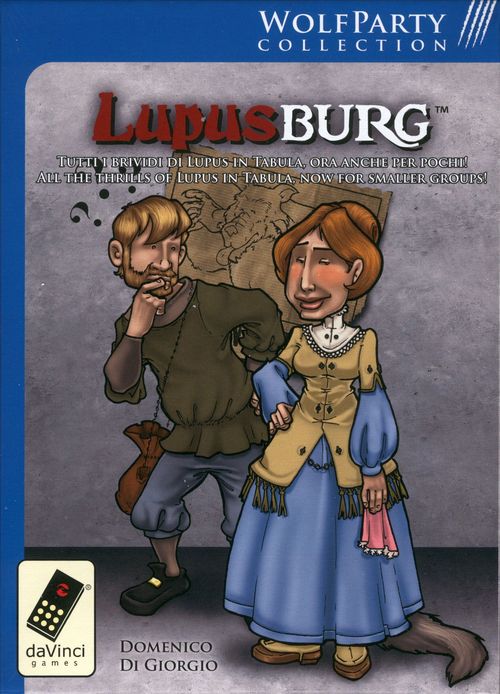
Lupusburg
Lupusburg Rulebook
Table of Contents
Table of Contents
Contents
(Before the first game carefully remove all the tokens from their frames.)
- The Burgomaster with base
- The Werewolf's claw
- 8 betting seals
- One linen bag
- 2 Werewolf evidence tokens: a paw print and a tuft of fur
- 16 voting tokens (with sides matching the evidence)
- 8 coins with values: 8, 7, 6, 5, 4, 3, 2, 2
33 cards:
- 16 characters:
- 1 Werewolf
- 1 Thief
- 14 Townsfolk
- 16 houses (2 for each family/color): 8 houses with a chest, and 8 without
- 1 summary card for the Burgomaster
- These rules
Goal of the Game
Disguised among the Townsfolk of Lupusburg is a voracious Werewolf! The goal of the Werewolf is to slaughter all of the Townsfolk. On the other hand, the goal of the Townsfolk is to lynch the Werewolf.
When night falls, the Werewolf slaughter one of the Townsfolk. During daytime, surviving Townsfolk lynch somebody, believing he is the Werewolf. The game ends when one side prevails over the other: either the Werewolf is lynched, or all the Townsfolk are slaughtered. If the Werewolf manages to slaughter everyone in the city, he wins! Otherwise, each of the other players earn points for his Townsfolk, and the player with the most points wins!
Preparation
The owner of the game takes the Burgomaster, or gives it to a player at random.
Sort the cards by type: houses and characters.
Each player choose a color, and takes the two matching houses and the betting seals; he also takes two voting tokens.
Each player lays his two houses face up in front of him, so that they form a circle as shown in the picture below. Only the owner knows which of this two houses hides his precious treasure chest!
Build a deck of characters depending on the number of players:
- 4 players: 1 Werewolf, 1 Thief, 6 Townsfolk
- 5 players: 1 Werewolf, 1 Thief, 8 Townsfolk
- 6 players: 1 Werewolf, 1 Thief, 10 Townsfolk
- 7 players: 1 Werewolf, 1 Thief, 12 Townsfolk
- 8 players: 1 Werewolf, 1 Thief, 14 Townsfolk
Shuffle the cards. Deal two characters face down to each player. If a player gets both the Werewolf and the Thief, reshuffle the cards and deal them out again.
Each player secretly looks at his characters, and keeps them secret until the game ends!
Important note: if a player has the Werewolf or the Thief, both of his characters act as the Werewolf or the Thief. In other words, the player will act as a Werewolf or as a Thief, until both of his characters are out of the game. (For simplicity's sake, during the rules, we will refer to the player with the Werewolf or with the Thief just with "the Werewolf" or "the Thief" respectively.)
Each players puts a character under one of his houses and the other one under his other house. Once placed, houses and characters cannot be moved.
Important: the Werewolf and the Thief my not be placed under the house with the chest.
Place the Werewolf claw in the middle of the table so that it does not point to any particular house. Put all the coins in the bag and shuffle them. The Burgomaster keeps the two Werewolf evidence tokens and the summary card handy.
Put any unused materials back in the box.
Make a circle with the houses, and place the claw in the middle; no other card may go there. Place the houses so that each player may comfortably reach them all with one hand.
Note: each player may look at his characters and houses at any time during the game. However, he may never show any of these to the other players!
How to Gain Victory Points: Characters, Chests, and Bets
In Lupusburg (unlike in Lupus in Tabula), there is always only one winner! Either the Werewolf wins, or if he gets lynched, the player with the most points wins!
Points are earned for your living characters, by saving your own chest, and winning your bet.
Living Characters
You gain 2 victory points for each of your characters still alive when the games ends.
The Chest
You have two houses. One of them conceals a chest that is worth 1 victory point.
In order to save your chest, and thus gain 1 victory point, you must have a living character in that house when the game ends.
The Bet
You bet on who the Werewolf is by using one coin and your own seal. The Werewolf bets too, but only to confuse the other players. If you have guessed correctly, you gain the coin you bet (and the corresponding amount of victory points) when the game ends.
An unused seal is worth 1 victory point at game end.
The Game
Two phases alternate during the game: the night and the day.
At night, the Werewolf slaughters one character, and the Thief sneaks into one house searching for the chest.
During the day, players accuse and lynch one character, believing he is the Werewolf.
The Night
All players close their eyes (including the Burgomaster and any players with no living characters).
In order to cover up accidental sounds, all players start tapping the table rhythmically with one hand, as close to them as possible, so that acting players may move their other hand freely around the table.
The Burgomaster (keeping his eyes closed!) calls the Thief aloud (e.g. "Thief, open your eyes. Thief, sneak into one of the houses").
The player with the Thief opens his eyes. Using his free hand, he checks one of the houses. He selects any one house, lifts it gently, looks at it, and puts it back exactly as it was. The Burgomaster slowly counts 10 seconds aloud, then he calls the end of the Thief phase (e.g. "3... 2... 1... Thief, close your eyes"). The Thief closes his eyes.
Note: this phase must always be played, even if the Burgomaster knows that the Thief has no living characters left, so no clues are given out. However, a Thief with no living characters does not open his eyes during the night, even when the Burgomaster calls his phase!
The Burgomaster now calls the Werewolf (e.g. "Werewolf, open your eyes. Werewolf, pick someone to slaughter").
The player with the Werewolf opens his eyes. He then moves the Werewolf claw so that it points at any one house of his choice: the character under that house is slaughtered! The Werewolf may even choose one of his own houses, provided he still has them both (that is, the Werewolf may eliminate one of his own characters to throw suspicion on the other players, but with only one living character he can't slaughter himself!).
The Burgomaster again counts 10 seconds, then he calls the end of the Werewolf phase (e.g. "3... 2... 1... Werewolf, close your eyes"). The Werewolf closes his eyes.
The Day
The night is over, and daytime starts.
The Burgomaster calls the beginning of the day (e.g. "It is daytime, everybody open your eyes"). All players open their eyes, and finally find out who has been selected by the Werewolf claw! That character has been slaughtered and is out of the game. The character and the house he was living in are set aside, face down, beside the owning player. You may never reveal your houses or your characters!
Example: It is the first turn of the game. At the command of the Burgomaster, all players open their eyes. The claw is pointing at one of Andrew's characters! Andrew removes that character and house from the game, and places them aside face down.
The Burgomaster may now use his privilege (this use is not mandatory). He chooses one living character: the owner of that character secretly shows it to the Burgomaster, who must then secretly show one of his own characters to that player.
Example: Emma (Burgomaster for the current turn) chooses the character in the left house of David... and finds the Werewolf! She acts like she has discovered nothing, and shows one of her cards to David. She chooses to use this information to her own advantage, keeping it secret. So, she chooses not to bet that David is the Werewolf at this time.
It's now time for betting. Starting with the Burgomaster and proceeding clockwise, each player chooses if he wants to bet and who to bet on. Players with no living characters may bet also. The Townsfolk and the Thief bet on who the Werewolf might be; the Werewolf bets to confuse the other players.
If you want to bet on any player, you:
- take your seal from in front of you;
- draw three coins at random from the bag (if there are less than three, draw all of them), choose one to use and return the others to the bag;
- place the coin face down, covered with your seal, in front of the player who you believe is the Werewolf.
Once the bet has been placed, it cannot be moved or taken back. You always bet on one player, not on one particular character. It is not mandatory to bet. Coins are played face down, and covered with the seal so that other players will not know their value!
Lynching
The players must now choose a character to lynch. Players can talk with each other to try to identify the Werewolf: there is no restriction on speech (truth, misdirection, lies...). However, the Werewolf disguised among the Townsfolk will probably throw suspicion on the Townsfolk.
As already stated, players may not reveal any of their cards to other players. Even players who have no living characters may take part in the discussions.
After three minutes of discussions, each player votes for a character to be lynched. During this phase, each player has two voting tokens, regardless of the number of living characters he still has. (The voting and lynching phase is identical to Lupus in Tabula).
Starting with the Burgomaster and proceeding clockwise, each player in turn chooses one living character and places one voting token on him. During this phase, the side of the token does not matter. Players continue placing tokens in turn until each of them has placed both tokens.
The two characters with the most votes are suspected of being a Werewolf. The Burgomaster places one Werewolf evidence token in front of each suspect: one receives the paw print, and the other one the tuft of fur. Ties are broken in favor of the character closer to the Burgomaster, counting clockwise. Players now take back all their voting tokens.
Example: It is now the second game turn. Starting from Andrew, after two voting rounds, votes are distributed as in the picture: Bea has one suspected character with 4 votes; the other suspect is David's with 2, because he is closer to the Burgomaster (A) than Emma's character.
The two suspects may try to defend themselves with one more brief speech. Once the speeches are over, players vote again to determine which of the suspected Werewolves will be lynched. This time though, only unsuspected living characters get one vote each (that is, eliminated characters and suspected characters yield no votes). This second voting takes place secretly and at the same time. Players lay their voting token on the table with the side corresponding to the player they want to lynch (with the matching symbol) face up, then cover it with one hand. Players with two voting tokens may freely choose to vote twice for the same suspect or to split their votes. Players may even vote for one of their own suspected characters.
When all players are done, votes are revealed at the same time, at the Burgomaster's command. The suspected character with the most votes is lynched and out of the game! The character and the house he was living in are set aside, face down, beside the owning player. Remember: you may never reveal your houses or your characters.
Example: Players have the following votes available: Andrew 1 vote, Bea 1 vote for her unsuspected character, Carl 2 votes, David 0 votes and Emma 1 vote. Players choose whom to vote for; votes are then revealed at the same time: Bea's character loses 3-2, and gets lynched!
End of the Day
The day is now over. The Burgomaster and the summary card are passed clockwise to the next player (even if he has no living characters). The new Burgomaster collects the Werewolf evidence tokens and a new night starts.
Summary by Number of Living Characters
| With 2 characters | With 1 character | With no characters | |
|---|---|---|---|
| Can I act at night? | ✓ | ✓ | ✗ |
| Can I bet? | ✓ | ✓ | ✓ |
| Can I talk? | ✓ | ✓ | ✓ |
| First voting | 2 votes | 2 votes | 2 votes |
| Second voting | One vote for each unsuspected character | One vote if the character is unsuspected | No votes |
End of the Game
The game ends when one of the following conditions is met:
- the Werewolf has as many living characters as all other players combined, so that the numbers are even (e.g. 2 and 2, or 1 and 1); or
- the Werewolf has no more living characters.
In the first case, the Werewolf wins!
In the second case, the Werewolf automatically loses! The Werewolf reveals his characters, and the other players tally their scores. A player with no living characters may still win if his score is the highest!
Each player reveals his characters and his houses and receives:
- 2 victory points for each of his living characters;
- 1 victory point for his chest, provided there is a living character in that house;
- the victory points for his seal:
- the points on the coins bet with the seal, if he guessed who the Werewolf was correctly;
- 0 points if he bet but didn't guess who was the Werewolf;
- 1 point if the seal is still in front of him (i.e., the seal was not used to place bet).
The player with the most points wins! Ties are broken in favor of the player closer the Burgomaster counting clockwise.
Example: The game ended with the lynching of Andrew the Werewolf! All players reveal their characters and points are tallied: Andrew does not score any points: he was the werewolf, and he has lost! Bea (purple) scores 3 points: 2 for her living character and 1 for the chest. Carl (blue) scores 9: 4 for his living characters, 1 for his chest, and 4 for his winning bet. David (green) scores 7 points for his winning bet. Emma (red) scores 3: 2 for her living character, and 1 for her unused betting token. Carl wins!
Note: For even more fun, play several games in a row, adding your scores together after each game. A winning werewolf is awarded points equal to the number of players in the game. It is recommended that all players start as the Burgomaster at least once. Pass this role among players from game to game.
Playing Tips
-
During the game, there are moments when the players all have their eyes closed. It is very important that players do not hear the movements of the other players acting during night. If tapping the table is not enough to cover up accidental noises, we suggest playing some background music.
-
The role of the Thief is highly strategic! Remember that in the house with the chest there cannot be the Werewolf, nor the Thief. The Thief can use this piece of information to his advantage: by watching which characters are seen by the Burgomaster using his privilege, he can try to identify who is actually the Werewolf. And when he is the Burgomaster he has access to both types of information – the houses and the characters. Lupusburg is a game of balance where the Thief is the focal point. As a side effect, the Thief may also make the other players lose points by aggressively lynching the characters with the chest... but this is not his primary goal!
-
During the night, the Thief looks at any one house and places it back as it was. If he wants, he may slightly move other houses (without looking at them!) in order to conceal which house he has just visited.
-
A Thief with no living characters does not open his eyes at night. If players agree, the Thief can open his eyes, and slightly move some houses, thus making the players believe that he is still alive and visiting houses! Obviously in this case he may not look under the houses!
-
Unlike Lupus In Tabula, in Lupusburg the townsfolk do not make a common front... and should not be sharing all their information! As a matter of fact, the Werewolf wins alone, but if he loses, there will be only one winner among the other players! Hence, players should try to make the best use of the information they gather: while in Lupus in Tabula is advisable to eliminate the Werewolf as soon as he is discovered, in Luspuburg it may be better to profit from this information! If you are lucky enough to discover a Werewolf early in the game, it is probably a good strategy not to cry it out loud: on the contrary, it might be a good idea to wait before you bet against him, and have the other players waste their seals by betting against innocent players. To make a long story short: when you have the Burgomaster's privilege, try not to let the other players find out what you now know: information in Lupusburg gives you a great power!
-
Pay careful attention to the votes of players who have seen some cards. You could gather some useful circumstantial information!
Suggestion: Using the Claw in Lupus in Tabula
You can also use the Werewolf's Claw when playing Lupus in Tabula, if you are playing the variant for 8 players. Instead of turning a card 90 degrees, simply point at your victim using the claw.