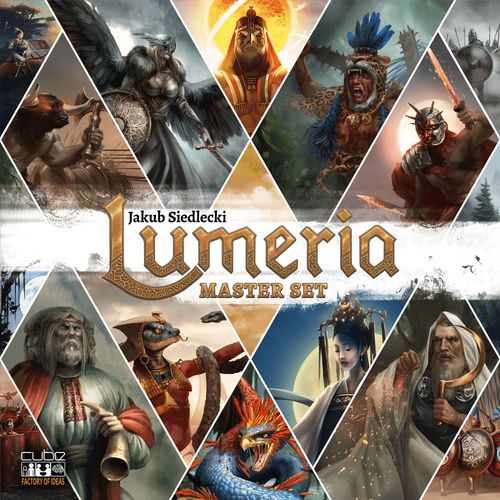
Lumeria: War of the Gods
Lumeria: War of the Gods Rulebook
Table of Contents
Table of Contents
Box Contents
- 1 board
- 36 unit cards
- 2 deity boards
- 6 activation dice
- 6 attack dice
- 16 gold tokens
- 20 wound tokens
- 8 faction tokens
- 22 scenario tokens
Board
The board has: A. recruitment spaces; B. camp spaces; C. renewal tracks (along the two side edges).
Unit cards
Front of a card: A. faction symbol; B. toughness; C. movement; D. attack value and type; E. cost; F. name; G. ability.
Activation dice
- A blank face means a finished activation.
- The "-" face means exhaustion.
- The "+" face means fortification.
Deity board
A. Faction symbol; B. March - space for a faction token; C. Volley - space for a faction token; D. Fortune - space for a faction token; E. Name; F. Ability - space for a faction token.
Unit setup diagram
The reverse of the deity board shows the unit setup diagram: a row of recruitment spaces (A) with letters on the spaces; the letters are the first letters of unit names (in the diagram: B, B, P, B, B, T, H, T).
Object of the Game
Lumeria is a game based on varied scenarios. This means it has no single, general object of the game. The goal and the means of achieving it depend on the rules in the description of the specific scenario chosen by the players.
To begin your adventure in the land of Lumeria, we recommend the basic scenario:
Three Hills
GOAL: the players' goal is to gain 10 victory points.
VICTORY POINTS: a player receives 1 victory point for each unit they control that, at the end of the round, in the cleanup phase, occupies one of the spaces marked on the illustration (the three hills). Use scenario tokens to mark the points gained.
TIE: if the players gain 10 victory points at the same time, the winner is the one who eliminated more of the opponent's units. If it is still a tie, the player who has units of higher combined cost on the board wins. If it is still a tie, each player rolls as many dice as the sum of the attack values of all their units on the board. The winner is the one who gets more hits on 4+. Repeat the last step until resolved.
Game Setup
To prepare the game, perform the following steps in the order given:
- Unfold the board so that it lies between you.
- Choose or draw one faction for each player.
- Give each player a deity board, 3 activation dice and the set of unit cards assigned to their faction. You can use the faction symbols visible in the top left corner.
- Next, divide your unit cards into types by name and form face-up stacks so that each stack contains only cards of one type. Each player lays out all their stacks in front of them, and places their deity board next to them.
- Place the supply of gold tokens, wound tokens, scenario tokens and attack dice within reach of both players.
- Set up the starting units on your side of the board, as shown on the reverse of your deity board. On the diagram, on the spaces marked with letters, place the unit cards whose name begins with that letter. Cards are always placed facing the opponent.
- Place one of your faction tokens in each of the three maneuver spaces on the right side of the deity board, and one faction token in the space on the left side of the board, next to the ability.
- Each take two attack dice and roll them, adding up the result. The player with the higher total decides who starts the game and thus becomes the First Player in the first round.
Note: in subsequent rounds no roll is made, and the next player becomes the First Player.
You are ready to begin the game!
Gameplay
A game of Lumeria is played over consecutive rounds. Each round consists of four phases, which must be carried out step by step, without changing the order below:
- Income
- Recruitment
- Battle
- Cleanup
Income
A phase that the players perform simultaneously. Each player takes 2 gold tokens from the supply.
Recruitment
A phase that lets players recruit, that is, bring new units onto the battlefield. Starting with the first player, the rivals may recruit one unit each in turn, until both decide that they do not want to or cannot recruit any more.
To recruit a unit, a player must return to the supply from their pool as many gold tokens as the cost shown on the card, and then place the paid-for unit on one of the unoccupied recruitment spaces on their side of the board.
A player may recruit any unit of their choice that lies in a face-up stack in front of them, as long as they have the right number of gold tokens and there is an empty recruitment space on the board.
If there is no room on the board or the player lacks the necessary funds to bring a unit onto the battlefield, they cannot do so and skip this step.
If only one player does not want to or cannot recruit, they pass the opportunity to the other player. Then, if the opponent has not passed, the first player again has the opportunity to recruit. If both players do not want to or cannot recruit further, proceed to the next phase.
Note: remember that a single recruitment brings in one unit, which means you can place units on the battlefield one at a time in turn, for as long as you do not decide to stop.
Example: Kuba is the first player, so he begins recruitment. Wanting to bring some life into his ranks, he pays 3 gold tokens and recruits Zbrojni (Men-at-Arms), which he places on an empty recruitment space. Now it is Tomek's turn; not wanting to fall behind, he recruits Berserkers, pays their cost and places them on the board. The opportunity to recruit returns to Kuba, who pays 1 gold and brings Woje (Warriors) into the game. Now it is Tomek's turn, but he has run out of gold. Kuba does not want to bring in any other unit, so the recruitment phase ends.
Battle
The battle phase is the main point of a game of Lumeria. In this phase the players will ALTERNATELY activate units, perform actions and carry out special maneuvers. All of it in order to fulfill the scenario's requirements and ultimately achieve victory. Poorly made decisions can backfire here, and daring maneuvers can provide an advantage on the battlefield!
The battle phase consists of the activation stage and an optional opportunity to perform maneuvers at the beginning or at the end of this phase (see: Maneuvers).
Course of the battle:
- Maneuvers - players may use available volley and/or march maneuvers
- Activations - players alternately activate units (use of fortune possible)
- Maneuvers - players may use available volley and/or march maneuvers
Maneuvers
Maneuvers are orders that let you perform additional actions, gain an advantage in battle or surprise your opponent. Each player has three maneuvers at their disposal, which are represented by faction tokens lying in the appropriate spaces for the given maneuver on the right side of the deity board. To perform a maneuver, choose the appropriate token and place it on the renewal track / next to the board (see "renewal track" below), then carry out the actions assigned to it. A maneuver exhausted in this way cannot be used until it is renewed by the action of the renewal track. Players perform maneuvers alternately. The maneuver stage ends when both players pass in a row.
The following maneuvers exist in the game:
March Players may perform it only in the maneuver stage. A maneuver is not mandatory, so the wish to perform it must be clearly announced. The first player may (but need not) declare and perform their first march. After them the opponent may (but need not) declare and perform a march. The opponent may declare a march also when the first player declared none or declared a different maneuver. The maneuver stage ends with two passes in a row.
Effect: when performing a march, choose up to 2 of your units and move each of them by a maximum of 1 space, following the normal movement rules.
Volley Players may perform it only in the maneuver stage. A maneuver is not mandatory, so the wish to perform it must be clearly announced. The first player may (but need not) declare and perform their volley first. After them the opponent may (but need not) declare and perform a volley. The opponent may declare a volley also when the first player declared none or declared a different maneuver. The maneuver stage ends with two passes in a row.
Effect: when performing a volley, choose up to 2 of your units with a ranged attack, and have each of them make an attack always using one die, regardless of the unit's attack value. The ranged attack rules and special unit rules remain unchanged.
Fortune Players may use fortune after any of their rolls, during their activation in the battle phase.
Effect: fortune allows you to re-roll all the dice used in one, chosen roll. You must accept the result of the second roll.
Note: remember that - according to the fundamental rule - the same dice may not be re-rolled twice.
Renewal track
The renewal track, located along the edge on both sides of the board, allows maneuvers to be renewed during the game. After a player uses the first of the maneuvers, they take the faction token from the appropriate place by the deity board and place it on the "0" space of the renewal track. During the game, while making attacks, the player moves the token on the renewal track one space down for each die that did not hit. If the token reaches the last space, the player may place it on a chosen, empty maneuver space on the deity board.
Note: only one token may be on the renewal track at a time! Even if more than one maneuver is used while the first is being renewed, the tokens are set aside. After a maneuver is renewed, the player may place another used token on the zero space of the renewal track, if they have one. They will be able to renew it thanks to subsequent rolls.
A deity's ability is not a maneuver, so it cannot be renewed in this way!
Activations
The activation stage is the main stage of the battle phase. The players - starting with the First Player - ALTERNATELY perform activations, each time activating one of the units they control. During this stage each player may activate up to three DIFFERENT units, after which the activation stage ends.
If a player does not have three units they could (or would like to) activate, they activate as many as they can, and then wait until the opponent activates their three units.
When activating a unit, a player may perform with it a maximum of two of the actions described below. The same action may not be performed twice. A possible attack MUST be the last or the only action during the unit's activation. After a unit's activation is finished, place an activation die on it with the blank face up - this will help you remember which units you have activated so far in this battle phase.
The same unit may not be activated twice during one battle phase.
5 available actions
- Move
- Run
- Fortify
- Aim
- Attack
Move
A unit may move a maximum number of spaces equal to the movement value on its card. It may only move to adjacent, unoccupied spaces - not diagonally. It may not move through other cards. A move of value "0" cannot be performed. A unit may pass through and stop on spaces with camps.
Example: Tomek wants to move his Berserkers. In the first step of their move they can move to spaces A, B and C, but not to space D (diagonal movement is not allowed) or E (moving through other cards is not allowed).
Run
Run is an action that may be performed ONLY if the unit earlier, during its activation, performed a move action. It allows an additional move according to the normal rules. After the run is finished, mark the unit as exhausted - place on it an activation die with the "-" face up.
Fortify
This action lets a unit fortify itself on the space it occupies. To remember this, place on it an activation die with the "+" face up.
Aim
An action that lets a unit with a ranged attack aim more precisely at the opponent. During the next ranged attack in the same activation, this unit receives +1 to hit, that is, it will inflict wounds on a result of 3+ instead of the standard 4+ (unless other modifiers apply).
Attack
This action lets you make an attack on an opponent's unit. It must be the last or the only action during a given activation.
Exhaustion and fortification
Exhaustion - some effects (such as performing the run action) cause a unit to become exhausted, which you mark with an activation die with the "-" symbol placed on the unit card. Exhaustion means that all attacks made against this unit receive a +1 to hit modifier (it is easier to wound it).
Fortification - some effects (such as performing the fortify action) cause a unit to become fortified, which you mark with an activation die with the "+" symbol placed on the unit card. Fortification means that all attacks made against this unit receive a -1 to hit modifier (it is harder to wound it).
Detailed attack rules
To make an attack, choose the attacking unit, the type of attack and determine its target.
Then roll a number of dice equal to the attack value shown on the attacking unit's card. Each result of 4 or more counts as a hit. For each hit, place one wound token on the defending unit.
Note: you may not attack your own units.
Types of attacks:
Melee attack This attack can only be made against a unit that the attacking unit is adjacent to (not diagonally).
PUSHBACK: if during a melee attack you manage to hit the opponent at least once, the attacking unit pushes the target one space in a straight line in the direction of the attack.
CORNERED: if a unit defending against a melee attack has no empty space behind it to which it could be pushed as a result of a hit (behind it is the edge of the board or another card), that unit is cornered. Melee attackers have a +1 to hit modifier against cornered units.
Ranged attack This attack can be made against a unit at most 3 empty spaces away in a straight line. There may be no other card on the line of attack.
Note: a hit in a ranged attack does not push the hit unit back, so the cornered rules do not apply here either.
Hit modifiers
Some unit abilities or texts on cards introduce +/- [number] to hit modifiers. They mean that it will be easier (+) or harder (-) for the given unit to score a hit in a given attack. Thus:
A. +1 to hit means that the unit will find it easier to hit the opponent, that is, it will hit on a die result of 3 and higher (as opposed to the standard result of 4).
B. -1 to hit means that it will be harder by 1 for the unit to hit the opponent, that is, it will hit on a result of 5 and higher (as opposed to the standard result of 4).
C. A result of 1 on a die always means no hit, regardless of any modifiers.
D. Modifiers are cumulative.
Example - melee attack: Tomek would like to perform an attack action with his Bies (Fiend). As the target he chooses the Berserkers standing opposite (A). Tomek takes attack dice in the number given by the attack symbol on the Bies card (3) and rolls. Since the Berserkers are not cornered (they can be pushed back as a result of the attack), no modifiers apply to this action, so the Bies hits on 4+. Tomek rolled 1, 3 and 5, which means one hit. He places 1 wound token on the attacked card and, because of the hit, pushes the Berserkers back one space (B). Unfortunately this is not enough to defeat the Berserkers, whose toughness is 2.
Example - ranged attack: This time Kuba wants to make an attack action. He chooses the Miotacze (Throwers) (C). As in the previous example he takes the appropriate number of dice, given by the attack symbol, and rolls. In this case no modifiers apply, so hits are scored on 4+. The dice show 4 and 6, which lets him inflict 2 wounds on the Woje (Warriors) and defeat them! Tomek must discard the defeated Woje card out of the game. He will no longer be able to use it (D). He then receives compensation of 1 gold token (see below).
Defeated unit
A unit is defeated if the number of wound tokens lying on it after the attack ends is equal to or higher than its toughness value. A defeated unit must be discarded off the board, thus forming its discard pile. It will no longer be available in this game, and the player who controls it receives compensation. If the defeated unit had previously been activated and has an activation die on it, place that die temporarily together with the card on the discard pile. This will help you remember that one of the three activations available in the round has been used, even when the unit is no longer on the battlefield.
Compensation
After the card is discarded, the player controlling the DEFEATED unit receives compensation in the form of 1 gold token, which they take from the supply.
Cleanup
The last phase of each round is the cleanup phase. In this phase carry out the following steps simultaneously, in order:
- Remove all activation dice from units on the board and from any cards on the discard piles. Leave the wound tokens in place.
Note: if in the given round you used the deity's ability, put its faction token back in its place by the deity board.
- Count points according to the scenario's instructions. In the case of the THREE HILLS scenario, each player receives 1 point for each of the three marked spaces on which a unit they control is located. Players take as many scenario tokens as the points they scored.
- Check whether any player has reached the number of victory points required by the scenario or fulfilled its conditions. If so, the game ends and you determine the winner. If not, proceed to the next step of the cleanup phase.
- If, in the last row on both sides of the board (by last we mean the row with the camps), there are units on the recruitment spaces, move all of those units one space forward, if possible. Then the next player becomes the First Player and you proceed to the income phase. The game continues.
End of the Game
The game ends when, during the penultimate step of the cleanup phase, the victory conditions specified in the scenario are met. Then you determine the winner according to the rules given in its description.
Gods
Besides the units fighting in the army, players also have powerful gods known from many mythologies of the world, who see their chance of gaining greater power on the shores of Lumeria.
God cards are not part of the army - they are not on the board. Instead, the gods watch over the warriors, supporting them with their power.
Each god has its own unique ability. To use it, remove from the deity board the faction token lying by it on the left side, and carry out its effect.
Remember that on the right side of the deity board there are spaces for three faction tokens belonging to the maneuvers that you can use during the game.
Fundamental Rules
- If a special ability conflicts with the rulebook, the ability takes precedence when interpreting the rules.
- The number of units available to the players, the specific special order tokens, the gold tokens and the discard pile are open information.
- Unless otherwise stated or affected by modifiers, a unit is hit on a result of 4 or higher. Regardless of modifiers, a 1 always means no hit.
- Spaces placed diagonally to each other are not adjacent spaces.
- If a text says "on a result of 4+" or similar, it means that you need to get a result of 4 or higher on the rolled die.
- Each die may be re-rolled only once. You must accept the result of the second roll.
- Unit cards may not be rotated.
Game Summary
Phase I: Income Take 2 gold tokens each.
Phase II: Recruitment Alternately recruit units, paying their cost.
Phase III: Battle
- Alternating maneuvers (march and/or volley)
- Alternating activations (in this stage, during your activation, you may use fortune):
- activation of up to 3 units,
- an activated unit may perform up to 2 different actions,
- available actions:
- A. Move - by the unit's movement value,
- B. Run - only after a move. Gives an additional move. Exhaustion (opponent +1 to hit),
- C. Fortify (opponent -1 to hit),
- D. Aim - +1 to hit in the same activation during a ranged attack,
- E. Attack (ranged or melee). Hit on 4+,
- melee - on adjacent spaces (not diagonally), pushback after a hit, cornered,
- ranged - up to 3 empty spaces in a straight line, no pushback and therefore no cornering,
- After defeating an opponent's unit, that opponent receives compensation - 1 gold.
- Alternating maneuvers (march and/or volley).
Phase IV: Cleanup
- Remove the activation dice from units on the board.
- Count points according to the scenario's guidelines.
- Check the victory conditions. If there is no winner, go to the next point.
- Mandatorily move units on the recruitment spaces 1 space forward, if possible.
Glossary
Activation - a unit's performance of up to two actions. Players perform up to three activations per round.
Action - one of the activities (such as move or attack) available to each unit.
Card - all units in the game are cards. The rules concerning cards do not refer to gods.
Space - a single square on the board.
Wound - a single wound token placed on a unit.
Camp - a space on the board with a picture of a military camp. Units cannot be recruited on these spaces, but they can be moved through and stopped on.
Unit - a unit is any card in the game that has a movement, attack and toughness value. The rules concerning units do not refer to gods.
Maneuver - one of the three orders available to each player. Its use is marked by removing the token from the appropriate place by the deity board.
Ability - abilities are all the skills resulting from the text on unit cards and deity boards.