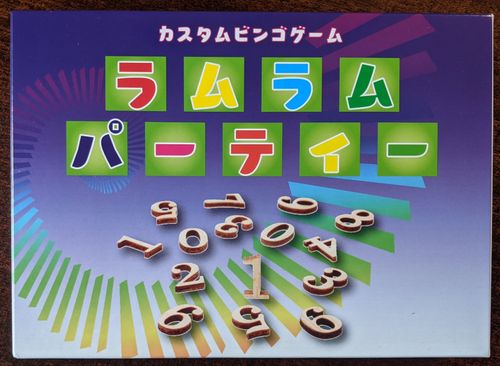
ラムラムパーティー (Lum Lum Party)
ラムラムパーティー (Lum Lum Party) Rulebook
Table of Contents
Table of Contents
Contents
1 game board; 100 bingo sheets; 5 pens; 4 six-sided dice; 2 wooden discs
Players: 3-5; Ages: 8+; Time: 30-45 min.
Game Preparation
Place the game board in the center of the table. Distribute two bingo sheets and a pen to each player. Place one of the wooden discs on the 0 space of the overflow track, and place the other disc nearby. Appoint the person who has most recently read the Japanese manga series "Urusei Yatsura" as the start player; if no one has read it, decide in any appropriate way.
How to Play
Each player writes numbers on his or her own bingo sheet while keeping the other players from seeing them. The game is played in two rounds, so one sheet is used for each round. When you finish writing, put the sheet face down or hold it in your hand so that it cannot be seen.
Fill-in-the-Numbers Rules
- Use numbers from 1 to 70, and do not write the same number more than once.
- Any number can be written in the leftmost column.
- The middle square may contain any two-digit number.
- For the other squares, write a number that satisfies one of the following three conditions: a. A number that is 1 more than the number in the box to the left. b. A number that is twice (x2) as large as the number in the box on the left. c. A number whose right most digit is the same as the number in the box on the left.
The Concept of "Current Value"
In this game, instead of the rattle of bingo, the numbers are determined by actions. The current value is represented by placing a circular disc over the numbers from 1 to 70 on the game board. At the beginning of the game, the current value is 0. The effect of the actions is to change the number of the current value and pseudo-bingo-rattle a new number.
Turns take place clockwise from the starting player. On your turn choose one of the following actions: Hop, Step, Jump, or Warp. The effect of each action depends on the current value, but basically, the effect will be to add a number to the current value; change the current value; and move the circular disc. Any player who has written the new current value on their bingo sheet says, "There it is!" and marks the corresponding number on the bingo sheet with a circle. Once you have circled a number, you may not circle it again.
The effect of the action chosen depends upon the current value:
- If the current value is between 0 and 20, refer to the row 20 information in the chart below the current value table.
- If the current value is between 21 and 40, refer to row 40.
- If the current value is between 41 and 60, refer to row 60.
- If the current value is between 61 and 70, line 70 is referenced.
The Concept of Overflow
If the current value would exceed 70 when processing the effect of an action, it will return to 1. (Zero is only available at the beginning of the game and will not reappear.) For example, if you want to step +5 from the current value of 68, the number would be 3 (just count the squares as you move the disk). When the number exceeds 70, it is called an "overflow" in this game. When you overflow, advance the overflow track by 1 (to the right.)
Action Effects
Hop - Add 1 to the current value. (Hop has a special effect limited to when the current value is 61-70. In addition to the normal hop effect of +1 to the current value, it has an immediate effect that gives 2 points to the player who chooses this action. Track these points in the "Special Hops" column on the bingo sheet and add them up when calculating the score.)
Step - Add the number shown (in the chart below the current value) to the current value.
Jump - Roll a number of six-sided die equal to the icons on the chart below the current value, and sum the die results. Add this number to the current value and move the disc.
Warp - For current values 0 through 60, refer to the instructions for Jump. For current values 61 through 70, you may declare any number from 1 to 20 and set the current value to that number. However, the player who chooses this action will not be able to circle any number, even if that number is on their bingo sheet. This action is treated as an overflow, not some sort of rewind.
When You Play for the First Time...
When you play for the first time, you may not know how to fill out the bingo sheet. Here is the easiest way to do it. First, fill the leftmost column with your favorite numbers. Next, fill in the middle square with the number you want. After that, fill in the columns horizontally, starting from the left. If you have trouble, you can write the numbers with the same right-most digit to make it easier to fill in.
What to Do If You Discover a Duplicate Number on Your Sheet During Play
It is against the rules to write the same number multiple times on a bingo sheet. However, sometimes the same number is written on the bingo sheet due to an oversight. If you notice this after the round has started, leave only one of the duplicated numbers on the bingo sheet and mark all other duplicated numbers with an X or fill them in so that they cannot be used.
End of Round and End of Game
The round ends when all players bingo at least one row/column/diagonal, or at the end of the turn when the overflow counter reaches 4. After calculating the scores, use the second bingo sheet to start another round; the starting player for the second round is the player with the lowest score in the first round. (In case of a tie, the player closest clockwise from the starting player in the first round.)
At the end of the second round, the scores are calculated and the player with the highest total score wins. In case of a tie, share the victory.
Score Calculation
- Rank Bonus - The player with the first bingo earns 15 points for first place; there are 10 points for second place; and 5 points for third place. If there are simultaneous bingos, the player closest to the starting player is ranked higher. There is no rank bonus for fourth or fifth players. A player cannot earn multiple rank bonuses.
- Primary Points - Each number circled on the bingo sheet is worth one point.
- Bingo Points - The tens-digit of each number in a bingo row/column/diagonal is added together and that value is earned in points (single-digit numbers are zero points). If there is more than one bingo, the sum of the numbers is used. In this case, duplicate squares are counted each time.